ES
ES 
A gutter apron is a strip of roof-edge flashing that guides water coming off the roof into the gutter instead of letting it run down the back of the gutter or behind the fascia. It sits at the very edge of the roof, works alongside the drip edge, and does a quiet but important job on any home that sees real rain. In the Tucson area, where a single monsoon storm can drop a lot of water in a short window, that small piece of metal earns its keep.
Most homeowners never think about the roof edge until water shows up where it should not, on the fascia board, along the soffit, or in the soil right next to the foundation. This guide explains what a gutter apron is, how it differs from a drip edge, when a home needs one, and how it fits into a full gutter system. If you are weighing your options, our rain gutter installation in Tucson is built around getting water off the roof and away from the house cleanly.
What is a gutter apron?
A gutter apron is a piece of bent metal flashing installed at the roof edge to direct roof runoff into the gutter. Its lower leg reaches out and down over the back edge of the gutter, so water leaving the roof drops into the trough rather than slipping behind it. Think of it as a bridge between the last few inches of roof and the top of the gutter.
The apron is one member of a small family of roof-edge flashings. On many homes it takes the form of an extended or specially bent drip edge whose lower leg is long enough to lap over the gutter. Terms vary by region and by manufacturer, so one crew's gutter apron is another crew's extended drip edge. What matters is the shape and the job: a wide, angled piece of metal that closes the gap where the roof meets the gutter.
Because it is exposed to sun and water all year, the material and the fit both matter. On the systems we install, the flashing is formed from aluminum, or from copper when it needs to match a copper gutter. Matching the metal keeps the whole edge shedding water as a single unit and avoids the staining that can come from mixing different metals at the roof line.
Gutter apron vs drip edge, what is the difference?
The short answer is that a drip edge is the general term and a gutter apron is a particular style of it. A drip edge is any metal flashing run along the eaves and rake edges of a roof to carry water off the deck and past the fascia. A gutter apron is a drip edge shaped specifically to steer that water into the gutter, with a longer lower leg that laps over the back of the trough.
In practice the two overlap. A standard drip edge protects the whole perimeter of the roof, including the sloped rake edges where there is no gutter at all. A gutter apron does its work along the eaves, right above the gutter run, and is most useful where the shingles do not overhang far enough to drop water cleanly into the trough. The table below lays out how they compare.
| Feature | Standard drip edge | Gutter apron |
|---|---|---|
| Shape | L-shaped or extended flashing along the roof edge | Wider flashing with a longer lower leg that laps over the back of the gutter |
| Main job | Carries water off the roof edge and past the fascia | Steers water directly into the gutter trough |
| Where it runs | Eaves and sloped rake edges, around the roof perimeter | Along the eaves, right above the gutter |
| Best when | You need protection along the whole edge, gutter or not | Shingles do not overhang enough and water slips behind the gutter |
Why gutter aprons matter for Tucson monsoon runoff
Gutter aprons matter most during heavy rain, and in the Tucson area that means the summer monsoon. When a storm hits, the volume of water coming off a roof rises quickly, and any gap at the roof edge becomes a path for water to run behind the gutter and down the fascia. Edge flashing keeps that surge moving into the gutter, where it belongs.
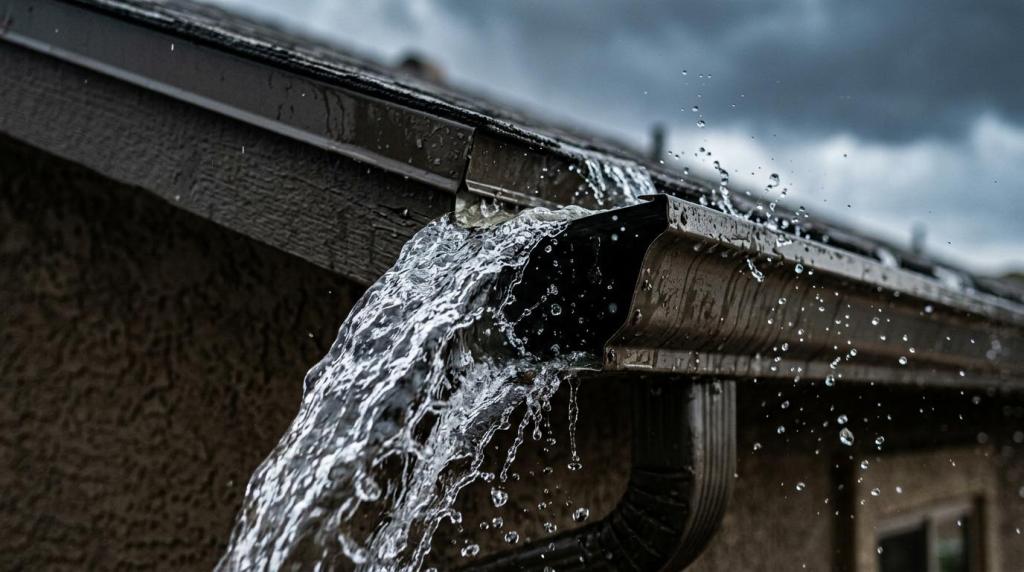
Water that gets behind a gutter does not simply disappear. It soaks the fascia board, works into the soffit, and can end up in the soil right against the foundation. Over time that leads to peeling paint, rotting wood, and the kind of ground erosion that undermines a slab. We cover the ground side of this in our guide to preventing foundation erosion with proper drainage, because the roof edge and the soil are two ends of the same system.
A well-sealed roof edge is one of several improvements that pay off in a monsoon climate. If you are getting your system ready for storm season, our list of gutter upgrades for Arizona monsoons walks through the others, from downspout placement to guard options, so the whole system moves water the same direction.
When does a home need a gutter apron or drip edge?
A home needs attention at the roof edge when water is not making it cleanly from the roof into the gutter. The clearest signs are staining or peeling paint on the fascia, water dripping behind the gutter during a storm, and dark streaks on the wall below the roof line. Any of these points to water escaping the edge instead of dropping into the trough.
Some homes were built without a proper apron, or the shingles sit flush with the edge and do not overhang enough to carry water past the fascia. Others had flashing that was damaged during a re-roof or bent out of line over the years. On a copper or aluminum gutter that is otherwise sound, adding or correcting the edge flashing is often a smaller job than replacing the gutter itself.
It is hard to judge the roof edge from the ground. The tuck of the flashing, the overhang of the shingles, and the alignment of the gutter all have to be seen up close. That is why the reliable answer is a look at the actual roof line rather than a guess. Our fascia wrap work already involves tucking aluminum under the drip edge to seal out water, so the roof edge is territory we are on all the time.
What building code says about drip edge
Building code generally treats a drip edge as a required part of a shingle roof, though the details vary by where you live. The International Residential Code calls for a drip edge at the eaves and rake edges of shingle roofs, and it sets minimums for how the pieces overlap and how far they extend. Local jurisdictions adopt and amend that code on their own schedule, so the exact rule in Tucson can differ.
According to the Journal of Light Construction's breakdown of the drip edge code, the International Residential Code has required metal drip edge at eaves and rakes since the 2012 edition, with adjacent segments overlapping at least 2 inches, the flashing extending at least a quarter inch below the roof sheathing and at least 2 inches back onto the roof deck, and fasteners set no more than 12 inches apart. Those are minimums, and many builders exceed them, especially in high-wind areas.
Because codes are adopted locally, the version enforced in Tucson or in unincorporated Pima County may not match any single number above. Before relying on a specific requirement, confirm the current rule with the Tucson or Pima County building department. The practical takeaway for a homeowner is simpler: the roof edge is meant to shed water past the fascia and into the gutter, and code exists to make sure it does.
How a gutter apron fits into a complete gutter system
A gutter apron is one link in a chain that starts at the roof edge and ends well away from the house. Above it sit the roof covering and the drip edge. Below it come the gutter, the downspouts, and whatever carries water to a safe runoff point. When every link is sized and aligned correctly, water has one clear path and no chance to wander behind the system.
The gutter itself does the heavy lifting. Seamless gutters are custom-formed on site in one continuous piece, which removes the joints where leaks usually start, and a well-supported aluminum system commonly lasts 30 years or more in the Tucson climate. Copper develops a natural patina and can last far longer than a standard system. The edge flashing simply makes sure the water these gutters are built to carry actually reaches them.
This is why the roof edge should not be looked at in isolation. The apron, the drip edge, the fascia, and the gutter all have to work together, and a change to one can affect the others. A single site review can check the whole edge at once and flag anything that needs attention before the next storm rolls through.
Key Takeaways
- A gutter apron is a form of roof-edge flashing, and a drip edge is the broader term for the metal that runs along the eaves and rakes.
- Both do the same job at heart: send roof water into the gutter, not behind it or down the fascia.
- The International Residential Code generally requires a drip edge on shingle roofs, but local adoption varies, so confirm the rule with the Tucson or Pima County building department.
- On aluminum and copper systems, the flashing is matched to the gutter so the whole edge sheds water as one unit.
- Signs of a problem at the edge include fascia staining, peeling paint, and water dripping behind the gutter in a storm.
- The surest way to know what your roof edge needs is a close look at the actual roof line.
Gutter Apron Questions from Tucson Homeowners
Is a gutter apron the same as a drip edge?
Not exactly. A gutter apron is one style of roof-edge flashing, while drip edge is the general name for the metal fitted along the eaves and rakes. Many installers use the terms loosely, so it helps to describe the shape you mean.
Do all Tucson homes need a gutter apron?
Not always. Homes where the shingles overhang well and the gutter sits correctly may shed water fine, while homes with a gap between the roof edge and the gutter benefit most. A site review is the surest way to tell.
Can a gutter apron be added to existing gutters?
Often yes. In many cases flashing can be fitted at the roof edge without replacing the gutters, though it depends on the roof covering and how the current edge is built. Confirm with an installer after a look at the roof line.
What material are gutter aprons made from?
On the systems we install they are formed from aluminum, and copper is used to match a copper gutter system. Matching the flashing to the gutter keeps the edge shedding water as one unit.
Does a gutter apron help during monsoon storms?
Yes. During heavy monsoon flow the volume coming off a roof rises fast, and edge flashing keeps that surge moving into the gutter rather than behind it. That protects the fascia and the ground below.
Is drip edge required by code in Tucson?
It depends. The International Residential Code generally calls for a drip edge on shingle roofs, but codes are adopted and amended locally, so check current requirements with the Tucson or Pima County building department.
Who installs gutter aprons and drip edge?
Both roofers and gutter contractors work at the roof edge, and the right choice depends on the job. For a gutter that is not draining cleanly at the back, a gutter specialist can review the edge and recommend a fix.
Gutters for flat roofs work differently than gutters on a pitched roof, because on a true flat or low-slope home most of the water never reaches an open eave. It leaves through canales, scuppers, or outlets cut through the parapet wall. That does not mean a flat-roof house has no use for gutters. It means the gutter work happens in specific places, and a run hung in the wrong place does nothing.
Santa Fe and Pueblo style homes are everywhere in Tucson, from midtown adobe remodels to newer builds in Marana and Vail, and they were designed for a climate where rain arrives in short, violent bursts. A monsoon cell can push weeks of runoff off a roof in twenty minutes. Where that water lands decides whether your stucco, your walkways, and your foundation come through the season intact. If you are still comparing profiles and materials, start with our aluminum and copper gutter systems.
Does a Flat Roof in Tucson Need Gutters
Sometimes, and almost never all the way around. A true flat roof already drains through its own built-in outlets, so it does not need a continuous perimeter gutter the way a pitched roof does. What these homes usually need is control of the water after it leaves those outlets, plus gutters on the sloped sections the house already has.
That distinction gets lost in most online gutter advice, which is written for shingle roofs with open eaves on all four sides. A parapet wall changes the whole picture. There is no eave to hang from along the main roof, and the water exits at three or four points instead of running off the full length of the edge. So the question is not whether to wrap the house in gutters. It is which parts of this particular house benefit, and what happens to the water that comes out of the parapet. Gutters for flat roofs are a targeted job, not a full wrap.
How Water Leaves a Flat Roof
A flat roof is not level. It is built with a slight pitch that pushes water toward a small number of exit points, and those points are canales, scuppers, parapet outlets, or drains piped through the interior of the building. Knowing which ones your house has, and where each one discharges, is the starting point for any drainage decision on a low-slope home.
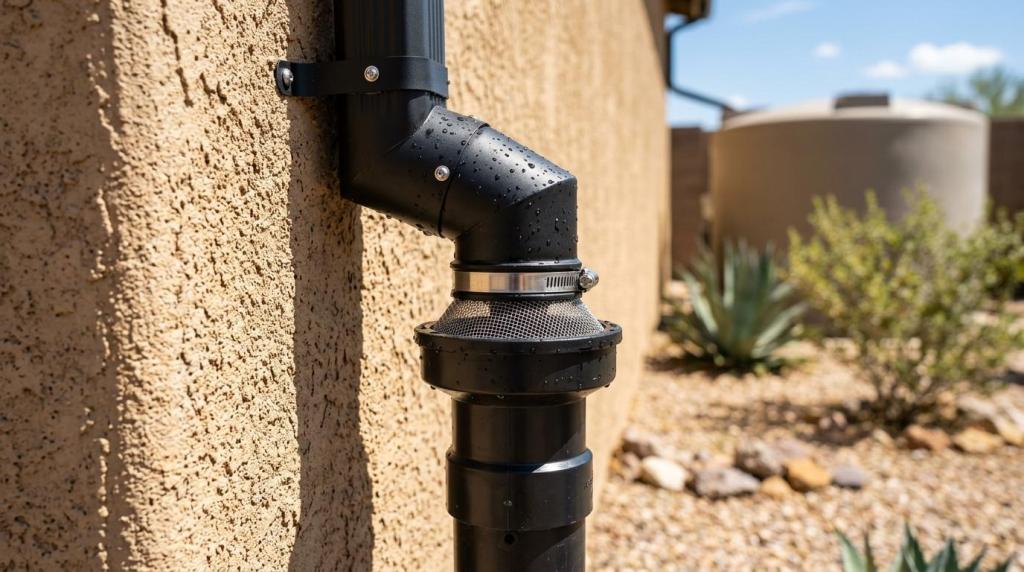
A canale is the projecting spout you see on Southwestern homes, pushing through the parapet so water is thrown clear of the wall below. A scupper is the same idea without the projection: an opening cut through the parapet at roof level, which usually needs something under it to catch the flow. Interior drains sit in the roof field and pipe water down inside the structure, which is roofing and plumbing territory rather than gutter work.
| Exit point | What it is | Where gutter work fits |
|---|---|---|
| Canale | A spout projecting through the parapet that throws water clear of the wall | Catching the discharge below and moving it away from the foundation |
| Scupper | An opening cut through the parapet wall at roof level | A catch point and downspout under the opening, where the wall allows it |
| Interior or through-wall drain | A drain in the roof field piped down inside the building or through the wall | Usually none, this is roofing and plumbing work |
| Low-slope eave | An open roof edge with a slight pitch and no parapet above it | A standard seamless gutter run with downspouts |
| Porch, carport, or patio cover | A separate lower roof, usually with its own slope | Standard gutters, sized to the length of the run |
The pitch built into the roof itself is a roofing specification, not a gutter one, and it is set by code rather than by preference. In a review of roof slope requirements, the National Roofing Contractors Association notes that the 2018 International Building Code prescribes a minimum of a quarter inch of rise per foot for membrane roof systems in new construction, and that on replacement work the codes apply a performance requirement instead, defined as drainage of the roof within 48 hours of rain. You can read the association's summary in Professional Roofing on roof slope guidelines. Code editions and local amendments vary, so confirm what applies to your property with the City of Tucson or Pima County before planning any roof work.
Roof Slope and Gutter Slope Are Two Different Numbers
Roof slope is measured in inches of rise per foot. Gutter slope is far gentler than that: the industry standard pitch for a gutter run is about a quarter inch of fall per 10 feet, and up to about half an inch per 10 feet in heavy rainfall areas. Mixing the two up is common, and it leads people to expect a visible tilt on a gutter that should look level to the eye.
The chart below shows how little pitch a low-slope roof carries compared with the coverings most people picture when they think of a roof. That shallow angle is exactly why exit points matter so much on these homes. There is not enough fall to push water sideways along an edge, so it collects and leaves where the roof tells it to.
What a Canale Does Well and What It Does Not
A canale gets water off the roof and past the face of the wall, and that is the whole of its job. It has no control over where the water lands, how fast it arrives, or what it does once it hits the ground. On a heavy monsoon day, a single canale can be moving the runoff from a large share of the roof, all of it falling in one spot.
Homeowners usually notice the consequences before they notice the cause. A dark stain feathering down the stucco under one outlet. A trench worn into decomposed granite beside the patio. Gravel scattered across a walkway after every storm. Soil pulling back from the foundation on one elevation while the rest of the house looks fine. None of that means the canale has failed. It means nothing is handling the water after the canale releases it.
How that gets solved depends on the wall, the outlet height, the grade below, and what is sitting in the splash zone, so it is not something to specify from a photo. This is the part of a flat-roof job that is worth a set of eyes on site.
Where Gutters for Flat Roofs Still Belong
Almost every flat-roof house in Southern Arizona has at least one sloped surface, and those are where standard seamless gutters earn their place. Porches, carports, patio covers, entry canopies, lower additions, and garage roofs are all built with enough pitch to shed toward an open edge, which is exactly what a gutter is designed to catch.
These are also the places where runoff causes the most daily nuisance, because they sit directly over the spots people use: the front door, the car, the shaded seating area. A short run of gutter across a patio cover with one downspout routed to the side solves a problem that the main roof drainage was never going to address.
Mixed rooflines are common too. Plenty of Tucson houses pair a flat main roof with a tiled entry element or a pitched wing added later, and the tiled section has its own rules about where the gutter sits and how far the water travels past the fascia. We cover that in detail in our guide to gutters on Tucson tile roofs.
Getting Parapet Runoff Away From the Foundation
Catching water is only half the work. The other half is carrying it far enough from the house that it cannot soak back toward the footing, which on a desert lot usually means discharging into a landscaped area, a swale, or a basin built to take it. Water that leaves a downspout and immediately pools against the wall has not really been managed.
Downspout sizing follows the same industry guidance on a low-slope home as anywhere else. The standard sizes are 2x3 inch and 3x4 inch, with larger sizes used on bigger roofs or where rainfall is intense, and one downspout typically serves roughly 30 to 35 feet of gutter. Flat-roof homes often need the larger end of that range at a single point, because a parapet outlet concentrates a lot of roof area into one release. Placement details are covered in our post on downspout installation in Tucson.
For owners who want the water gone rather than visible, underground drainage ties into the gutter system and carries runoff to a safe runoff area away from the structure. It is also a reasonable first step for anyone considering rainwater collection later, since the water is already being captured and routed rather than thrown at the dirt.
Profiles and Materials That Suit a Parapet Roofline
All three profiles we form work on a flat-roof home, and the choice is mostly architectural. European box gutters suit the hard horizontal lines of a parapet, K-style is available in 5 inch, 6 inch, and 8 inch, and half-round reads softer against an older adobe or territorial facade. Every run is seamless, custom-formed on site in one continuous piece.
Materials are aluminum or copper. Aluminum is the workhorse here, lasting 30 or more years in this climate without rusting, and .027 inch is the residential industry standard thickness. The heavier .032 upgrade exists mainly for heavy-snow regions, which Tucson does not have, so .027 suits local conditions. Copper develops a natural patina and can last up to four times longer than a standard system, which is why it shows up on restoration work where the look matters as much as the lifespan.
Support matters more than most people assume. During a storm a full gutter can hold the weight of a grown adult, and the accepted standard is hangers set roughly every 24 inches. On a low-slope home the fascia available to fasten into is often shorter or in worse condition than on a pitched roof, since it sees direct sun on the elevations that have it. That gets checked before anything is hung.
Key Takeaways
- Gutters for flat roofs concentrate at the few points where water actually leaves the roof, not around the full perimeter.
- Canales and scuppers move water off the roof but do not control where it lands, which is where stucco staining and foundation erosion start.
- Porches, carports, patio covers, and garage roofs are the sloped surfaces on a flat-roof home where standard seamless gutters fit directly.
- Standard downspouts are 2x3 inch and 3x4 inch, with one typically serving roughly 30 to 35 feet of gutter, and larger sizes used for bigger roofs or intense rainfall.
- Underground drainage can carry runoff from the gutter system to a safe runoff area for owners who do not want a tank yet.
- Flat-roof drainage varies more by house than tile or shingle work does, so the layout is worth confirming on site before anything is ordered.
Flat Roof Drainage Questions from Tucson Homeowners
Can you put gutters on a house with a parapet wall?
Yes, though the gutter does not go on the parapet itself. A parapet has no eave to hang from, so gutters are fitted to the sloped roof areas of the property and to the points below where the parapet releases its water. The right layout depends on wall height and where each outlet sits.
What is the difference between a canale and a scupper?
A canale extends beyond the wall and drops water clear of the building, while a scupper is a plain opening through the wall with no projection. Both release roof water, and a scupper more often needs something below it to receive the flow.
Will gutters fix water pooling on my flat roof?
No. Standing water on the roof surface is a roof slope and roof drainage matter, and a gutter at the edge cannot influence it. If water sits on your roof after a storm, that is a conversation for a roofing contractor rather than a gutter contractor.
Why is there a stain on the stucco below my roof outlet?
That is usually splash and mineral wash from water leaving the outlet and running back against the wall. Redirecting the discharge away from the wall face is the common remedy, and the right approach varies with wall height and what sits in the splash zone below.
Can a flat roof supply a rainwater harvesting tank?
Yes. Runoff from a low-slope roof can be routed into storage in the same way as runoff from a pitched roof, provided the discharge point can be reached and tied into a line. Tucson Water offers rainwater harvesting rebates, and terms and eligibility change, so confirm current details with the utility.
What gutter size suits a carport or patio cover?
It depends on how much roof area drains onto that surface. K-style comes in 5, 6, and 8 inch widths, so a small cover is often served well by a smaller size while a long run collecting a larger area needs more capacity. A site measurement settles it.
Does a flat roof home have fascia to fasten to?
Usually yes on the sloped sections such as porches, carports, and garages, where a wood fascia board runs along the open edge. Parapet walls are built differently and may present no fascia at all. Where wood fascia exists, an aluminum fascia wrap covers it in a chemically bonded finish rated for 50 to 100 years.
Gutters for tile roofs are not a different product, they are a different installation. The materials are the same ones we hang on any Tucson home, aluminum or copper, formed seamlessly on site. What changes is where the gutter sits, how it is sized, and how the crew works around a roof covering that does not tolerate being walked on carelessly.
Clay and concrete tile is everywhere in Southern Arizona, on everything from 1970s ranch houses to new builds in Oro Valley and Marana. Yet most gutter advice online is written for asphalt shingle, which behaves differently at the eave in ways that matter. This post covers what actually changes. If you are still choosing a profile, our rain gutter options are the starting point.
Do You Need Special Gutters for Tile Roofs
No. There is no separate tile roof gutter you need to buy. The same K-style, half-round, and European box profiles are used, in the same aluminum and copper, and they are formed on site the same way.
What tile changes is the geometry at the eave and the behavior of the water arriving. Those two things affect placement, size, and downspout count. So the honest answer is that the gutter is standard and the install is not, which is the opposite of how it is usually sold. For a broader look at what suits this climate generally, we cover that in the best rain gutters for Tucson.
Why Tile Changes Where the Gutter Sits
Tile projects further past the fascia than shingle does, so water leaves the roof further out from the wall. A gutter positioned by eye against the fascia can end up behind the line the water is actually falling on, which produces the classic complaint of a roof that overshoots its gutters in a hard storm.
This is understood in the tile trade rather than being a gutter-side opinion. Tile roofing installation guidance treats the eave and gutter detail as part of working out the desired overhang, alongside tile dimensions and eave closure. The Tile Roofing Industry Alliance publishes the installation manuals that cover those eave details. In other words the gutter is part of the roof edge detail, not an accessory bolted on afterward.
In practice that means measuring where the discharge line falls before setting the gutter, not just hugging the fascia board. On a re-roof this is worth raising early, because if tile is being replaced the overhang may change and the gutter position should be confirmed against the new edge rather than the old one.
How Water Actually Leaves a Tile Roof
Barrel and S-profile tile does not shed water evenly along the eave. The shape channels flow into the pans between the raised sections, so runoff arrives at the gutter concentrated into streams rather than spread as a sheet. Flat tile behaves more evenly, but still overhangs.
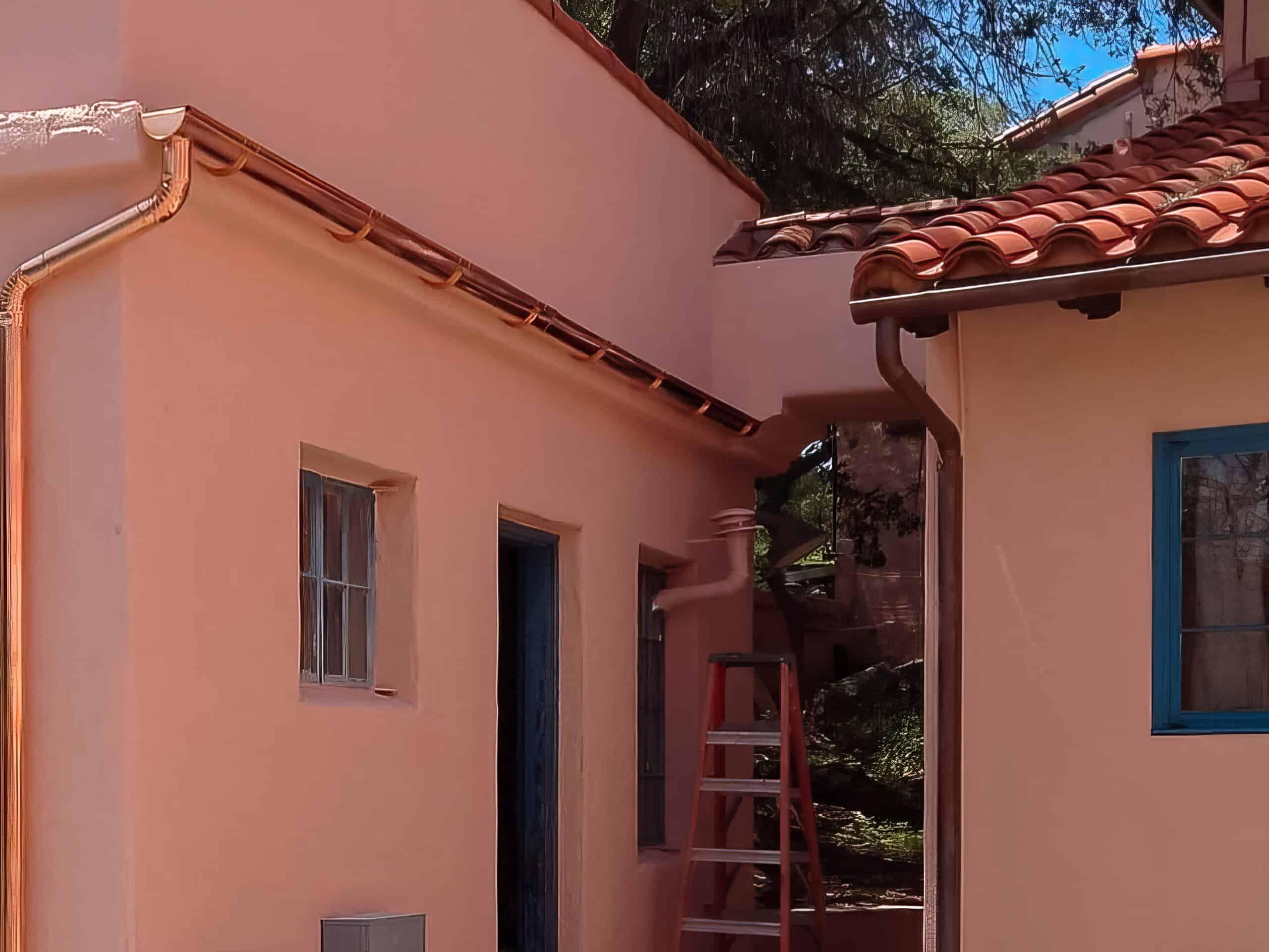
Concentrated flow matters during monsoon season, when a large volume arrives in a short window. A trough that would handle the same total spread evenly can be overwhelmed at the specific points where the pans discharge. That pushes toward being generous on sizing and deliberate about where downspouts go, rather than spacing them out by habit.
| Tile roof factor | Why it matters at the gutter | What it changes |
|---|---|---|
| Tile overhangs the fascia | Water leaves the roof further out than on shingle | Gutter set to the discharge line, not just to the board |
| Barrel and S-profile pans | Runoff concentrates into streams rather than a sheet | Sizing and downspout placement account for point flow |
| Grit and debris from tile | Material works loose and collects in the trough | Clearing stays part of routine maintenance |
| Tile is brittle underfoot | Careless access can crack tile and cost a repair | Work approached from the gutter line where possible |
| Fascia sits beneath the tile edge | The board carries the entire gutter load | Condition assessed before anything is hung |
Getting the Slope Right on a Long Run
A gutter has to fall toward its outlets or water sits in it. The accepted standard is about a quarter inch of fall per 10 feet of run, and up to half an inch per 10 feet where rainfall is heavy. That sounds trivial until you work it out across a long elevation.
On a tile roof that drop has to be achieved while staying under the tile edge along the whole run, which is why long elevations are often split into two runs draining to separate downspouts rather than forced into one continuous fall. Seamless rain gutter installation helps here, because a run formed on site in one piece has no joints competing with the pitch.
Aluminum or Copper Under Tile
Both work well under tile and the choice is mostly about appearance and budget horizon. Aluminum does not rust, handles the heat and ultraviolet load without becoming brittle, and is built to last 30 or more years. It can be finished to sit quietly against the roof rather than drawing attention.
Copper is the choice when the gutter is meant to be seen. It develops a natural patina over time and can last up to four times longer than a standard system, and the weathered tone sits particularly well against terracotta and earth-toned tile. Copper gutter installation is common on Spanish and Mediterranean styles for exactly that reason.
On profile, K-style is offered in 5, 6, and 8 inch and covers most homes. Half-round suits traditional and Spanish designs and pairs naturally with copper. Downspouts come in standard 2x3 and 3x4 inch sizes with larger sections for bigger roofs, and given the concentrated flow off barrel tile, sizing up is worth discussing rather than defaulting to the smallest that fits.
Protecting the Tile During Installation
Cracked tile is the avoidable cost on this kind of job. Clay and concrete tile is brittle, and weight in the wrong place breaks it, which turns a gutter installation into a roofing repair and a color-matching exercise on tile that may no longer be manufactured.
The practical answer is to minimize time on the roof field and work from the gutter line and ladders wherever the job allows. Where access across tile is unavoidable, it is done deliberately and in the right places rather than casually. It is a fair question to ask any contractor before they start, and a vague answer tells you something.
The Fascia Underneath Matters
The gutter does not hang from the tile, it hangs from the fascia board underneath. During a storm a loaded gutter can hold the weight of a full-grown person, and all of that transfers into the wood through hangers set at roughly every 24 inches.
Fascia under a tile edge is partly shaded by the overhang, which helps, but it still takes monsoon moisture and years of heat cycling. Because the tile edge sits above it, deterioration can develop with less of it visible from the ground than on an exposed roofline. If the board is soft or the existing gutter is sagging, that gets addressed before new gutter goes up, not after.
Homeowners across Tucson, Oro Valley, Marana, Vail, Sahuarita, Green Valley, and Three Points live under tile more often than not, so this comes up on most jobs. It is a short check during the site visit rather than a separate exercise.
Key Takeaways
- Gutters for tile roofs use the same profiles and materials as any other roof, and it is the installation that differs.
- Tile overhangs further than shingle, so the gutter is set to where water actually falls rather than tight to the fascia.
- Barrel and S-profile tile concentrates runoff into streams, which argues for generous sizing and deliberate downspout placement.
- Achieving proper fall under a tile edge often means splitting a long elevation into two runs rather than one.
- Cracked tile is the avoidable cost, so how a contractor plans to access the roof is a fair question to ask up front.
- The fascia carries the load, and under a tile edge its condition is less visible from the ground.
Tile Roof Gutter Questions from Tucson Homeowners
Do tile roofs need special gutters?
No. The same profiles and the same aluminum or copper are used as on any other roof. What differs is the installation, specifically where the gutter is positioned relative to the tile overhang, how it is sized for concentrated runoff, and how the roof is accessed during the work.
Why does water overshoot my gutters on a tile roof?
Usually because the gutter sits behind the line the water is actually falling on. Tile projects further past the fascia than shingle, so a gutter positioned tight to the board can miss part of the discharge during heavy rain. Correcting the position generally solves it.
Does barrel tile need bigger gutters?
It is worth discussing. Barrel and S-profile tile channels runoff into the pans, so water arrives concentrated at points rather than spread evenly along the eave. That makes generous sizing and well placed downspouts more important than they would be under flat roofing.
Will installing gutters crack my roof tiles?
It should not, provided access is planned. Tile is brittle and weight in the wrong place breaks it, so the work is approached from the gutter line and ladders wherever possible. Ask any contractor how they intend to access the roof before work begins.
Should I choose copper or aluminum under clay tile?
Both perform well, so it comes down to appearance and how long you want the system to last. Aluminum does not rust and is built for 30 or more years. Copper develops a patina that suits terracotta tile and can last up to four times longer than a standard system.
Do gutters attach to the tile or the fascia?
To the fascia board underneath the tile edge. Nothing hangs from the tile itself. That is why the condition of the fascia is checked first, since it carries the full weight of a loaded gutter during a storm.
Should gutters go on before or after a tile re-roof?
Raise it early either way. If tile is being replaced the overhang can change, so gutter position should be confirmed against the finished roof edge rather than the old one. Coordinating the two avoids setting a gutter to a line that is about to move.
European box gutters are the squared-off profile you see on contemporary and architecturally driven homes, and they are one of the three gutter shapes we install across Southern Arizona alongside K-style and half-round. Where K-style has a decorative front edge and half-round has a curved trough, the box profile is exactly what the name says: a clean rectangular channel with straight sides.
Most homeowners meet this profile through their architect or builder rather than by shopping for it. It shows up on flat-roofed and low-slope designs, on modern desert builds, and on properties where a curved gutter would look wrong against a hard horizontal roofline. If you are weighing it against the more common options, our rain gutter lineup is the place to start, and this post covers what makes the box profile different in practice.
What a European Box Gutter Actually Is
It is a hung gutter with a rectangular cross-section, mounted to the fascia like any other gutter. The sides are straight and vertical, the bottom is flat, and the face presents as a crisp horizontal band rather than a moulded or rounded shape.
That geometry is the whole point. On a home with strong horizontal lines, a box gutter reads as part of the architecture rather than as hardware bolted on afterward. It is a deliberate design choice, which is why it turns up on custom builds far more often than on tract housing.

Not the Same Thing as a Built-In Box Gutter
This distinction matters, and it trips people up constantly. A European box gutter is a hung gutter that attaches to the fascia and can be removed or replaced like any other. A built-in box gutter, sometimes called a built-in or internal gutter, is a trough constructed into the roof structure itself.
They are very different propositions. A built-in gutter sits inside the building envelope, so a failure there puts water into the structure rather than onto the ground, and in sheet metal practice built-in gutters are treated as one of the higher-risk details, typically calling for soldered or welded joints instead of sealed laps. A hung box gutter carries none of that risk profile. It drains to the outside of the building like a conventional gutter and simply happens to be square.
So if you have read warnings about box gutters and leaks, check which type is being discussed. Most of that concern is aimed at built-in troughs, not at a hung European profile.
Why the Shape Affects Capacity
A rectangular channel uses its width more efficiently than a curved one. In a half-round gutter the trough narrows toward the bottom, so the lower portion of the profile holds less than its top width suggests. A box gutter keeps its full width all the way down, which means more cross-sectional area for the same face dimension.
This is not a marketing claim, it is geometry, and the industry treats it that way. SMACNA's downspout and gutter sizing method, drawn from its Architectural Sheet Metal Manual, sizes gutters from local rainfall intensity and the roof area draining into each run, and it explicitly accounts for the gutter width to height ratio along with section length and downspout count. Profile shape is a variable in the calculation, not an afterthought.
In practical Tucson terms, that matters because our rain does not arrive gently. Most of the annual total falls in a handful of intense monsoon storms, so the relevant question is not how much water a gutter moves over a season but whether it can handle a short, violent burst without overshooting. Sizing should be worked out from your actual roof, not assumed from what the neighbors have.
How the Three Profiles Compare
All three profiles do the same job and all three are installed seamlessly. The differences are in appearance, in how the shape uses its width, and in which architecture each one suits.
| Profile | Shape | Usually suits |
|---|---|---|
| K-style | Decorative front edge with a flat back, offered in 5, 6, and 8 inch | The default on most homes, widest size range |
| Half-round | Curved open trough | Historic, Spanish, and traditional designs, often in copper |
| European box | Straight-sided rectangular channel | Contemporary, low-slope, and architecturally driven builds |
If your decision is really between the two more common shapes, we cover that matchup in detail in half-round versus K-style gutters.
Aluminum or Copper
European box gutters are made in aluminum or copper, which are the two materials we work in. There is no steel option, and for this climate that is not a limitation. Aluminum does not rust, handles heat and ultraviolet exposure without becoming brittle, and is built to last 30 or more years here.
Copper is the other direction entirely. It develops a natural patina over time, shifting from bright metal toward the darker weathered tone people associate with older architecture, and a copper system can last up to four times longer than a standard one. On a box profile the effect is striking, because the flat faces give the patina a large uninterrupted surface to develop across.
How They Are Formed and Hung
Seamless gutters are custom-formed on site in one continuous piece, which removes the joints that otherwise become the first leak point. That matters more on a box profile than on any other shape, because straight sides and sharp corners give a seam nowhere to hide, visually or functionally.
Support is the other half of the job. During a storm a loaded gutter can hold the weight of a full-grown person, and all of that load transfers into the fascia. The accepted standard is hangers set roughly every 24 inches, with a pitch of about a quarter inch of fall per 10 feet of run so water actually moves toward the outlets. Downspouts come in standard 2x3 and 3x4 inch sections with larger sizes for bigger roofs, and one downspout typically serves somewhere around 30 to 35 feet of gutter.
Where sealant is used, it needs to be a UV-stable, flexible product rated for high heat. Rooflines here move as they expand and contract through a large daily temperature swing, and a rigid sealant simply cracks. Because box gutters are so often specified as part of a wider design intent, this work usually runs through our custom gutter design service rather than off a standard spec.
Where European Box Gutters Fit on a Tucson Home
The box profile suits homes with strong straight lines: contemporary desert builds, low-slope and flat roofs, and pueblo or territorial designs where a curved gutter would fight the parapet. On a traditional pitched roof with decorative trim, K-style or half-round usually sits better.
One local caution. Homes in managed communities across Oro Valley, Marana, Sahuarita, and parts of Tucson may be subject to guidelines covering exterior colors and finishes, and those rules vary from one association to the next. If your property is governed by an HOA, check its requirements before settling on a material or finish. Aluminum can be finished to match a palette, while copper is deliberately left to weather, and not every association treats those the same way.
Key Takeaways
- A hung European box gutter and a built-in roof trough are different systems, and most published leak warnings are about the built-in kind.
- A rectangular channel keeps its full width to the bottom, so it uses its face dimension more efficiently than a curved trough.
- The recognized sizing method treats width to height ratio, run length, downspout count, and local rainfall intensity as inputs, so sizing is calculated rather than assumed.
- Aluminum and copper are the two available materials, and neither rusts the way a steel product would.
- Seamless forming matters more on a box profile, because straight sides and sharp corners leave a seam nowhere to hide.
- HOA color and finish rules differ by community, so confirm them before choosing between a finished aluminum and a weathering copper.
Box Gutter Questions from Tucson Homeowners
What are European box gutters?
They are hung gutters with a straight-sided rectangular cross-section, mounted to the fascia like any other gutter. The squared shape suits contemporary and low-slope architecture where a curved profile would look out of place. They are one of three profiles installed in the Tucson area, alongside K-style and half-round.
Are box gutters more likely to leak?
Not when they are hung gutters. The leak concerns usually raised about box gutters refer to built-in roof troughs, which sit inside the building envelope and are a recognized high-risk detail in sheet metal work. A hung European profile drains outside the structure like a conventional gutter.
Do box gutters hold more water than K-style?
For a given face dimension a rectangular channel offers more cross-sectional area than a curved one, because it keeps its full width down to the base. Actual capacity still depends on the size specified, the length of each run, and how many downspouts serve it. Sizing should be calculated for your roof rather than assumed.
What materials are box gutters available in?
Aluminum and copper. Aluminum does not rust, handles heat and sun well, and is built to last 30 or more years. Copper develops a natural patina and can last up to four times longer than a standard system, which is why it is often chosen where appearance is part of the design.
Are box gutters seamless?
Yes, they are custom-formed on site in one continuous piece. That matters more on this profile than most, because straight sides and sharp corners make any joint obvious both visually and as a potential leak point.
Will a box gutter suit an older Tucson home?
Sometimes, though often not. The profile is at its best against strong horizontal lines such as flat roofs, parapets, and contemporary builds. On a traditional pitched roof with decorative trim, K-style or half-round usually looks more natural. It is worth reviewing on site rather than deciding from a catalog.
Do I need HOA approval for copper gutters?
Possibly, and it varies by community. Associations across Oro Valley, Marana, Sahuarita, and parts of Tucson may have rules on exterior colors and finishes, and a weathering copper behaves differently from a finished aluminum. Check your own association guidelines before committing to a material.
If you’re looking for gutter installers in Vail, you probably already know the problem. A lot of homes here go from long dry stretches to hard monsoon bursts fast, and that runoff has to go somewhere. Without the right gutters, downspouts, and drainage layout, water ends up against stucco, around foundations, across walkways, or pouring off roof edges where it does damage over time.
Southern Arizona Rain Gutters installs seamless rain gutters and rainwater harvesting systems for homeowners in Vail and across the Greater Tucson area. We design systems for Southern Arizona conditions, with the sun, dust, UV exposure, and monsoon runoff in mind, so your gutter system does more than just hang on the fascia and hope for the best.
Gutter installers in Vail, AZ for monsoon runoff and year-round roof-edge protection
Southern Arizona Rain Gutters serves Vail and nearby communities with custom gutter installation, downspouts, fascia wraps, underground drainage, repairs, and seasonal cleaning. For many homeowners, the goal is straightforward: get water off the roof cleanly, move it away from the house, and stop the staining, erosion, and splashback that show up after summer storms.
In Vail, the right gutter setup is not always the same from one house to the next. Roof pitch, valley concentration, patio covers, courtyard areas, and where runoff needs to land all affect sizing and placement, which is why we look at the actual roof sections before recommending a profile or downspout layout.
Southern Arizona Rain Gutters fabricates continuous seamless runs on site and installs them with heavy-duty hangers and UV-resistant sealant. That gives you fewer joints, fewer leak points, and a system built for intense sun and sudden rain instead of a pieced-together setup that starts separating early.
"Southern Arizona Rain Gutters has installed gutters in Southern Arizona since 2005."
Seamless gutter profiles and materials for Vail homes
Southern Arizona Rain Gutters offers 5-inch, 6-inch, and 8-inch gutter sizes in K-Style, half-round, and European box profiles. Many Tucson-area homes use 5-inch gutters with 2x3 or 3x4 downspouts, while heavier roof sections or stronger runoff areas may call for a 6-inch system.
That matters in Vail because one roofline may be fine with a standard 5-inch K-Style run, while another section with a long slope or concentrated valley water needs more carrying capacity. We size the system to the roof and runoff pattern so you are not paying for the wrong profile or getting undersized gutters that overflow when the monsoon hits.
Southern Arizona Rain Gutters installs aluminum, copper, and steel options, along with fascia wraps and a wide range of colors and finishes. If you want something practical and low-maintenance, aluminum with a long-lasting finish is a common fit. If you want a more custom look, copper with patina gives you a distinctive finish that ages well and adds character.
"Southern Arizona Rain Gutters offers 5-inch, 6-inch, and 8-inch K-Style, half-round, and European box gutter profiles."
Here’s what homeowners in Vail often ask us to include in the project:
- Seamless gutter installation: On-site fabricated runs sized for the roof and runoff volume
- Downspouts and drainage: Standard downspout setups or underground drainage where runoff needs better control
- Exterior upgrades: Fascia wrap, gutter repairs, seasonal cleaning, and rainwater-harvesting tie-ins
Rainwater harvesting in Vail with gutters, cisterns, and rebate-aware planning
A standard gutter system can do more than protect your house. Southern Arizona Rain Gutters also designs rainwater harvesting systems that use your roof runoff as a water source for landscape use, with custom storage from 200 to 10,000+ gallons.
For Vail homeowners who want to conserve water, that can be a smart upgrade. Southern Arizona is dry, and NOAA says the Southwest was drier on an annual basis in the 1991–2020 normals than in the previous normals period. When rain does come, capturing it makes more sense than watching it wash away from the property.
Southern Arizona Rain Gutters installs above-ground plastic tanks and steel culvert cisterns, and the systems can be paired directly with your new gutters and downspouts. We also use sealed, UV-protected tanks and screened openings to help prevent algae growth and mosquito issues, which matters here where sun exposure is strong for most of the year.
"Southern Arizona Rain Gutters designs custom rainwater harvesting systems from 200 to 10,000+ gallons."
If you are trying to qualify for the Tucson Water rainwater harvesting rebate, timing matters. Tucson Water requires workshop attendance before installation and pre-approval before the project starts for rebate eligibility, and workshops taken before July 2023 do not qualify. The listed rebate is $1.00 per gallon when the total system storage equals or exceeds the total required storage.
Not every Vail property is in the same utility situation, so we do not assume rebate eligibility. But if your home is in Tucson Water service and you want a harvesting system, Southern Arizona Rain Gutters can plan the layout with those requirements in mind so you do not install first and find out later that the paperwork timing was wrong.
Southern Arizona Rain Gutters makes Vail gutter projects easier to plan
Most homeowners are not looking for a complicated process. You want to know what will be installed, where the water will go, what the material options are, and whether the system will hold up in the sun and storms.
Southern Arizona Rain Gutters starts with the house itself. We look at roof lines, runoff concentration points, fascia condition, where downspouts can discharge safely, and whether the project is strictly drainage or part of a larger rainwater harvesting plan. That helps you get a gutter system that matches the structure instead of a one-size-fits-all recommendation.
If you are comparing appearance as well as function, we can help with that too. K-Style often fits the look of many modern and Southwestern homes, half-round can make sense for a more traditional style, and European box profiles can work when you want a cleaner architectural line. The benefit for you is a system that looks intentional, not like an afterthought.
Vail gutter installation options for homeowners who want long-term value
Southern Arizona Rain Gutters is usually the right fit when you want a real installation plan, not a quick patch. That includes homeowners replacing aging gutters, owners adding gutters to a house that never had enough drainage control, and people tying roof runoff into a storage system for landscape watering.
We are also a good fit if sun damage is part of the concern. In Southern Arizona, materials and sealants that look acceptable on day one can fail early if they are not chosen for UV exposure. Southern Arizona Rain Gutters uses UV-resistant sealant and installs seamless runs to reduce the weak points that often show up first.
If you only need parts pickup for a do-it-yourself project, we also offer parts pickup. If you want full professional installation, we handle the design, supply, and installation side so the system is coordinated from gutter profile to downspout discharge to cistern connection if needed.
Gutter pricing, payment plans, and what to expect before installation
Price depends on the roof layout, gutter size, material choice, downspout count, drainage routing, and whether the project includes harvesting components like tanks or cisterns. A simple aluminum gutter job is different from a copper installation with fascia wrap and underground drainage, so we prefer to give you a scope that matches the house.
Southern Arizona Rain Gutters also offers payment plans on jobs exceeding $2,000. The company states a 25% minimum deposit applies, which can help if you are making a larger investment in the home and want to move forward without doing the whole project cost at once.
That kind of clarity matters because most homeowners are not shopping for gutters every year. You should know what you are getting, what is included, and whether the project is being planned as basic runoff control or a more involved water-harvesting setup.
Local Vail-area gutter experience you can verify
Southern Arizona Rain Gutters is a Tucson-based company serving the Greater Tucson area, including Vail, Marana, Oro Valley, Sahuarita, Sonoita, Green Valley, Nogales, and Rio Rico. That local service coverage matters because roof drainage in Southern Arizona is not the same as it is in wetter parts of the country. Here, the system has to deal with heat, dust, UV exposure, and brief but heavy storm events.
Southern Arizona Rain Gutters also lists contractor licenses R.O.C. 326453 and R.O.C. 326462. For homeowners in Vail, that gives you a clear company identity to check as you compare installers, materials, and project scope.
If you want gutters that are sized for your roof, installed for Southern Arizona weather, and ready to support rainwater harvesting if that is part of the plan, contact Southern Arizona Rain Gutters for a Vail-area estimate. We’ll look at your roofline, runoff, material options, and next steps so you can make a solid decision for your home.
If your Rio Rico home sends roof water over entryways, against stucco, or straight into planting beds every summer, Southern Arizona Rain Gutters can fix that with a gutter system designed for the way storms actually hit Southern Arizona. We design, supply, and install seamless aluminum and copper rain gutters, downspouts, fascia wrap, and optional rainwater harvesting tie-ins for homeowners across Rio Rico and the surrounding area.
Rio Rico is part of the Southern Arizona Rain Gutters service area, and that local coverage matters. In southeast Arizona, monsoon rain often comes in short, heavy bursts. The National Weather Service Tucson notes localized storm totals can reach 1 to 3 inches, so your gutters need to move water quickly, not just look good along the roofline.
Rain gutter installation in Rio Rico for monsoon runoff control
A gutter system that works in Rio Rico starts with sizing and placement, not guesswork. Southern Arizona Rain Gutters looks at rooflines, valleys, slope, and discharge points so your gutters and downspouts are matched to runoff concentration, which is what really matters when one hard monsoon cell unloads over your block.
"Southern Arizona Rain Gutters offers custom seamless K-Style gutters in 5-inch, 6-inch, and 8-inch sizes for Southern Arizona runoff."
For many homes, seamless K-Style gutters are the practical choice because they handle roof runoff well and fit common residential roof profiles cleanly. If your house calls for a different look, Southern Arizona Rain Gutters also offers half-round and European-box profiles, along with aluminum in multiple colors and copper that develops a natural patina over time.
Here are some of the gutter options we install for Rio Rico homeowners:
- Profiles: K-Style, half-round, and European-box
- Materials: Seamless aluminum and copper
- Related components: Downspouts, fascia wrap, and harvesting-ready connections
Because Southern Arizona Rain Gutters builds around your home, you are not limited to a one-size-fits-all setup that may be too small for monsoon runoff or poorly placed for your walkways and stucco walls.
Southern Arizona Rain Gutters installs seamless gutters, downspouts, and fascia wrap for Rio Rico homes
A good install is about where the water goes after it leaves the roof. Southern Arizona Rain Gutters has measured rooflines, valleys, and discharge points since 2005 for residential installations, which helps us place downspouts where water clears doors, walkways, planting areas, and foundation edges instead of soaking the same trouble spots over and over.
"Southern Arizona Rain Gutters has measured rooflines, valleys, and discharge points since 2005 for residential gutter installations."
We also install fascia wrap when the trim line needs a cleaner, more protected finish. On Rio Rico homes that take a lot of sun and weather on exposed edges, fascia wrap can help cover vulnerable trim and give the gutter line a more finished appearance.
When we put together your estimate, we walk through the details that affect both looks and performance: profile, size, material, color, downspout placement, and whether fascia wrap makes sense. That makes it easier for you to compare real options instead of looking at a price with no explanation behind it.
Rio Rico gutter installation with optional rainwater harvesting and cistern-ready planning
If you want your new gutters to do more than move water away from the house, Southern Arizona Rain Gutters can design the layout so it is ready for harvesting from the start. We build systems that can feed above-ground plastic tanks or steel culvert cisterns, with capacities from 200 to 10,000+ gallons, and we use sealed, UV-protected tanks with screened openings to help prevent algae and mosquitoes.
"Southern Arizona Rain Gutters designs harvesting systems from 200 to 10,000+ gallons with sealed, UV-protected tanks and screened openings."
That matters in Southern Arizona because water conservation is not just a nice extra. A cistern-ready gutter plan lets you capture roof runoff for landscape use and avoid tearing the system apart later if you decide to add storage.
Southern Arizona Rain Gutters can keep the setup simple or plan for a larger storage system, depending on your property and goals. If you are already investing in the house, it often makes sense to get the gutter installation right now so future cistern is easier.
What your Rio Rico gutter installation includes from Southern Arizona Rain Gutters
Most homeowners call us for one of four reasons: old gutters are failing, the house never had gutters, water is dumping in the wrong places, or they want to tie roof runoff into a harvesting system. Southern Arizona Rain Gutters handles all of those situations with a custom design instead of a stock package.
A typical Rio Rico gutter project with Southern Arizona Rain Gutters includes:
- Roof and drainage review: We measure rooflines, valleys, and discharge points.
- System design: We recommend the right profile, gutter size, and downspout layout based on runoff concentration.
- Material and finish choices: You choose from seamless aluminum in multiple colors or copper, with fascia wrap if needed.
- Installation or supply options: We provide professional installation, and parts are also available for DIY pickup.
We are a strong fit if you want a local company that already serves Rio Rico, understands monsoon drainage, and can connect the gutter work to longer-term water control. Southern Arizona Rain Gutters also offers flexible payment plans, which can help when you want to handle the project before storm season instead of putting it off.
Trust matters with visible exterior work. Southern Arizona Rain Gutters reports a 4.8 Google rating based on 453 reviews, and that kind of feedback matters when you are choosing who to trust with your roof runoff, curb appeal, and the parts of your home that water can quietly damage over time.
Schedule a Rio Rico gutter estimate before the next hard storm
If roof water is splashing back on stucco, washing out soil, or pouring where you walk every day, it is worth fixing before the next monsoon. Southern Arizona Rain Gutters can come out to Rio Rico, measure the roofline, review profile and material options, and design a system that fits your house and the way water moves across your property.
Whether you want straightforward seamless gutter installation, better downspout placement, fascia wrap, or a gutter system that is ready for a future cistern, Southern Arizona Rain Gutters can help you get it done the right way. Reach out for a Rio Rico estimate and get your roof runoff under control before the weather does it for you.
Questions Rio Rico homeowners ask us most
How long does a gutter installation usually take?
Most Rio Rico homes are finished in a single day once the material and layout are confirmed. Larger properties, steeper rooflines, or projects that add fascia wrap or harvesting connections can run into a second day. We give you a realistic timeframe when we finalize the estimate so you can plan around it.
Do I need to be home while the work is being done?
Not for the entire job, since almost everything happens on the exterior. We do like to have a quick conversation at the start to confirm downspout locations and where water should discharge, and again at the end to walk the finished system with you. As long as our crew has clear access to the roofline and work areas, you are free to come and go.
How far ahead of monsoon season should I schedule?
Southern Arizona's monsoon typically ramps up in mid-June, so late winter and spring are the easiest times to get on the calendar. Booking early means your system is in place before the first heavy cell hits, and it avoids the rush that builds once storms start rolling through and everyone calls at once.
How much upkeep do gutters need in Rio Rico's dry climate?
Less than in wetter regions, but not zero. Dust, blown grit, and debris from mesquite, palo verde, and nearby trees still settle in over time and can slow drainage. A quick clearing before monsoon season and another look afterward is usually enough to keep water moving the way it should.
Are gutter guards worth adding here?
They can be, especially if your roof sits under overhanging branches or collects a lot of windblown debris. Guards cut down on how often you clear the troughs, though they are an added cost and not every home needs them. We can look at your specific tree cover and roofline during the estimate and tell you honestly whether they make sense.
Will seamless gutters work with my tile or metal roof?
Yes. Seamless aluminum and copper attach at the fascia and roof edge, so they pair with the tile, shingle, foam, and metal roofs common on Southern Arizona homes. We adjust the mounting and hanger spacing to suit your roof type so the finished line sits clean and holds up through storm season.
In Tucson, a downspout is not a small detail. When summer storms hit, roof water comes off fast, and where that water lands affects your stucco, walkways, planting areas, and foundation. Southern Arizona Rain Gutters installs downspouts, seamless gutters, and rainwater harvesting systems for homes and businesses across Tucson and the surrounding Southern Arizona communities.
If you are replacing old downspouts, adding a full gutter system, or routing roof runoff into a tank or basin, Southern Arizona Rain Gutters gives you a layout that fits your roofline and your property. We work with homeowners, property managers, and commercial owners who want drainage that looks clean, holds up in desert sun, and performs during monsoon season.
Downspout installation in Tucson, AZ built for monsoon runoff
Tucson does not get steady rain all year. A lot of the runoff pressure shows up in July, August, and September, when normal rainfall is about 2.21 inches, 1.98 inches, and 1.32 inches. That means your downspouts need to be placed and sized for short, heavy bursts, not just average dry weather.
Southern Arizona Rain Gutters has been installing gutters in Southern Arizona since 2005, and that local experience matters when we size roof runoff, set continuous slope, and choose downspout locations. Many Tucson homes use 5-inch gutters with 2x3 or 3x4 downspouts, while heavier roof sections or stronger runoff may call for a 6-inch system.
"Southern Arizona Rain Gutters has installed gutters in Southern Arizona since 2005, with many Tucson homes using 5-inch gutters and 2x3 or 3x4 downspouts."
We do not treat downspouts like an afterthought. Southern Arizona Rain Gutters custom fabricates seamless runs, plans discharge points, and installs hangers every two feet so the system is supported and tested for real water flow before the job is finished.
Southern Arizona Rain Gutters plans slope, discharge, and collection points that protect your home
A good-looking downspout is not enough if water sits in the gutter or dumps in the wrong place. For rainwater collection systems, the 2021 IPC calls for a minimum continuous slope of 1/8 inch per foot, and the system should not allow water to pool anywhere along the run.
Southern Arizona Rain Gutters applies those slope and drainage rules in a practical way, so water keeps moving and exits where it will not cause erosion or property damage. That matters on Tucson lots where hard soils, gravel beds, and narrow side yards can turn one bad discharge point into a recurring mess.
"For rainwater collection, Southern Arizona Rain Gutters plans for the 2021 IPC minimum of 1/8 inch per foot continuous slope so water keeps moving."
If your goal is simple drainage, we can route downspouts away from entries, patios, and splash-prone walls. If you want to capture water, Southern Arizona Rain Gutters can tie those downspouts into above-ground tanks or steel culvert cisterns with sealed, UV-protected storage and screened openings that help prevent algae and mosquitoes.
Tucson rainwater harvesting downspouts with rebate-aware system design
Some Tucson homeowners are not just trying to get water away from the house. They want to keep it on the property and use it well. Southern Arizona Rain Gutters designs rainwater harvesting systems from 200 gallons to 10,000+ gallons, so your downspout installation can be part of a larger water conservation plan instead of a standalone fix.
If you want to pursue the Tucson Water rainwater harvesting rebate, the timing matters. Tucson Water requires active Tucson Water service at the property, pre-approval before the system is purchased or installed, and an approved workshop before installation for applicants seeking the rebate.
"Southern Arizona Rain Gutters designs harvesting systems from 200 to 10,000+ gallons, and Tucson Water rebates can reach $1,999 per property when requirements are met."
That does not mean every property needs a large cistern. Sometimes the right answer is a clean downspout run to a basin or planting area. Sometimes it is a full collection setup sized to capture at least 1 inch of rainfall from the collecting roof area. Southern Arizona Rain Gutters helps you sort that out before material is ordered, which can save you from rework and missed rebate requirements.
Aluminum, copper, K-Style, and fascia wrap options that fit Tucson homes
Downspouts have to work, but they also live on the front of your house. In Tucson, they also have to take a beating from heat and UV exposure. With local climate normals showing about 68 days a year at 100 degrees or higher, finish durability matters more here than it does in milder places.
Southern Arizona Rain Gutters installs seamless aluminum gutters in multiple colors, along with copper gutters and downspouts for homeowners who want a more distinctive look. We can match the system to your trim, roofline, and profile preferences, including K-Style setups that fit many homes in Tucson neighborhoods.
If the fascia needs attention too, Southern Arizona Rain Gutters also offers fascia wrap as part of the project. That gives you a cleaner finished edge and helps protect exposed wood in a climate where intense sun and storm cycles can wear materials down faster than people expect.
What your Tucson downspout installation includes from Southern Arizona Rain Gutters
A proper installation should be clear from the start. Southern Arizona Rain Gutters typically builds the job around the parts that actually affect performance and appearance:
- Roof runoff sizing based on the roof sections, valleys, and likely spill points
- Continuous slope planning and downspout placement for drainage or collection
- Custom fabrication of seamless runs to reduce unnecessary joints
- Hangers set every two feet for support
- A final water test to confirm flow before the project is wrapped up
That process is useful whether you need a straightforward residential downspout replacement or a larger system that feeds cisterns. Southern Arizona Rain Gutters also offers flexible payment plans, and if you are handling part of the project yourself, we can supply parts for DIY pickup.
Southern Arizona Rain Gutters is a strong fit for Tucson homeowners who want drainage that looks right and works right
Some homeowners call because water is splashing against stucco or pooling near a walkway. Others are investing in the house and want copper or color-matched aluminum that improves curb appeal while solving the runoff problem. Southern Arizona Rain Gutters is a good fit when you want both sides handled correctly: the appearance on the wall and the water movement off the roof.
Southern Arizona Rain Gutters serves the greater Tucson area along with Oro Valley, Marana, Vail, Sahuarita, Green Valley, Nogales, Rio Rico, Sonoita, and Three Points. That local service area matters because the same monsoon pattern, heat load, and water conservation concerns show up across Southern Arizona, even when roof styles and lot layouts change.
If you are planning downspout installation in Tucson, AZ, the next step is simple. Contact Southern Arizona Rain Gutters to talk through your roof runoff, your drainage trouble spots, and whether you want basic discharge control or a downspout system tied into rainwater harvesting. We will help you choose a setup that fits your home and makes the next storm a lot less of a problem.
Common downspout questions from Tucson homeowners
How many downspouts does my home need?
The number depends on how much gutter runs along your roofline and how the roof sheds water, not just the size of the house. A common starting point is one downspout for roughly every 30 to 40 feet of gutter, with extra outlets added wherever a roof section sends a large volume to a single spot. During the walkthrough, Southern Arizona Rain Gutters looks at where water naturally concentrates and places outlets so no single downspout gets overwhelmed during a hard monsoon burst.
How far from the house should a downspout release water?
Getting water out of the gutter is only half the job. It also has to land far enough from the wall that it does not soak back toward the foundation. A general guideline is to move discharge at least four to six feet from the base of the house, using extensions, a splash area, or a routed line when the grade is tight. On lots with hard soil or narrow side yards, that added distance keeps runoff from working its way back against stucco and slab.
Can you add or reroute downspouts without replacing my whole gutter system?
Yes. If your gutters are in good shape but water is dumping in a bad spot, Southern Arizona Rain Gutters can add an outlet, move a downspout, or extend a run without tearing out the existing system. This comes up often when a downspout was placed where it splashes a doorway or feeds water toward a patio. We confirm the current gutters can carry the load first, then adjust the downspouts to fix the problem area.
How long does a downspout installation usually take?
Most residential jobs are finished in a single day, though the exact time depends on the length of the runs, the number of downspouts, and whether the work ties into tanks or a harvesting setup. Fabrication happens on site, so runs are formed to fit your roofline before they go up. Larger properties or systems feeding cisterns can take longer, and you get a realistic timeframe with your quote.
What maintenance do downspouts need in the desert?
Desert debris is different from what people usually picture with gutters. Instead of heavy leaf fall, Tucson systems tend to collect palo verde and mesquite litter, seed pods, blown grit, and stray roof gravel that can settle at the outlets. A quick check before monsoon season, clearing the top of each downspout and confirming water still runs freely, is usually enough to keep things moving. Screened openings on harvesting systems also cut down on buildup and keep pests out.
If you live in Tucson or anywhere in Southern Arizona, gutter guards are not a simple yes-or-no upgrade. I get asked about them all the time, usually right before monsoon season or right after a big overflow stains a patio, washes out a planting bed, or dumps water next to the foundation.
The short answer is this: gutter guards can be worth it in Arizona, but only when the whole gutter system is built for Arizona rain. A guard on a too-small gutter is still a too-small gutter. And a guard that handles oak leaves back east may struggle here with dust, palo verde seed pods, and the kind of hard summer downpour that can hit a roof all at once.
That’s the part many homeowners miss.
How Arizona monsoon rain changes the gutter guard question
A lot of states get steady rain. Southern Arizona gets long dry stretches, then a sudden burst during the North American monsoon. In our area, the monsoon season runs from mid-June through the end of September, and Tucson’s rainfall usually peaks in July and August. That means your gutter system may sit mostly dry for weeks, then get tested hard in a single afternoon.
When that happens, water has to move fast. If it cannot get through the gutter, into the outlet, and down the downspout quickly enough, it spills over the front edge or backs up. That runoff can hit stucco, stain fascia, puddle near the slab, and cut channels into soil around the house. Even in a dry climate, runoff management matters because roofs shed a surprising amount of water in a short time.
This is why I usually tell homeowners to think about capacity first and protection second.
What debris actually fills Arizona gutters
People hear “gutter guards” and picture big leaves. Around Tucson, that is only part of the story. We deal with finer, lighter debris that behaves differently once the first storm hits and turns everything into a muddy paste.
Common gutter debris on Southern Arizona homes includes:
- mesquite leaflets
- palo verde blossoms
- seed pods
- dust and grit
- small twigs
- roofing granules
That mix is one reason some guard styles work better here than others. A guard may keep out larger debris but still let in enough fine material to create sludge. Or it may trap that fine material right on top of the guard, where it bakes in the sun, then seals itself tighter after a storm.
The sun is part of the problem too. Arizona UV exposure is rough on plastics, foam inserts, and lower-grade finishes. What looks good the first year can get brittle, warped, or chalky faster here than many homeowners expect.
Gutter guard types for Arizona homes
There is no single “best” guard for every house. Roof pitch, tree cover, gutter profile, and water volume all matter. Most homes here use K-Style gutters, usually 5-inch or 6-inch, and the guard has to match both the profile and the amount of runoff the roof creates.
Here’s a practical look at the main categories.
| Guard type | How it handles Arizona debris | How it handles monsoon flow | Typical concern |
|---|---|---|---|
| Foam insert | Fair at first | Poor to fair | Breaks down in sun, holds grit |
| Brush insert | Catches large debris | Fair | Traps fine dust and seed fluff |
| Basic screen | Keeps out leaves and twigs | Fair | Fine debris can sit on top and clog openings |
| Perforated solid cover | Good with larger debris | Good if properly installed | Can sheet over in heavy rain if pitch or outlet is wrong |
| Micro-mesh guard | Often best with mixed debris | Good to very good | Needs proper slope and occasional cleaning of surface |
Micro-mesh guards usually make the most sense on Arizona homes that actually need protection. They do a better job with fine material than wide-opening screens. But even micro-mesh is not magic. If the gutter is undersized, if the downspout outlet is too small, or if the roof dumps too much water into one section, overflow can still happen.
There is another point worth being plain about. University of Arizona rain harvesting guidance has warned against some leaf-type screens and downspout screening because they can become the clog point. I agree with that. A guard system should not create a maintenance trap in the one place where you need water moving freely.
Why gutter size and downspout capacity matter more than the guard
This is where many installs go sideways. Homeowners buy a guard because they are tired of cleaning, but the gutter itself was never sized for monsoon intensity. The guard gets blamed when the real issue is the base system.
If you have a long roof run, a steep roof, a tile roof shedding fast runoff, or a section feeding a cistern, capacity matters a lot. In many cases, moving from a 5-inch K-Style gutter to a 6-inch system, or increasing downspout size and count, does more for performance than adding a guard alone. On bigger rainwater harvesting setups, University of Arizona examples even call for 6-inch gutters, 5-inch downspouts, and larger conveyance piping to handle intense storm events.
A guard should support water movement, not choke it down.
Some warning signs show up again and again on Arizona homes:
- Front-edge overflow: Water pours over the face of the gutter during short, heavy storms.
- Outlet bottleneck: The gutter looks full near the downspout opening while water backs up upstream.
- Splash at the base: The downspout dumps too close to the house or the extension cannot keep up.
- Uneven roof drainage: One section of roof carries far more runoff than the rest.
- Drainage by appearance only: The gutters look clean, but the underground pipe or downspout is undersized.
This is also where the fascia board matters. If the fascia board is soft, split, or sun-damaged, adding guards on top of an aging attachment surface is not a smart long-term move. Sometimes a fascia wrap repair or replacement should happen before any guard is installed.
When gutter guards are worth the cost on Tucson homes
There are homes where guards make very good sense. There are also homes where I would rather see the budget go into larger gutters, better downspouts, or improved grading first.
Guards tend to be worth it when the home sits under mesquite, palo verde, eucalyptus, or other debris-dropping trees and the gutters are hard to access. Two-story sections are an obvious example. So are homes with fragile landscaping, pool decks, or walkways below the eaves where regular ladder work is not ideal.
They also make sense when the house has a working water harvesting setup. If you are trying to feed cisterns, keep sediment down, and make the system easier to manage, a good guard can help reduce what enters the gutter in the first place. It does not replace filtration or first flush diverters, but it can cut down the mess.
Here’s a simple way I look at it on Arizona properties:
- Good fit: Heavy tree debris, difficult access, properly sized gutters, homeowner wants less frequent cleanout.
- Questionable fit: Minimal tree cover, undersized gutters, known overflow, homeowner expects zero maintenance.
- Strong fit with harvesting: Gutters feed cisterns, debris control matters, system includes serviceable cleanout points.
- Poor fit: Cheap plastic products in full sun, clogged downspout screens, or any setup that slows water at the outlet.
One more thing: gutter guards are often sold as “maintenance free.” They are not. They are “less maintenance” when chosen and installed well.
Gutter guards with rainwater harvesting and cisterns
Arizona homeowners often look at gutters a little differently because water has value here. If runoff can be directed into a tank instead of washing into the yard, that water can support trees, shrubs, and seasonal planting. That is where gutter guards become part of a larger system, not just a debris accessory.
For harvesting setups, I like to keep the path from roof to cistern straightforward and easy to service. The guard should reduce bulk debris at the gutter level. After that, a first flush diverter can help remove the dirtiest initial runoff, and the tank or cistern should have screened inlets and sealed openings to keep out mosquitoes, algae-promoting light, and extra debris.
That setup works better than putting a fussy screen right at the downspout throat and hoping it never clogs. Once a clog forms there during a monsoon burst, water usually backs up fast. On harvesting systems, the best detail is often the simplest one that is still easy to open, rinse, and inspect.
Pre-monsoon gutter guard maintenance in Southern Arizona
Even the best guard needs a check before storm season. I tell homeowners to look things over in late spring or early June, before the first real summer cells roll through.
What you are checking for is not complicated. You want open flow, secure attachment, and no weak points where sun, wind, or last year’s debris caused trouble. A five-minute walk around the house after a dry spell can tell you a lot, and a hose test can tell you even more.
A good pre-monsoon check should include:
- Guard surface: Brush off built-up dust, blossoms, and seed pods.
- Downspout flow: Run water and make sure it exits freely at the bottom.
- Fasteners: Check for loose hangers, lifted sections, or rattling parts.
- Fascia and soffit: Look for stains, peeling paint, or signs of repeat overflow.
- Harvesting components: Clean first flush parts and inspect cistern screens.
If water skips over the top of the guard during a hose test, that does not always mean the guard product is bad. It may mean the angle is off, the gutter is too small, the roof section is carrying too much runoff, or the outlet capacity is not there. That is why diagnosis matters more than brand names.
A well-built Arizona gutter system should do three things at once: move hard monsoon rain, handle fine desert debris, and send runoff where you actually want it to go.
If a guard helps with that, it is worth looking at. If it only hides a sizing problem, it is money better spent somewhere else.
Questions we hear from Tucson homeowners
Can gutter guards be added to my existing gutters, or do I need new ones?
In many cases guards can be fitted to gutters that are already sound and correctly sized. The deciding factor is the condition of what is already up there. If the gutters are secure, pitched right, and large enough for your roof, a retrofit is usually straightforward. If they sag, leak at the seams, or were never adequate for the runoff, adding a guard first just locks the existing problem in place. We look at both the gutters and the surface they hang on before recommending a retrofit versus a replacement.
Can I install gutter guards myself?
You can, and plenty of homeowners do with the snap-in and drop-in products sold at the big box stores. The trade-offs are ladder safety on two-story sections, getting the fit right so water does not skip past the opening, and picking a product that survives our sun. A fair number of the problems I get called out to fix started as a well-meaning DIY guard that never matched the gutter or the roof. Low and simple work is manageable for a careful homeowner. Anything involving real height or an existing overflow usually justifies professional fitting.
Do metal gutter guards offer any wildfire or ember protection?
They can help. In fire-prone stretches of Southern Arizona, a fine metal mesh keeps windblown embers from settling into dry material inside the gutter, which is a known ignition point along the roofline. Foam and plastic products work against you here, since they put flammable material exactly where you do not want it. If ember resistance matters for your property, a noncombustible metal mesh over a clean gutter is the version worth considering.
Do gutter guards keep birds, rodents, and insects out?
A solid guard does reduce nesting and pest access by closing off the open trough where birds build and where debris collects. It is one of the quieter benefits homeowners notice. That said, it is not pest control. A guard will not stop determined rodents at the roof edge or seal every gap, and material sitting on top of a guard can still draw insects. Treat it as removing an easy invitation rather than a guaranteed barrier.
Is there a best time of year to install gutter guards in Tucson?
Late winter through spring is the sweet spot, well before summer monsoon season. Getting guards on early means the system is proven out before the first hard storm rather than during it. Fall is a reasonable second choice, once the summer debris has dropped. The stretch I steer people away from is trying to book an install mid-monsoon after an overflow, when demand spikes and the gutters are already under stress. Planning ahead gets you a calmer install and a better result.
Do gutter guards work on low-slope or flat desert-style roofs?
They can, but a low-slope or flat roof changes the math. These roofs often drain through canales or scuppers rather than a continuous eave gutter, so guard coverage depends on how the water actually leaves the roof. Where gutters are present, the slower runoff of a low-pitch roof lets fine dust settle on the guard surface instead of washing off, which makes a self-clearing mesh and correct gutter pitch more important, not less. It is worth having the drainage layout looked at rather than assuming a standard guard drops right in.
If you own a home in Oro Valley, rain gutters are less about everyday rain and more about controlling roof runoff when monsoon storms hit hard. Southern Arizona Rain Gutters designs and installs custom seamless gutter systems for Oro Valley homes so water moves off the roof and away from stucco, walkways, patios, and foundations instead of dumping in the wrong place.
Southern Arizona Rain Gutters is based in Tucson and serves Oro Valley as part of the Greater Tucson area. We install seamless aluminum gutters in multiple colors as well as copper gutters for homeowners who want a more distinctive architectural finish. Seamless runs mean fewer joints along the roofline, which helps reduce leak points and gives the house a cleaner look.
We also install fascia wrap when the trim needs better protection and a more finished appearance. In Oro Valley, where the sun is hard on exposed exterior materials, choosing the right finish and profile is not just about looks. It helps the system hold up better over time.
K-Style gutters are a strong fit for many homes because they handle good water volume and work well with common rooflines. Half-round gutters can make more sense when you want a different visual style or you are pairing the system with copper details on the home.
Rain gutter installation in Oro Valley built for monsoon runoff control
Oro Valley gets long dry stretches, then intense summer storms. The National Weather Service says peak monsoon conditions in southeast Arizona are typically mid-July through mid-August, and Tucson climate normals show 2.21 inches of rain in July and 1.98 inches in August compared with just 0.20 inches in May and 0.23 inches in June. Southern Arizona Rain Gutters uses that Southern Arizona weather pattern to design custom 5-inch, 6-inch, or 8-inch K-Style gutters, plus half-round options, so your system is built for burst periods of rainfall instead of light, occasional showers.
"Southern Arizona Rain Gutters offers 5-inch, 6-inch, and 8-inch K-Style gutters for Southern Arizona runoff control."
That matters because the right gutter layout does more than catch water at the roof edge. Southern Arizona Rain Gutters places downspouts and runoff paths to reduce splashback, soil erosion, staining on stucco and masonry, and the puddling that tends to show up near doors, patios, and walkways after a storm.
"Southern Arizona Rain Gutters serves Oro Valley and has a 4.8 rating based on 453 reviews."
If your current setup drops water into planters, washes out gravel, or leaves muddy spots against the house, a custom gutter system usually fixes several problems at once. You get cleaner drainage, less mess around the property, and better control during heavy summer rain storms and windy monsoon weather.
Custom seamless gutters, copper gutters, and fascia wrap for Oro Valley homes
Southern Arizona Rain Gutters installs seamless aluminum gutters in multiple colors as well as copper gutters for homeowners who want a more distinctive architectural finish. Seamless runs mean fewer joints along the roofline, which helps reduce leak points and gives the house a cleaner look.
We also install fascia wrap when the trim needs better protection and a more finished appearance. In Oro Valley, where the sun is hard on exposed exterior materials, choosing the right finish and profile is not just about looks. It helps the system hold up better over time.
K-Style gutters are a strong fit for many homes because they handle good water volume and work well with common rooflines. Half-round gutters can make more sense when you want a different visual style or you are pairing the system with copper details on the home.
Rain gutters in Oro Valley that can feed rainwater harvesting systems
If you want your gutter project to do more than move water away from the house, Southern Arizona Rain Gutters can connect it to rainwater harvesting. We design and install harvesting systems from 200 to 10,000+ gallons using above-ground plastic tanks and steel culvert cisterns, so monsoon runoff can become stored water for landscape use instead of going to waste.
"Southern Arizona Rain Gutters builds rainwater harvesting systems from 200 to 10,000+ gallons."
Our harvesting systems use sealed, UV-protected tanks and screened openings to help prevent algae and mosquitoes. That is a big deal in the desert, where strong sun and exposed standing water can turn into maintenance headaches fast.
If you are not ready for a full cistern right now, Southern Arizona Rain Gutters can still set up your gutter and downspout layout so adding storage later is much easier. That gives you a cleaner first phase now and a clear path toward water conservation when you are ready.
What Southern Arizona Rain Gutters installs on Oro Valley homes
Here is what you can choose from when we build a gutter system for your property:
- Gutter profiles: 5-inch, 6-inch, and 8-inch K-Style gutters, plus half-round gutters
- Materials and finishes: Aluminum in multiple colors and copper with natural patina
- Related upgrades: Downspouts, fascia wrap, and rainwater harvesting connections or full cistern systems
Southern Arizona Rain Gutters custom designs each system to the roofline and runoff path instead of treating every house the same. That means you get a system that fits the home, handles local storm patterns, and looks like it belongs there.
Oro Valley gutter service with clear options for installation, payment, and DIY pickup
Gutter pricing in Oro Valley depends on the roofline, the gutter size and profile, the material you choose, the number of downspouts, and whether you want fascia wrap or rainwater harvesting included. Southern Arizona Rain Gutters keeps the process grounded in those real job details, and we offer flexible payment plans for homeowners who want to protect the property now without pushing the whole cost into one payment.
We also offer professional installation and DIY parts pickup. Southern Arizona Rain Gutters gives you both options, which is useful if you like doing some of your own property work but still want the right components for Southern Arizona conditions.
If you are comparing bids, it helps to look beyond simple gutter footage. In Oro Valley, the important questions are whether the system is sized for monsoon runoff, whether the material can handle intense sun, and whether the discharge points actually improve drainage around the house.
Why Southern Arizona Rain Gutters is a strong fit for Oro Valley homeowners
Southern Arizona Rain Gutters serves Oro Valley from our Tucson location at 1627 N Stone Ave, Tucson, AZ 85705. Our testimonials page shows a 4.8 rating based on 453 reviews, and customers there specifically mention gutter installation, downspouts, drainage piping, and monsoon preparation.
We are a good fit when you want a custom gutter system instead of a generic add-on, when you need better runoff control before monsoon season, or when you want to tie roof drainage into water conservation plans. Southern Arizona Rain Gutters is also a practical choice if you want color-matched aluminum, copper gutters, or a system that can support cisterns now or later.
If you manage a residential property or a commercial building in Oro Valley, we can apply the same approach: size the system for the roof, plan the runoff path, and make sure the installation fits Southern Arizona weather instead of fighting it.
Get a gutter plan for your Oro Valley home
If you are ready to stop roof runoff from beating up the sides of your home or you want to add rainwater harvesting at the same time, talk with Southern Arizona Rain Gutters about your Oro Valley property. We can help you choose the right profile, material, and drainage setup so your gutter system works when monsoon season shows up, not just when the weather is easy.
Questions Oro Valley homeowners often ask
When is the best time of year to install gutters in Oro Valley?
The stretch before monsoon season, roughly spring through early summer, is ideal. Installing while the weather is dry means your system is ready before the first heavy storms arrive, rather than scrambling after runoff has already caused problems. Scheduling ahead also avoids the busy period when many homeowners request work at the same time, so you have more flexibility on timing.
How much maintenance do gutters need in the desert?
Less than you might expect, but not zero. Palo verde, mesquite, and other desert trees drop fine debris and seed pods that can collect in the channels, and blowing dust settles over the dry months. A check before monsoon season and another afterward is usually enough to keep water moving freely. Homes with overhanging trees or a lot of nearby vegetation may need a look more often.
Can you work with or replace the gutters already on my home?
Yes. Many Oro Valley homes come with older or undersized gutters that were not built for burst rainfall, and replacing them is common. We assess what is there, confirm whether the current layout is sending water to the right places, and design a replacement that fits the roofline and handles local storm volume properly.
How long does a typical installation take?
Most residential jobs are completed in a single day once the system is measured and fabricated, though larger homes, copper systems, or projects that include fascia wrap or a harvesting connection can run longer. We give you a realistic timeline when we scope the job so you know what to expect before work begins.
Will copper gutters keep their bright look, or do they change over time?
Copper naturally darkens and develops a patina as it weathers, shifting from a bright finish toward deeper brown and eventually a soft green tone over the years. Many homeowners choose copper specifically for this aging character. If you prefer a consistent, unchanging color instead, color-matched aluminum is the better route.
Do I need HOA approval before adding gutters in Oro Valley?
Some Oro Valley communities have guidelines covering exterior finishes and colors, so it is worth confirming with your HOA before work starts, especially if you are choosing copper or a specific gutter color. We are happy to provide the product and finish details you may need to submit for approval.
If you are picking gutters for a Tucson home, this choice comes up all the time: do you go with the rounded profile that looks classic, or the more common profile that handles a lot of water and mounts easily to the fascia board?
Most homeowners are really balancing three things at once. They want the house to look right, they want the system to hold up through monsoon season, and they do not want to be up on a ladder dealing with clogged gutters every few months. Here in Southern Arizona, that balance matters more than people think. We do not get long stretches of steady rain, but when a storm hits, roof runoff can come fast and hard.
The short version is simple. K-Style is usually the better default if water handling is the top priority. Half-round often wins on appearance and easier cleaning, especially on traditional homes. The best answer depends on your roof, your fascia, and whether you want to tie the system into rainwater harvesting.
Half-round and K-Style gutter profiles explained
These two profiles do the same job, but they look and behave differently.
A half-round gutter is exactly what it sounds like. If you cut a pipe in half lengthwise, that is basically the shape. It has a smooth, curved interior and a softer look from the street. On older homes, custom homes, and certain architectural styles, that rounded profile just fits better.
A K-Style gutter has a flat back and a shaped front that looks a little like crown molding. That flat back is one reason it is so common on residential homes. It sits against the fascia board well, and it is straightforward to install on many houses built in the last several decades.
The shape also affects performance. K-Style gutters usually carry more water than half-round gutters of the same nominal width. Half-round gutters are usually easier to rinse out and clean because they do not have the inner corners that tend to trap grit and debris.
| Factor | Half-round gutters | K-Style gutters |
|---|---|---|
| Appearance | Traditional, softer lines | More common, sharper profile |
| Water capacity | Usually lower at the same size | Usually higher at the same size |
| Cleaning | Easier because of smooth interior | Can trap debris in corners |
| Installation | Often needs brackets or hangers | Flat back mounts easily to fascia |
| Typical home fit | Historic, custom, architectural homes | Standard residential homes |
| Cost trend | Can run higher depending on brackets and material | Often the more budget-friendly option |
Water capacity during Tucson monsoon season
In Tucson, annual rainfall numbers do not tell the whole story. What matters for gutters is storm intensity. A roof can stay dry for weeks, then dump a heavy sheet of runoff in ten minutes during a monsoon cell. That is when undersized gutters show you their limits.
This is where K-Style often gets the nod. Because of the profile, it generally moves more water than a half-round of the same labeled size. If a homeowner has a big roof plane, steep pitch, tile roofing, or strong valleys that concentrate runoff, K-Style is often the safer starting point.
Style alone does not decide this, though. Roof size, roof pitch, valley layout, and downspout sizing matter just as much. A well-sized half-round system can work fine on the right home, and a poorly sized K-Style system can still overflow.
When we look at a Tucson house, these are usually the main capacity questions:
- Roof area: Larger collection areas dump more water into each gutter run
- Roof pitch: Steeper roofs move runoff faster
- Valleys: Two roof sections meeting in one point can overload a small gutter
- Tile roofing: Water can come off unevenly and hard during storms
- Downspout size: A bigger gutter still needs enough exit capacity
A lot of homes do well with 5-inch gutters. Some need 6-inch gutters and larger downspouts, especially if the roof is steep or the runoff is concentrated. If you are also sending water to cisterns, sizing gets even more important because you want the system to capture water cleanly, not lose it over the front edge.
Maintenance and cleaning differences between gutter styles
Half-round gutters have a real advantage here.
Because the inside is curved and smooth, debris has fewer places to catch. In Tucson, that matters. We get dust, seed pods, palo verde leaves, mesquite litter, roofing grit, and the occasional bird nest material. In a half-round, a lot of that stuff is easier to flush out. If a homeowner likes to hose out the system a few times a year, half-round is often the simpler profile to maintain.
K-Style gutters can collect debris in the bottom corners. That does not make them a bad choice. It just means they usually need a little more attention if the house has overhanging trees or if the roof drops a lot of grit. On the plus side, if the system is sized correctly and pitched correctly, K-Style still performs very well in our climate.
Common gutter debris in Southern Arizona includes:
- palo verde leaves
- mesquite pods
- roof granules
- dust and silt
- bougainvillea litter
- bird nesting material
Cleaning habits matter more than style for lifespan. A neglected gutter of any profile will hold wet debris, stain faster, and stress the hangers during storms.
Installation details, fascia boards, and Arizona sun exposure
K-Style gutters are often easier to install on standard fascia boards because of the flat back. On many Tucson homes, that is a practical advantage. The profile sits cleanly against the fascia, and that makes layout and hanger placement pretty efficient.
Half-round gutters usually need external brackets, straps, or specialty hangers. That can look great on the right house, especially if the architecture is older, more detailed, or meant to show the gutter instead of hiding it. It also means installation details matter a bit more. The bracket spacing, outlet placement, and roof edge relationship all have to be right.
Arizona sun is rough on every exterior product. Sealants, finishes, and plastic parts all take a beating over time. That is why material choice matters as much as gutter shape. Seamless aluminum is a very common fit here because it gives you long continuous runs, solid color options, and less maintenance than many homeowners expect. Copper half-round gutters look excellent on the right home, but they are usually chosen more for appearance and longevity than budget.
If the fascia is already worn, gutter installation may also include fascia wrap or repairs. That step often gets missed in early budgeting, but it matters. Gutters are only as solid as the trim they are fastened to.
Cost differences between half-round and K-Style gutters
Most of the time, K-Style comes in as the more practical choice on price, especially in aluminum. It is common, the components are easy to source, and the installation is usually more direct on standard residential fascia.
Half-round can be close in price on some projects, but it often climbs when you factor in brackets, specialty accessories, and premium materials. If a homeowner wants copper half-round with decorative hangers, that is a very different budget than aluminum K-Style in a common color.
The gutter profile is only one part of the price. The layout of the house can swing the cost just as much as the style.
A few of the biggest cost drivers are:
- Material: Aluminum is common; copper costs more
- Size: 6-inch systems cost more than 5-inch systems
- Access: Two-story and hard-to-reach areas take more labor
- Fascia condition: Rotten or damaged boards need work before installation
- Harvesting tie-ins: Cistern connections, diverters, and filtration add parts and labor
That is why a simple price-per-foot number only tells part of the story. On one house, a half-round system may be only a modest jump. On another, it may be a clear premium choice.
Which gutter profile looks better on different home styles
This is where half-round really makes its case.
If the house has historic character, exposed rafter tails, masonry detailing, or a softer architectural style, half-round gutters often look more natural. The shape does not fight the lines of the home. It reads as intentional instead of purely functional.
On many ranch homes, tract homes, and newer builds, K-Style looks right because it matches the sharper trim details and standard fascia layout. A lot of homeowners barely notice it once it is installed, which is exactly what they want.
There is also a middle ground. Some custom homes can go either way, especially if the owner wants a clean exterior but still wants a little architectural character. In those cases, the roofline and fascia details usually decide it.
If appearance is the main driver, stand in the street and look at the trim details. If the home has crisp lines, K-Style usually fits. If the home has curved or traditional details, half-round often feels more at home.
Rainwater harvesting with half-round and K-Style gutters
Both profiles can work with rainwater harvesting systems. The real question is whether the system is sized and laid out correctly for the amount of roof runoff.
In Tucson, that matters because harvested rain can go a long way in the landscape. Trees, desert-adapted planting beds, and seasonal garden areas all benefit from stored roof runoff. If you are feeding above-ground tanks or larger cisterns, the gutter system has to collect water reliably during short, intense storms.
K-Style often makes sense for harvesting because it usually gives you more carrying capacity. That can help when a big roof is feeding a tank system during a monsoon downpour. Half-round still works well on many homes, especially if the collection area is moderate and the homeowner wants the traditional look.
A good harvesting setup usually includes:
- screened inlets
- sealed, UV-protected storage
- proper overflow routes
- downspout filters where needed
- tank placement that makes maintenance realistic
If you are collecting water, do not look at the gutter in isolation. Think about the whole path, from roof edge to downspout to cistern, and where overflow goes when the tank is full.
How to choose the right gutter profile for your home
If a homeowner asks me which profile to choose without seeing the house, I usually say K-Style is the safer default. It handles water well, it mounts easily, and it fits most homes in Southern Arizona.
If the house has traditional architecture, or if easier cleaning and appearance matter more than maximum capacity, half-round is worth a serious look. It is not just a decorative option. On the right house, it is a very solid working gutter.
A practical way to decide is this:
- Look at the roof first: Size, pitch, valleys, and tile matter more than many people expect.
- Look at the fascia next: Flat, standard fascia often points toward K-Style; specialty details may suit half-round.
- Decide what matters most: Water capacity, cleaning ease, architectural fit, or tying into cisterns.
- Match the size to the roof: A 5-inch system works on many homes, but some roofs need 6-inch gutters and larger downspouts.
If both profiles would work, let the house break the tie. If the home is telling you it wants a softer, older look, half-round can be the right call. If the roof throws a lot of water and the goal is straightforward performance through monsoon season, K-Style usually earns its spot.
Questions homeowners ask before choosing a profile
Can I switch my home from K-Style to half-round gutters, or the other way around?
In most cases, yes, and the natural time to do it is when you replace an aging system. The thing to plan around is the mounting hardware, since each profile hangs differently. Moving from K-Style to half-round usually means new brackets rather than reusing the old fascia-mounted hangers, and the existing downspout locations may or may not line up with the new layout. Because of that, a profile change is best treated as a full replacement rather than a partial swap.
Are half-round gutters available seamless the way aluminum systems often are?
Seamless runs are most commonly associated with the flat-backed style, while half-round is often installed in sections joined at the seams and outlets. Some half-round can be formed in longer lengths, but the rounded shape and bracket mounting mean the joints are handled differently than on a flat profile. If seamless construction is a priority for you, it is worth raising early so the profile and material can be matched to that goal from the start.
Do gutter guards or leaf screens work with both profiles?
Guards are made for both, but the selection is not identical. The flat top edge on the more common profile is what most standard screen products are built around, so choices tend to be broader there. Half-round guards exist as well, though the curved opening sometimes calls for profile-specific products. Keep in mind that in our dusty climate, fine material like roof grit and silt can still work past many guards, so they tend to reduce cleaning frequency rather than remove the need for it entirely.
Is one profile a better choice for a two-story home?
Neither profile is off-limits on a two-story house. What matters more is safe access for future cleaning and how much runoff the upper roof concentrates. Since half-round is easier to rinse out, some homeowners lean toward it on hard-to-reach upper runs to cut down on hands-on cleaning at height. If capacity is the real concern on a large upper roof plane, a correctly sized flat-profile system still tends to be the stronger performer.
Can I use half-round on one part of the house and K-Style on another?
You can, and it occasionally makes sense. A homeowner might want half-round across a visible front elevation for the look and the flat profile along the back where capacity or budget carries more weight. The trade-off is a slightly less uniform appearance at close range and two sets of components to keep up with over time. If you take this route, matching the color and downspout style helps the two profiles read as one cohesive system from the street.