ES
ES 
When you want to keep more of the rain that actually hits your roof, the tank is only part of the job. Southern Arizona Rain Gutters designs and installs cistern systems for homeowners, commercial property owners, and property managers across Tucson and Southern Arizona who want to capture roof runoff, manage monsoon water better, and store it for later use.
In this climate, a cistern install has to do more than hold water. It needs gutters and downspouts that collect well, storage that stands up to desert sun, screened and sealed components that help keep out mosquitoes and light, and overflow planning that sends extra water away safely instead of back toward your house, patio, or foundation.
Custom cistern installation in Tucson starts with roof runoff, storage, and overflow planning
Southern Arizona Rain Gutters builds rainwater collection systems around the way your property actually sheds water. We look at your roof runoff, gutter layout, downspout locations, tank placement, and overflow path so the cistern does useful work when a fast monsoon storm hits, not just when the weather is mild.
"Southern Arizona Rain Gutters offers cistern systems from 200 gallons to over 10,000 gallons for Southern Arizona properties."
That matters in Tucson because rain often comes in short, heavy bursts. A well-planned system helps you capture more water off the roof, reduce wasteful runoff, and avoid creating a new drainage problem just because the tank filled up.
Southern Arizona Rain Gutters can design a simple residential setup or a larger storage system for a bigger property. If your project needs more capacity, we also install steel culvert cisterns on site for larger-volume rainwater harvesting.
Tucson rainwater rebate requirements affect cistern sizing, timing, and installation order
If you want your project to qualify for the local rebate, the order of steps matters. For Tucson-area properties with active Tucson Water service, Tucson Water’s rainwater harvesting rebate requires customers to attend an approved workshop before submitting rebate pre-approval, and the system must be approved before you purchase or install it.
"For rebate-driven projects, Southern Arizona Rain Gutters plans around Tucson Water’s approved workshop, pre-approval, and one-year installation window."
Southern Arizona Rain Gutters helps you think through those requirements before equipment shows up in the driveway. That is especially important when tank size, roof capture area, and overflow design all affect whether the system makes sense for your property and your budget.
Tucson Water also says customers have one year after approval to complete installation. If rebate eligibility is part of your plan, we will talk through sizing and layout early so you are not guessing on capacity or buying a tank before the paperwork is in the right place.
Steel culvert cisterns and sealed tanks built for Southern Arizona sun
Not every property needs the same type of storage. Southern Arizona Rain Gutters installs cistern options ranging from compact 200-gallon tanks to systems that hold over 10,000 gallons, and our steel culvert cisterns are designed for 800 to 20,000+ gallons when a larger setup makes more sense.
"Southern Arizona Rain Gutters installs steel culvert cisterns on site with 800 to 20,000+ gallons of storage."
For steel culvert systems, water can enter through a top feed or wet feed system and fill the tank until it reaches the overflow pipe. Excess water is redirected safely away, and the built-in valve system makes draining and cleaning more manageable.
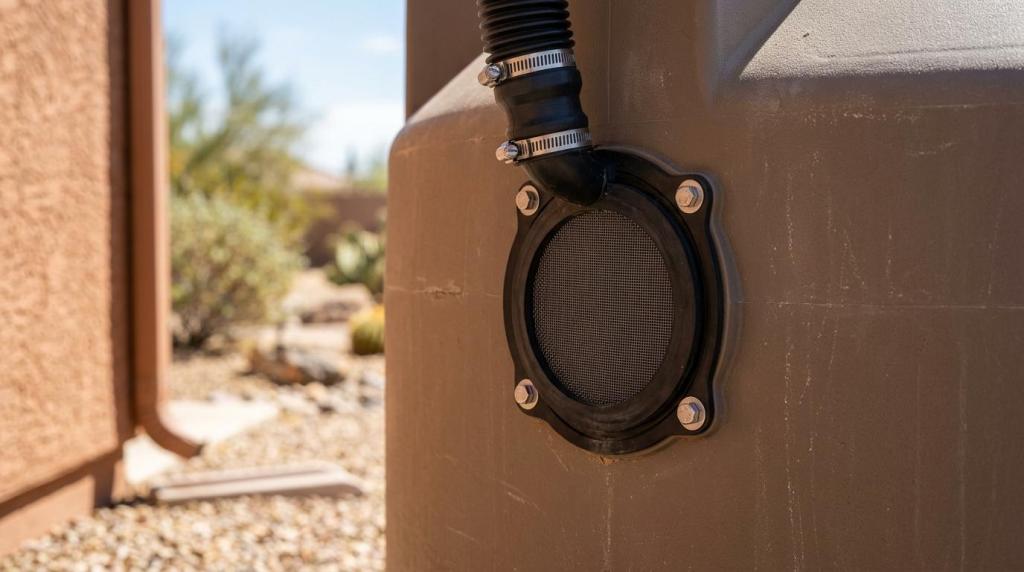
Southern Arizona Rain Gutters also installs sealed, UV-protected tanks with screened openings, which is a big deal in the desert. Keeping out light helps control algae growth, and screened access points help keep mosquitoes out. On properly sealed cisterns, you are not depending on chlorination just to deal with light-driven algae issues.
Maintenance stays straightforward. Southern Arizona Rain Gutters generally recommends spraying the inside of a cistern with a hose about once a year, or when the tank is empty, to clear out any sediment that has collected over time.
Gutters, downspouts, K-Style profiles, and fascia wrap that improve rainwater collection
A cistern only works as well as the collection system feeding it. Southern Arizona Rain Gutters installs seamless aluminum and copper rain gutters, including K-Style profiles, along with downspouts and fascia wrap so the roof edge, drainage path, and storage all work as one system.
That gives you two benefits at once. You get cleaner, more controlled roof runoff into the cistern, and you improve day-to-day drainage around the home when there is more rain than you want to store.
Southern Arizona Rain Gutters offers multiple gutter colors and materials, including aluminum with long-lasting finishes and copper with patina options. If you are already investing in your home, it makes sense to match the gutter system to the house instead of adding a tank to aging or undersized gutters that were never set up for collection.
Southern Arizona Rain Gutters helps homeowners and property managers across the Tucson area
Some projects are about water conservation. Some are about stopping nuisance runoff. A lot of them are both. Southern Arizona Rain Gutters installs cistern systems for homeowners in Tucson, Vail, Marana, Oro Valley, Sahuarita, Green Valley, Nogales, Rio Rico, Sonoita, and 3-Points, as well as commercial and managed properties that need a more deliberate rainwater plan.
Rainwater harvesting can work on small residential landscapes and on larger properties too. The right system depends on your roof area, where the tank can sit, how you want overflow handled, and how much stored water you actually want available after a storm.
Southern Arizona Rain Gutters is a good fit when you want a real collection system instead of piecing together barrels and adapters from different places. It is also a good fit if you want one local company to handle the gutters, cistern connections, and storage planning with Southern Arizona weather in mind.
What you can expect from a Southern Arizona Rain Gutters cistern project
Southern Arizona Rain Gutters keeps the process practical. We start with the roof and the site, because that tells us more than a catalog ever will.
Here is what usually gets worked out early in the project:
- Roof and runoff review: We look at the roof sections, gutter runs, downspout locations, and where water naturally wants to go during a storm.
- Storage and placement: We help match the property to the right cistern type, whether that is a smaller above-ground tank or a larger steel culvert installation.
- Feed and overflow details: We plan how water enters the cistern, where overflow goes when the tank is full, and how the system can be cleaned and maintained.
- Installation path: If you want full installation, Southern Arizona Rain Gutters handles that. If you are taking on part of the project yourself, we also offer parts for DIY pickup.
That early planning helps answer the questions most property owners care about. Will it fit the site? Will it handle monsoon rainfall? Will it be manageable to maintain? And if a rebate is part of the plan, are you following the right sequence from workshop to approval to installation?
Southern Arizona Rain Gutters also offers flexible payment plans, which can make a larger cistern or integrated gutter-and-storage project easier to move forward without cutting corners on the system design.
If you are ready to capture roof runoff with a cistern system that fits your property, talk with Southern Arizona Rain Gutters about your roof area, storage goals, and rebate considerations. We will help you sort out the right tank, the right collection setup, and the right next step for your Tucson-area home or property.
Questions About Cistern Installation in Southern Arizona
Do I need a permit to install a cistern in Tucson?
For most above-ground rainwater harvesting tanks in Arizona, a permit is not required. However, requirements can vary depending on tank size, placement, and whether the system involves any structural work. If your project includes a larger steel culvert cistern or site grading for overflow, it is worth confirming with your local jurisdiction before installation begins. Southern Arizona Rain Gutters can help you understand what applies to your specific project.
Can a cistern system work on a flat or low-slope roof?
Yes, though the collection efficiency depends on how well your gutters and downspouts are set up to move water off that roof type. Flat and low-slope roofs can still shed meaningful volume during a monsoon storm, but the gutter layout and downspout placement need to account for slower drainage. We look at your actual roof geometry during planning so the collection side of the system matches what the tank is being asked to hold.
What happens to the water in the cistern if I do not use it between storms?
A properly sealed and UV-protected tank significantly slows the conditions that cause water to degrade. Screening keeps out debris and mosquitoes, and blocking light limits algae growth without relying on chemical treatment. That said, stored rainwater is best used for irrigation rather than drinking, and during extended dry stretches between monsoon storms, you may want to draw the tank down rather than letting water sit for months at a time.
Is my roof material going to affect the quality of water I collect?
It can. Asphalt shingles, tile, and metal roofing each introduce different potential contaminants into collected water, ranging from mineral residue to granule runoff. For irrigation and landscaping purposes, roof material is rarely a dealbreaker, but it is a factor worth knowing. First-flush diverters, which redirect the initial runoff that carries the most surface debris before it reaches your tank, are one option for improving collection quality regardless of roof type.
How does a cistern system hold up through Tucson winters and dry seasons?
Southern Arizona's winters are mild enough that freeze damage to above-ground tanks is generally not a concern at Tucson elevations. The bigger consideration is the long dry season between spring and the summer monsoon. During that stretch, whatever is in the tank at the end of the rainy season is what you have until the rains return. Sizing the system around your actual dry-season irrigation needs, rather than just maximizing storage, tends to give you a more useful setup.
Can I add a cistern to an existing gutter system, or does everything need to be replaced?
It depends on the condition and layout of what is already there. If your gutters and downspouts are in good shape and positioned where collection makes sense, they may only need minor modifications to route water toward the cistern. If they are undersized, aging, or poorly placed for collection, it makes more sense to address that as part of the same project. We assess the existing system during planning so you are not investing in storage that a marginal collection setup cannot reliably fill.