ES
ES 
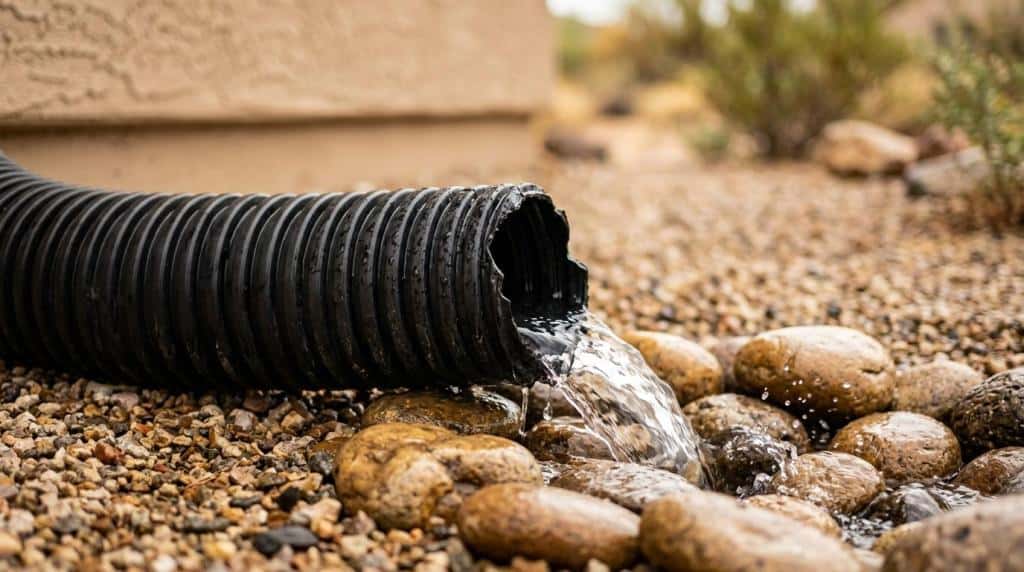
Foundation erosion usually starts higher up than most people think. In Tucson, I’ve seen plenty of homes with cracking at a corner, washed-out soil under a drip line, or muddy splash marks on stucco, and the real problem was roof runoff with nowhere good to go.
That makes sense in Southern Arizona. We go through long dry stretches, the soil gets hard, and then monsoon season shows up with a fast, heavy burst of water. If that water drops right next to the house, it can soften soil, cut little channels, stain walls, and slowly work against the foundation.
A good drainage setup does two things at once: it keeps water from pounding the soil beside the house, and it moves that water to a place where it can drain safely or be stored in cisterns for later use. That’s the whole game.
Why Tucson roof runoff causes foundation erosion
A roof collects a surprising amount of water, even in the desert. When that water comes off one edge, one valley, or one scupper, it gets concentrated into a narrow strip of ground. That concentrated flow is what starts the damage.
On a house without gutters, the runoff falls straight down and hammers the same area storm after storm. On a house with undersized gutters or too few downspouts, the system can overflow in a monsoon and do almost the same thing. Either way, the soil at the base of the house gets more water than it should.
Tucson adds a few local twists. Sun damage breaks down cheap sealants and brittle plastics. Blowing dust builds up in gutters and underground drains. Some lots have clay-heavy soil that stays wet longer than you’d expect, while others have sandy pockets that wash out quickly. A drainage plan has to account for all of that, not just average rainfall.
Flat roofs need extra attention too. When a flat roof drains through scuppers, the water often shoots out with force. If there’s no scupper box, leader head, or controlled downspout path, that discharge can hit one spot beside the house and dig it out fast.
Warning signs of poor drainage around the foundation
Most drainage issues are visible before they become expensive structural repairs. The trick is knowing what to look for after a storm and not brushing it off as normal.
If you walk the perimeter after a monsoon and see soil movement, splash marks, standing water, or stains, the house is telling you something.
- Soil trenches below roof edges
- Splash-back marks on stucco
- Exposed footing or shallow voids near corners
- Downspouts dumping right at the slab edge
- Ponding water that stays for hours
- Cracks near doors, windows, or stem wall corners
One sign by itself does not always mean foundation trouble. A few signs together usually mean the drainage is overdue for correction.
Gutter system features that prevent soil washout
The gutter itself is only part of the system. What matters is the profile, the size, the slope, the hanger spacing, and where the downspouts discharge. I tell homeowners this all the time: a gutter that catches water but dumps it at the wrong spot has not solved much.
For most Tucson homes, seamless aluminum gutters are a solid choice because they hold up well in heat and don’t have a seam every few feet waiting to leak. Copper can be a beautiful long-term option too, especially on custom homes, but the same drainage rules still apply no matter what material you choose.
K-Style is the profile I see most often on residential work because it handles a good amount of water and fits the look of many homes here. Half-round and European box profiles also have their place, mostly when the design of the house calls for them. The best profile is the one that matches the roof runoff and the architecture, not just the one that looks nice from the street.
Fascia condition matters more than people realize. If overflow has already been running behind the gutter, the fascia board may be taking damage from both water and sun. Fascia wrap can help protect that trim and give the new gutter a cleaner, more durable mounting surface.
Here’s a simple way to look at the parts that matter most:
| Gutter system part | Why it matters for foundation erosion | Tucson-specific note |
|---|---|---|
| Gutter size | Prevents overflow during heavy bursts | Many homes do better with 6-inch gutters than 5-inch in monsoon-prone areas |
| Profile | Affects capacity and appearance | K-Style is common and practical for many residential roofs |
| Proper slope | Keeps water moving to outlets | Too little slope leaves standing water and debris |
| Downspout size | Controls how fast water leaves the gutter | Small downspouts can back up during intense storms |
| Hanger spacing | Keeps gutter from sagging under storm load | Heat and sudden water load can expose weak support |
| Fascia wrap | Protects trim behind the gutter | Helpful where sun and past overflow have worn the fascia |
Gutter size and downspout placement for monsoon flow
A lot of erosion problems come from simple undersizing. If one roof plane is large, or a valley pushes everything to one corner, a small gutter and one little downspout may not keep up. That is why larger 6-inch systems, bigger downspouts, or extra outlets often make sense here.
Placement matters just as much. Downspouts should be located where they can move water away from the foundation without creating a new low spot or flooding a walkway, courtyard, or neighbor-facing wall.
Downspout discharge options that move water away from the house
This is where many systems fail. The gutter works, the downspout works, and then the water gets dropped one foot from the house. You’ve controlled the roof, but not the drainage.
The discharge point should send water to a safe outlet. That may be daylight on a slope, a rock-lined drainage area, an underground pipe run, or a rainwater harvesting tank with a planned overflow path. The right choice depends on the lot and the soil.
The options usually look like this:
- Splash block: Better than nothing, but often too short for monsoon flow or clay-heavy soil
- Downspout extension: A simple fix when you need to move water farther from the stem wall
- Underground drain line: Clean look, good for tight side yards and patios, needs proper slope and a clear outlet
- Cistern connection: Captures roof runoff for irrigation and reduces discharge volume
- Rock outlet pad: Helps slow water at the end of a pipe and reduces scour
If a home has a harvesting setup, the overflow path has to be treated as part of the design, not an afterthought. A full cistern during a storm still needs to release water somewhere safe. I’ve seen good tanks cause bad erosion simply because the overflow dumped right at a corner.
Grading and surface drainage near the foundation
Gutters are the first line of defense, but they are not the only one. The soil around the house needs to fall away from the foundation so runoff keeps moving instead of sitting there. A common target is about 6 inches of fall within the first 10 feet where the lot allows it.
That sounds simple, but landscaping often works against it. Gravel beds settle. Irrigation creates low spots. New pavers get installed a little too high near the house. A decorative berm gets built in the wrong place and suddenly water is trapped against the stem wall.
On homes where the yard layout is tight, a shallow swale or an area drain may be needed to catch water and steer it away. In some cases, especially on an uphill side yard, a French drain or interceptor drain can help with shallow subsurface water that lingers near the foundation.
One caution I always give Tucson homeowners: don’t assume that because the soil looks dry most of the year, it drains well. Some desert soils shed water fast at the surface and then hold it in the wrong spot.
Drainage solutions for flat roofs and enclosed yards
Flat-roof homes are common in Southern Arizona, and they can put out a lot of water through a small number of openings. When scuppers discharge hard against bare soil, the damage can show up fast.
That is where scupper boxes, header boxes, and properly sized downspouts earn their keep. They capture that concentrated roof flow and put it into a controlled drainage path instead of letting it blast the ground below.
Enclosed courtyards and narrow side yards bring a different problem. Water has fewer escape routes. If there’s a wall, gate, or raised planter boxing the space in, an underground drain line or area drain may be the cleanest fix. In those spots, a visible downspout extension can become a trip hazard, so the drainage plan has to fit how the space is actually used.
Best drainage choices for common Southern Arizona home conditions
No single setup fits every property. Roof shape, soil type, yard slope, and how much space you have all change the answer.
Here’s a practical guide homeowners can use:
| Home condition | Best drainage move | Main thing to avoid |
|---|---|---|
| Slab home with no gutters | Add seamless gutters and move discharge away from slab edge | Letting roof water free-fall beside exterior walls |
| Flat-roof home with scuppers | Use scupper boxes and direct flow into downspouts or drains | Leaving scupper discharge to hit one bare spot |
| Tight side yard | Underground drain line tied to downspouts | Short splash blocks that create ponding |
| Yard with clay-heavy soil | Focus on surface drainage and positive grade away from house | Dumping water where it can soak slowly beside the foundation |
| Home set up for water conservation | Tie gutters into cisterns with screened inlets and overflow planning | Forgetting the overflow route during big storms |
| Sloped lot | Controlled outlet with rock protection or pipe to daylight | Allowing runoff to cut channels down the slope |
Pre-monsoon gutter and drainage checks for homeowners
The best time to fix drainage is before the first hard summer storm, not after you see washed-out soil by the patio. A quick inspection once or twice a year can catch most of the common issues.
Walk the house after a rain if you can. That tells you more than any guess from a dry-day view.
- Check gutters: Look for sagging runs, standing water, loose hangers, and corners that overflow
- Check downspouts: Make sure every one is connected, clear, and sending water well away from the house
- Check grade: Fill low spots where water settles near the stem wall or slab edge
- Check outlets: Inspect underground drain exits, splash areas, and rock pads for clogging or washout
- Check scuppers and flat-roof drains: Clear debris so water does not spill where it should not
- Check harvesting systems: Clean screens, confirm the cistern overflow route, and keep openings sealed against mosquitoes and algae
If you do those checks and still see erosion, the fix is usually not bigger landscaping. It’s better water control from the roofline down. That is what protects the foundation, the stucco, and the ground your house is sitting on.
Questions Homeowners Often Have About Drainage and Foundation Protection
How long does it typically take for poor drainage to cause structural foundation damage?
It depends heavily on soil type, storm frequency, and how concentrated the runoff is. In some cases, visible soil washout starts within a single monsoon season, but actual structural movement usually takes years to develop. The more immediate risks are cosmetic damage to stucco, wood trim, and painted surfaces. That said, once soil under or beside a foundation starts shifting, repair costs climb quickly. Catching the drainage problem early costs far less than addressing what comes after it.
Does decomposed granite or gravel landscaping around a home help with drainage or make it worse?
It depends on how it's installed. A thin layer of decomposed granite over undisturbed soil can actually shed surface water fairly well. The problem comes when gravel settles and creates a bowl effect near the house, or when it gets packed down and compacted over time so water pools rather than moves. Gravel also doesn't slow down the initial impact of roof runoff the way planted groundcover can. If the grade underneath isn't sloping away from the house, the material on top won't fix that.
Can drainage be improved without replacing existing gutters?
Often, yes. If the gutters themselves are intact and sized appropriately, adding extensions, repositioning downspout outlets, or tying into an underground drain line can fix the problem without a full replacement. Poor discharge location is behind a lot of erosion issues, and that can sometimes be corrected with relatively minor changes. Where gutters are undersized, sagging, or leaking at seams, combining the discharge fix with an upgrade usually makes more sense than patching around a failing system.
Is foundation erosion damage typically covered by homeowner's insurance?
Generally, no. Standard homeowner's policies exclude damage from surface water, flooding, and gradual water intrusion, which is the category that drainage-related foundation erosion falls into. Coverage is more likely to apply when there's a sudden and accidental event like a pipe burst. Damage that develops over time from repetitive storm runoff is usually treated as a maintenance issue rather than a covered loss. Separate flood insurance also may not apply since this type of erosion isn't the same as rising floodwater.
What is the difference between cosmetic soil erosion and actual foundation movement?
Cosmetic erosion shows up as splash marks, surface trenches, and staining, but the structure itself is unaffected. Foundation movement is a different issue and usually shows up inside the house: doors and windows that stick or no longer close cleanly, visible cracking at wall corners or above window frames, or gaps forming between walls and ceilings. A crack in stucco on the exterior is not always a sign of structural movement, but a crack that runs from a window corner at an angle, or that has grown over time, is worth having assessed by a structural engineer rather than just a contractor.
Do tree roots near the foundation contribute to drainage problems?
They can go either direction. Roots from mature trees draw moisture out of the soil and can actually help dry out areas that would otherwise stay wet. But invasive roots can also crack drain lines, lift pavers, and disrupt the graded slope near the house. In Tucson, mesquite and palo verde roots tend to spread wide and shallow, which can shift gravel beds and surface grade over time. When an underground drain line is part of the drainage plan, root intrusion is worth considering when choosing where to route it and what pipe material to use.