ES
ES 
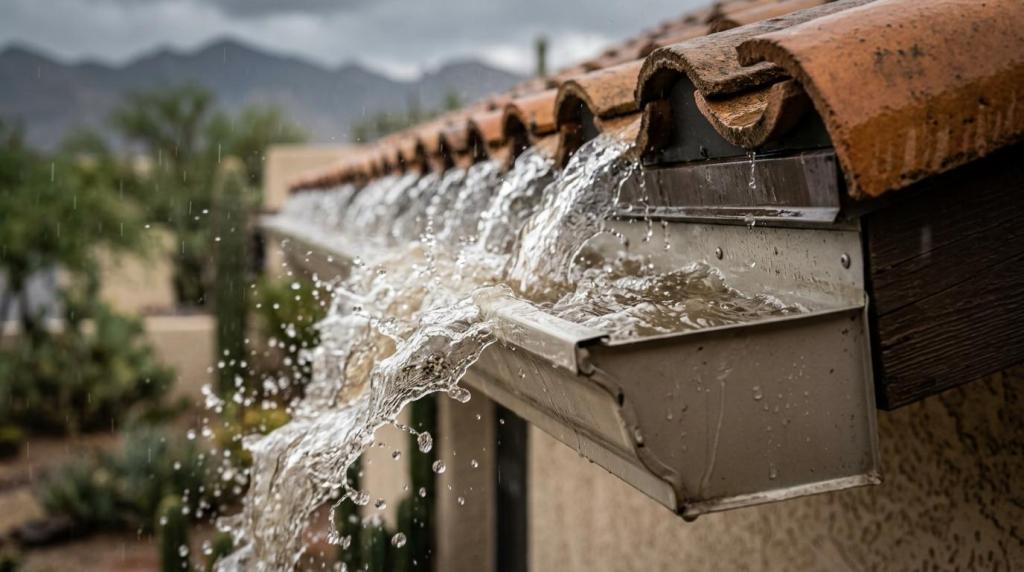
If you are picking gutters for a Tucson home, this choice comes up all the time: do you go with the rounded profile that looks classic, or the more common profile that handles a lot of water and mounts easily to the fascia board?
Most homeowners are really balancing three things at once. They want the house to look right, they want the system to hold up through monsoon season, and they do not want to be up on a ladder dealing with clogged gutters every few months. Here in Southern Arizona, that balance matters more than people think. We do not get long stretches of steady rain, but when a storm hits, roof runoff can come fast and hard.
The short version is simple. K-Style is usually the better default if water handling is the top priority. Half-round often wins on appearance and easier cleaning, especially on traditional homes. The best answer depends on your roof, your fascia, and whether you want to tie the system into rainwater harvesting.
Half-round and K-Style gutter profiles explained
These two profiles do the same job, but they look and behave differently.
A half-round gutter is exactly what it sounds like. If you cut a pipe in half lengthwise, that is basically the shape. It has a smooth, curved interior and a softer look from the street. On older homes, custom homes, and certain architectural styles, that rounded profile just fits better.
A K-Style gutter has a flat back and a shaped front that looks a little like crown molding. That flat back is one reason it is so common on residential homes. It sits against the fascia board well, and it is straightforward to install on many houses built in the last several decades.
The shape also affects performance. K-Style gutters usually carry more water than half-round gutters of the same nominal width. Half-round gutters are usually easier to rinse out and clean because they do not have the inner corners that tend to trap grit and debris.
| Factor | Half-round gutters | K-Style gutters |
|---|---|---|
| Appearance | Traditional, softer lines | More common, sharper profile |
| Water capacity | Usually lower at the same size | Usually higher at the same size |
| Cleaning | Easier because of smooth interior | Can trap debris in corners |
| Installation | Often needs brackets or hangers | Flat back mounts easily to fascia |
| Typical home fit | Historic, custom, architectural homes | Standard residential homes |
| Cost trend | Can run higher depending on brackets and material | Often the more budget-friendly option |
Water capacity during Tucson monsoon season
In Tucson, annual rainfall numbers do not tell the whole story. What matters for gutters is storm intensity. A roof can stay dry for weeks, then dump a heavy sheet of runoff in ten minutes during a monsoon cell. That is when undersized gutters show you their limits.
This is where K-Style often gets the nod. Because of the profile, it generally moves more water than a half-round of the same labeled size. If a homeowner has a big roof plane, steep pitch, tile roofing, or strong valleys that concentrate runoff, K-Style is often the safer starting point.
Style alone does not decide this, though. Roof size, roof pitch, valley layout, and downspout sizing matter just as much. A well-sized half-round system can work fine on the right home, and a poorly sized K-Style system can still overflow.
When we look at a Tucson house, these are usually the main capacity questions:
- Roof area: Larger collection areas dump more water into each gutter run
- Roof pitch: Steeper roofs move runoff faster
- Valleys: Two roof sections meeting in one point can overload a small gutter
- Tile roofing: Water can come off unevenly and hard during storms
- Downspout size: A bigger gutter still needs enough exit capacity
A lot of homes do well with 5-inch gutters. Some need 6-inch gutters and larger downspouts, especially if the roof is steep or the runoff is concentrated. If you are also sending water to cisterns, sizing gets even more important because you want the system to capture water cleanly, not lose it over the front edge.
Maintenance and cleaning differences between gutter styles
Half-round gutters have a real advantage here.
Because the inside is curved and smooth, debris has fewer places to catch. In Tucson, that matters. We get dust, seed pods, palo verde leaves, mesquite litter, roofing grit, and the occasional bird nest material. In a half-round, a lot of that stuff is easier to flush out. If a homeowner likes to hose out the system a few times a year, half-round is often the simpler profile to maintain.
K-Style gutters can collect debris in the bottom corners. That does not make them a bad choice. It just means they usually need a little more attention if the house has overhanging trees or if the roof drops a lot of grit. On the plus side, if the system is sized correctly and pitched correctly, K-Style still performs very well in our climate.
Common gutter debris in Southern Arizona includes:
- palo verde leaves
- mesquite pods
- roof granules
- dust and silt
- bougainvillea litter
- bird nesting material
Cleaning habits matter more than style for lifespan. A neglected gutter of any profile will hold wet debris, stain faster, and stress the hangers during storms.
Installation details, fascia boards, and Arizona sun exposure
K-Style gutters are often easier to install on standard fascia boards because of the flat back. On many Tucson homes, that is a practical advantage. The profile sits cleanly against the fascia, and that makes layout and hanger placement pretty efficient.
Half-round gutters usually need external brackets, straps, or specialty hangers. That can look great on the right house, especially if the architecture is older, more detailed, or meant to show the gutter instead of hiding it. It also means installation details matter a bit more. The bracket spacing, outlet placement, and roof edge relationship all have to be right.
Arizona sun is rough on every exterior product. Sealants, finishes, and plastic parts all take a beating over time. That is why material choice matters as much as gutter shape. Seamless aluminum is a very common fit here because it gives you long continuous runs, solid color options, and less maintenance than many homeowners expect. Copper half-round gutters look excellent on the right home, but they are usually chosen more for appearance and longevity than budget.
If the fascia is already worn, gutter installation may also include fascia wrap or repairs. That step often gets missed in early budgeting, but it matters. Gutters are only as solid as the trim they are fastened to.
Cost differences between half-round and K-Style gutters
Most of the time, K-Style comes in as the more practical choice on price, especially in aluminum. It is common, the components are easy to source, and the installation is usually more direct on standard residential fascia.
Half-round can be close in price on some projects, but it often climbs when you factor in brackets, specialty accessories, and premium materials. If a homeowner wants copper half-round with decorative hangers, that is a very different budget than aluminum K-Style in a common color.
The gutter profile is only one part of the price. The layout of the house can swing the cost just as much as the style.
A few of the biggest cost drivers are:
- Material: Aluminum is common; copper costs more
- Size: 6-inch systems cost more than 5-inch systems
- Access: Two-story and hard-to-reach areas take more labor
- Fascia condition: Rotten or damaged boards need work before installation
- Harvesting tie-ins: Cistern connections, diverters, and filtration add parts and labor
That is why a simple price-per-foot number only tells part of the story. On one house, a half-round system may be only a modest jump. On another, it may be a clear premium choice.
Which gutter profile looks better on different home styles
This is where half-round really makes its case.
If the house has historic character, exposed rafter tails, masonry detailing, or a softer architectural style, half-round gutters often look more natural. The shape does not fight the lines of the home. It reads as intentional instead of purely functional.
On many ranch homes, tract homes, and newer builds, K-Style looks right because it matches the sharper trim details and standard fascia layout. A lot of homeowners barely notice it once it is installed, which is exactly what they want.
There is also a middle ground. Some custom homes can go either way, especially if the owner wants a clean exterior but still wants a little architectural character. In those cases, the roofline and fascia details usually decide it.
If appearance is the main driver, stand in the street and look at the trim details. If the home has crisp lines, K-Style usually fits. If the home has curved or traditional details, half-round often feels more at home.
Rainwater harvesting with half-round and K-Style gutters
Both profiles can work with rainwater harvesting systems. The real question is whether the system is sized and laid out correctly for the amount of roof runoff.
In Tucson, that matters because harvested rain can go a long way in the landscape. Trees, desert-adapted planting beds, and seasonal garden areas all benefit from stored roof runoff. If you are feeding above-ground tanks or larger cisterns, the gutter system has to collect water reliably during short, intense storms.
K-Style often makes sense for harvesting because it usually gives you more carrying capacity. That can help when a big roof is feeding a tank system during a monsoon downpour. Half-round still works well on many homes, especially if the collection area is moderate and the homeowner wants the traditional look.
A good harvesting setup usually includes:
- screened inlets
- sealed, UV-protected storage
- proper overflow routes
- downspout filters where needed
- tank placement that makes maintenance realistic
If you are collecting water, do not look at the gutter in isolation. Think about the whole path, from roof edge to downspout to cistern, and where overflow goes when the tank is full.
How to choose the right gutter profile for your home
If a homeowner asks me which profile to choose without seeing the house, I usually say K-Style is the safer default. It handles water well, it mounts easily, and it fits most homes in Southern Arizona.
If the house has traditional architecture, or if easier cleaning and appearance matter more than maximum capacity, half-round is worth a serious look. It is not just a decorative option. On the right house, it is a very solid working gutter.
A practical way to decide is this:
- Look at the roof first: Size, pitch, valleys, and tile matter more than many people expect.
- Look at the fascia next: Flat, standard fascia often points toward K-Style; specialty details may suit half-round.
- Decide what matters most: Water capacity, cleaning ease, architectural fit, or tying into cisterns.
- Match the size to the roof: A 5-inch system works on many homes, but some roofs need 6-inch gutters and larger downspouts.
If both profiles would work, let the house break the tie. If the home is telling you it wants a softer, older look, half-round can be the right call. If the roof throws a lot of water and the goal is straightforward performance through monsoon season, K-Style usually earns its spot.
Questions homeowners ask before choosing a profile
Can I switch my home from K-Style to half-round gutters, or the other way around?
In most cases, yes, and the natural time to do it is when you replace an aging system. The thing to plan around is the mounting hardware, since each profile hangs differently. Moving from K-Style to half-round usually means new brackets rather than reusing the old fascia-mounted hangers, and the existing downspout locations may or may not line up with the new layout. Because of that, a profile change is best treated as a full replacement rather than a partial swap.
Are half-round gutters available seamless the way aluminum systems often are?
Seamless runs are most commonly associated with the flat-backed style, while half-round is often installed in sections joined at the seams and outlets. Some half-round can be formed in longer lengths, but the rounded shape and bracket mounting mean the joints are handled differently than on a flat profile. If seamless construction is a priority for you, it is worth raising early so the profile and material can be matched to that goal from the start.
Do gutter guards or leaf screens work with both profiles?
Guards are made for both, but the selection is not identical. The flat top edge on the more common profile is what most standard screen products are built around, so choices tend to be broader there. Half-round guards exist as well, though the curved opening sometimes calls for profile-specific products. Keep in mind that in our dusty climate, fine material like roof grit and silt can still work past many guards, so they tend to reduce cleaning frequency rather than remove the need for it entirely.
Is one profile a better choice for a two-story home?
Neither profile is off-limits on a two-story house. What matters more is safe access for future cleaning and how much runoff the upper roof concentrates. Since half-round is easier to rinse out, some homeowners lean toward it on hard-to-reach upper runs to cut down on hands-on cleaning at height. If capacity is the real concern on a large upper roof plane, a correctly sized flat-profile system still tends to be the stronger performer.
Can I use half-round on one part of the house and K-Style on another?
You can, and it occasionally makes sense. A homeowner might want half-round across a visible front elevation for the look and the flat profile along the back where capacity or budget carries more weight. The trade-off is a slightly less uniform appearance at close range and two sets of components to keep up with over time. If you take this route, matching the color and downspout style helps the two profiles read as one cohesive system from the street.