ES
ES 
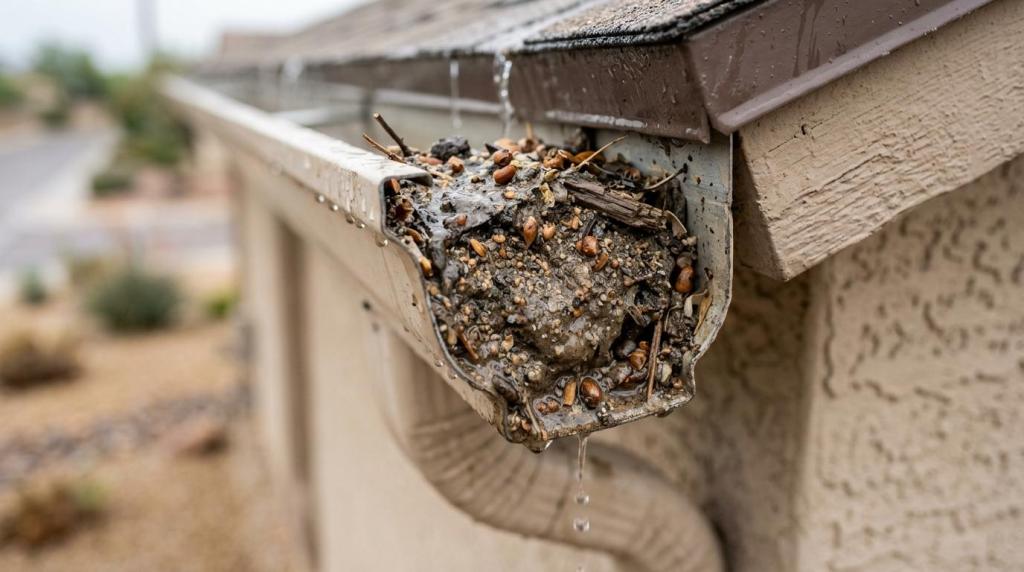
If you own a home in Arizona, gutter cleaning usually is not a once-and-done yearly chore. For most houses in Tucson and across Southern Arizona, a good rule is twice a year, plus a quick check after major monsoon storms.
That answer surprises some homeowners.
Arizona looks dry most of the year, so it is easy to assume gutters do not get very dirty here. Then monsoon season shows up with hard rain, high winds, dust, seed pods, and shredded leaves, and suddenly a gutter that looked fine in May is spilling water over the front walk in July. I see that pattern all the time on homes with K-Style gutters, half-round profiles, and even newer systems that were installed correctly.
If your property has mesquite, palo verde, pine, eucalyptus, or heavy roof debris from nearby trees, the cleaning schedule usually needs to be tighter. If you collect rainwater into barrels or cisterns, maintenance matters even more because now you are not just protecting fascia and stucco. You are also protecting water quality.
Arizona gutter cleaning schedule for most homes
For many Arizona homes, the safest schedule is simple: clean once before monsoon season and inspect again after monsoon season, with a second cleaning if debris has built up.
Arizona’s monsoon season runs from June 15 through September 30, and in Southern Arizona the first real summer storms often start showing up in late June or early July. That gives homeowners a clear maintenance window. If your gutters are packed with leaves, roof grit, and bird nest material before those storms arrive, the system cannot move water the way it should.
A lot of homes can get by with one full cleaning and one inspection. Many others need two cleanings every year. The difference usually comes down to tree cover, roof design, and whether the gutters feed into a harvesting setup.
| Home condition | Typical gutter schedule | Extra checks |
|---|---|---|
| Minimal trees, simple roofline | Clean once a year, inspect after monsoon | Check after any big summer storm |
| Moderate tree debris | Clean twice a year | Spot-check valleys and downspouts |
| Heavy tree cover | Clean every 3 to 6 months | Check after wind events |
| Rainwater harvesting system | Clean gutters and screens twice a year | Inspect overflow routes and connections after storms |
That table is a starting point, not a rigid rule. One house in Oro Valley may only need a light cleaning once a year, while another in older central Tucson with mature trees may need much more attention.
Why Arizona gutter debris is different
Arizona debris does not always look like the soggy leaf sludge people picture in wetter climates. Here, a lot of the buildup is dry and light until rain hits it. Dust, grit from shingle roofs, blossoms, seed husks, and small twigs can sit in a gutter for months. Then one strong storm turns that loose material into a heavy, muddy blockage.
The sun is part of the problem too. UV exposure dries organic debris into a crust that sticks to the gutter bottom. It can bake onto aluminum gutters and around seams, outlets, and end caps. Once that happens, water starts flowing around the blockage instead of through the downspout.
Wind matters just as much as rain during monsoon season.
A hard gust can load one side of a house with leaves and roof litter in a single afternoon. So even if your annual rainfall is not huge, your rain event intensity can still be rough on gutters. That is why Arizona homeowners should think less about yearly rainfall totals and more about sudden storm behavior.
After a few years in the field, you start to notice the same trouble spots over and over:
- Roof valleys
- Downspout outlets
- Behind chimney crickets
- Areas below overhanging trees
- Corners where mud settles
Best times to clean gutters before and after monsoon season
The most practical time for the first cleaning is late spring to early summer, before monsoon storms get rolling. In Tucson, that usually means sometime between April and early June. You want the gutters open and the downspouts flowing before the first heavy cells move through.
The second key window is right after monsoon season, usually in early fall. Even if the gutters do not look terrible from the ground, a post-monsoon inspection catches washed-in sediment, separated downspout connections, and signs of overflow.
If you only do one cleaning all year, do not skip that pre-monsoon timing.
A lot of overflow damage in Arizona is not caused by old gutters. It is caused by gutters that were simply too full when the storm hit. Water pours over the front lip, runs behind the fascia, stains stucco, splashes against the foundation, and carves out landscaping below. On homes with fascia wrap, that trapped moisture can also shorten the life of trim details if it keeps happening.
Post-storm gutter checks during Arizona monsoon season
Even clean gutters need quick inspections after a major storm. Monsoon storms can dump rain fast, and they can come with hail, dust, high winds, and flash flooding conditions. A system that handled a normal shower may struggle during one of those bursts.
You do not need to climb a ladder after every storm. Often a simple ground-level check tells you plenty. Look for water marks on stucco, splashout near the base of downspouts, sagging sections, or runoff cutting through gravel beds.
After a strong storm, check these areas first:
- Downspout connections: make sure elbows and outlets did not loosen
- Overflow routes: see where excess water actually went
- Gutter slope: watch for standing water the next day
- Screened inlets: remove packed leaves, blossoms, or mud
- Fascia areas: look for fresh staining or peeling paint
Homes with rainwater harvesting systems need more gutter maintenance
With rainwater harvesting setups, the maintenance standard needs to be higher. A harvesting system does not just move roof runoff away from the house. It collects it for later use. That means cleaner gutters, cleaner strainers, and better screening.
For most harvesting setups, cleaning twice a year is a smart baseline. That includes the gutters themselves, visible screens, and strainers. After major storms, it also helps to check downspout connections and overflow routes so the water goes where the system was designed to send it.
This is especially important in Southern Arizona because heat and sunlight can make small maintenance problems get worse fast. A torn screen, loose lid, or failed seal on a tank can lead to algae growth, mosquito access, or debris entering the cistern. On systems with sealed, UV-protected tanks, annual checks of caps, seals, and mosquito barriers help keep the stored water in better shape.
A few parts deserve regular attention on any collection system:
- First-flush components: clear out trapped sediment
- Cistern inlets: confirm screens are intact
- Tank lids and caps: keep them sealed against light and pests
- Overflow piping: make sure overflow exits away from the house
- Leaf baskets and strainers: clean before they restrict flow
If you have invested in a larger system, whether that is a compact barrel setup or steel culvert cisterns holding several thousand gallons, routine cleaning protects that investment. Dirty gutters can send roof grit and organic debris straight into storage, and then every later step gets harder.
Signs your Arizona gutters need cleaning sooner
A fixed calendar is helpful, but your house may tell you sooner.
I tell homeowners to pay attention to performance, not just dates. If the gutter system is doing its job, water should move quickly to the downspouts and away from the home. When that changes, it usually means buildup, poor slope, or a loose section.
Watch for these common warning signs:
- Water spilling over the front edge
- Staining on stucco or fascia
- Plants growing in the gutter
- Birds nesting near downspouts
- Gravel trenches washing out below discharge points
- Water sitting in sections a day after rain
Sagging matters too. Even a well-supported aluminum gutter can start to dip if mud and wet debris stay in it too long. Good installations often use hangers or supports every two feet, but no support layout is meant to hold heavy debris forever.
What happens when gutters are left dirty in Tucson
The first issue most people notice is overflow. The less visible issues are the ones that cost more.
When water spills over clogged gutters, it often lands right where you do not want it: against stucco walls, around window trim, near entryways, and at the foundation line. On flatwork and patios, that overflow can leave mineral staining. As MMMBRO explains in its guide to salt efflorescence on masonry, those chalky surface films are typically soluble salts drawn out by migrating moisture after repeated wetting and drying. Around planting beds, it can erode soil and expose roots.
In Tucson, overflow also tends to expose weak grading around the house. If the yard already drains poorly, clogged gutters can dump a lot of water in one place very quickly. That can mean puddling near stem walls, muddy walkways, and moisture where the building envelope should stay dry.
With rainwater harvesting setups, the downside is larger. Dirty gutters lower water quality, clog strainers, and keep tanks from filling the way they should. In a desert climate where water conservation matters, losing usable runoff because of basic maintenance is frustrating and avoidable.
DIY gutter cleaning versus hiring help in Arizona
Some homeowners are comfortable cleaning gutters themselves, especially on a single-story house with easy access. Others would rather not deal with ladders, roof edges, power lines, or tile roofs that can crack under bad foot placement.
There is no shame in either choice.
If you do it yourself, focus on safety and inspection as much as debris removal. A quick flush with a hose helps confirm whether the downspouts are actually clear. It also shows where water may be escaping at seams or behind the gutter.
A professional visit usually makes more sense when the roof is steep, the house is two stories, the gutters tie into cisterns, or you suspect more than just debris. Sometimes what looks like a cleaning issue is really a pitch problem, a bad outlet location, or undersized profiles for the roof area.
A smart service call should do more than scoop leaves:
- Remove debris
- Flush and test flow
- Check hanger stability
- Inspect seams, outlets, and end caps
- Note any fascia or roof-edge issues
That last point matters. Cleaning is routine maintenance, but it is also an inspection chance. Catching a small separation in a downspout connection is a lot better than waiting until the next monsoon storm sends water behind the wall line.
For most Arizona homeowners, the practical plan is simple enough to remember: clean or inspect before monsoon season, check again after monsoon season, and tighten the schedule if your home has trees or a rainwater harvesting system. That keeps the gutters working, protects the house, and helps make the most of the rain we do get.
Questions Tucson Homeowners Ask About Gutter Cleaning
Do gutters in Tucson need cleaning outside of monsoon season?
Yes. Southern Arizona gets a second, quieter rainy season in the winter, roughly December through March, when Pacific storms move through. Those rains are gentler than summer bursts, but a channel packed with fall leaf drop and old dried debris can still back up during them. A quick check before the winter rains arrive keeps water moving and protects the roof edge and walls through the cooler, damper stretch of the year.
Will gutter guards or screens let me skip cleaning altogether?
Not entirely. Guards and screens reduce how much material drops into the channel, which helps a lot under trees like mesquite and palo verde. They are not maintenance-free, though. In Southern Arizona, wind-blown grit and fine organic material can build up on top of a screen or slip through the mesh, so guarded systems still need periodic clearing and a check that water is draining the way it should.
I just had new gutters installed. Do they already need cleaning?
It is worth a look sooner than you might expect. New installations often collect leftover roofing grit, small metal shavings, and dust that settle during and shortly after the work. A first inspection a few months in, ideally before the next storm season, confirms everything is draining and nothing was left behind. After that, your ongoing schedule comes down to the trees and roof around your home.
How long does a professional gutter cleaning usually take?
For a typical single-story Tucson home, a straightforward cleaning and flush often runs about one to two hours. Larger homes, two-story rooflines, steep pitches, or systems tied into cisterns take longer because there is more to reach and more to inspect along the way. If a crew spots a repair issue while they are up there, they will usually walk you through it rather than quietly fold it into the same visit.
Can dirty gutters attract pests around my Tucson home?
They can. Trapped debris and lingering moisture create the kind of damp, sheltered pockets that insects and small animals look for. In the Tucson area, that can include roof rats, which are drawn to overgrown greenery and cluttered roof edges, along with the usual ants and other insects. Keeping the gutters clear removes an easy nesting and water source close to the roofline, which is one more payoff beyond simple drainage.