ES
ES 
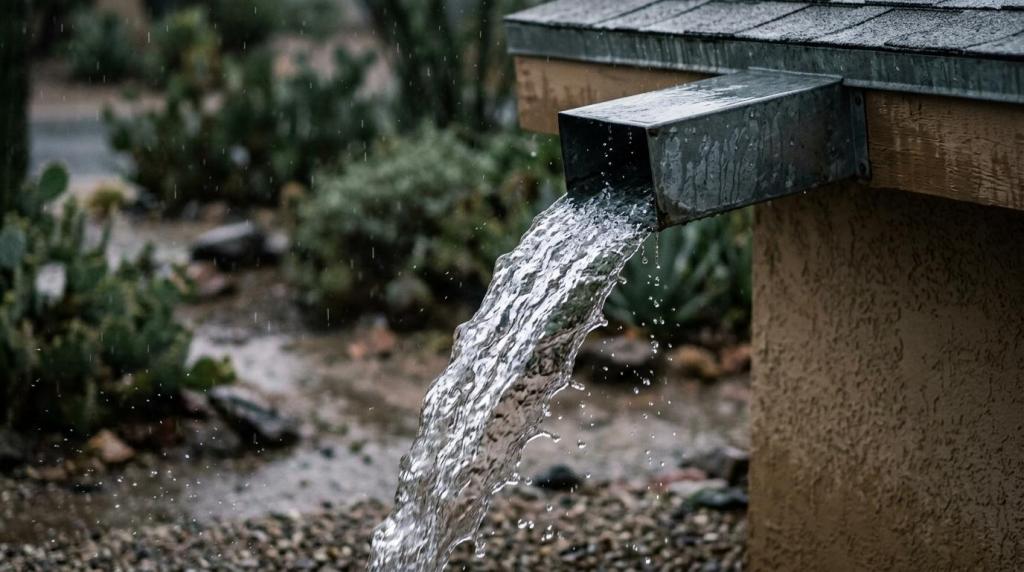
A roof can collect a lot more water than most people think, even here in Southern Arizona where we spend much of the year looking at blue sky and dry ground.
Then monsoon season shows up, and all that roof runoff has to go somewhere.
If you want a quick answer, the amount of rainwater you can collect depends on three things: your roof area, how much rain falls, and how efficient your setup is at getting that water from roof to storage. The simple math is easy. The real-world answer takes a little more thought, especially in Tucson where short, heavy storms can dump a lot of water in a hurry.
The basic roof rainwater collection formula
The standard estimate used in rainwater harvesting is:
roof collection area in square feet × rainfall in inches × 0.623 = gallons
That 0.623 number is the conversion factor. It comes from the fact that one inch of rain falling on one square foot equals 0.623 gallons. The University of Arizona Water Wise program uses this formula, and it is a solid place to start.
So if you have a 1,500 square foot collection area and your roof gets 15 inches of rain over the year, the math looks like this:
1,500 × 15 × 0.623 = 14,017 gallons
That is the gross amount hitting the roof area. It does not mean you will store every bit of it. Some water is lost to splash, first-flush diversion, gutter overflow, small leaks, debris buildup, and simple system inefficiency. A practical collection factor often falls in the 75% to 90% range, which is why a good estimate should include a little wiggle room.
Rainwater collection examples for Tucson-area homes
Here is where homeowners usually get interested. Once you put a few sample numbers on paper, the idea starts to feel real.
Tucson rainfall swings from year to year, so it helps to look at a range instead of pretending every year is the same. A dry year and a wet monsoon season can give you very different results. The table below uses common roof sizes and shows both gross yield and a more realistic usable yield at 85% efficiency.
| Roof collection area | Rainfall | Gross gallons | Usable gallons at 85% |
|---|---|---|---|
| 1,000 sq. ft. | 10 in. | 6,230 | 5,296 |
| 1,000 sq. ft. | 12 in. | 7,476 | 6,355 |
| 1,500 sq. ft. | 12 in. | 11,214 | 9,532 |
| 1,500 sq. ft. | 15 in. | 14,018 | 11,915 |
| 2,000 sq. ft. | 12 in. | 14,952 | 12,709 |
| 2,000 sq. ft. | 15 in. | 18,690 | 15,887 |
That surprises people all the time. Even a modest house can put thousands of gallons into a harvesting system over the course of a year. The bigger question is not just how much falls on the roof. It is how much you can actually capture, store, and use before the next storm arrives.
What changes your real-world rainwater yield
This is where the simple formula meets real life.
A roof may have plenty of catchment area, but the actual system still has to move water through gutters, downspouts, screens, filters, pipes, and into tanks or cisterns. If one part is undersized, the rest of the setup cannot make up for it. In Tucson, that usually shows up during a hard monsoon storm when a gutter fills fast and downspouts cannot keep pace.
The collection factor matters because every system has losses. Federal guidance on rainwater harvesting commonly accounts for these losses with a collection factor, often using about 75% to 90%. In a well-built residential setup with clean gutters, screened inlets, and decent storage layout, many homes land somewhere in that range. In a neglected setup, it can be lower.
A few of the biggest factors are easy to spot once you know what to look for:
- Roof area feeding the system: Only the roof sections draining to the connected gutters count toward the harvest number.
- Gutter and downspout capacity: Small outlets can back up during heavy monsoon bursts.
- Debris load: Leaves, seed pods, dust, and shingle grit can reduce flow.
- First-flush diversion: A system may intentionally discard the dirtiest first bit of runoff.
- Tank size: If the cistern fills up early, extra water goes to overflow instead of storage.
- Maintenance level: Clean screens and working filters make a noticeable difference.
Roof material also affects performance, though not as much as many homeowners assume. Metal roofs usually shed water cleanly and quickly. Tile roofs can work well too, but they may slow flow a bit and hold more dust between storms. Flat or low-slope roofs need careful drainage planning, because ponding and uneven flow can cut into collection.
Why roof size alone does not answer the storage question
A lot of people start with, “My roof is 2,000 square feet, so what size tank do I need?” That is a fair question, but roof size is only one piece of the picture.
Storage has to match your roof area and your rainfall pattern and how you plan to use the water. A homeowner watering a few desert-adapted trees has different needs than someone trying to support a larger landscape through long dry stretches. In some cases, a pair of 300-gallon tanks makes sense. In others, it takes a 2,500-gallon cistern, or several tied together, to make the system worth the investment.
Downspout placement matters too. I have seen houses with plenty of roof area but poor collection potential on one side because the drainage points were awkward, too far from tank locations, or expensive to pipe together. That is why a real design usually looks at more than square footage.
When sizing a system, these are the pieces that usually drive the layout:
- Collection area: Which roof sections drain to which downspouts
- Storage size: How much water you want to hold between storms
- Overflow routing: Where excess water goes when tanks are full
- Use case: Irrigation, tree basins, washdown, backup non-potable use
- Tank location: Access, shade, visibility, and base support
- Sun exposure: UV protection matters a lot in Southern Arizona
That last point is easy to underestimate. Our sun is hard on plastics, sealants, finishes, and exposed components. If you are installing above-ground tanks, UV-stable materials and screened openings are not optional details. They help prevent algae, keep mosquitoes out, and give the system a longer service life.
Gutter and downspout sizing for Tucson monsoon rain
This is the part homeowners often skip when they focus only on gallons.
A roof might be able to collect 10,000 gallons over time, but if the gutters cannot handle a fast summer downpour, a lot of that water ends up overshooting the system. During monsoon season, the issue is not just annual rainfall. It is rainfall intensity. A short storm can dump a surprising amount of water in ten or fifteen minutes, and your gutter profile, outlet size, and downspout count have to keep up.
That is why gutter design matters as much as tank size. K-Style gutters are popular because they carry a good volume of water and fit most home styles well. Half-round profiles have their place too, especially on certain architectural styles, but the best profile is the one that matches the roof load, the fascia condition, and the drainage plan. If fascia boards are weathered, a fascia wrap may be part of the fix before new guttering goes on.
I also tell homeowners not to think of gutters as a stand-alone product. On a harvesting setup, they are the front end of the system. If the front end fails, the tanks never get the water.
Some common signs the gutter layout needs work are pretty obvious once you see them:
- Water spilling over the front edge
- Staining below outlets
- Erosion at the foundation
- Splashing at patio edges
- Downspouts that run full and loud in every storm
- Overflow before tanks are full
How cistern size affects how much rainwater you actually keep
A big roof can fill a small tank very quickly. That sounds great until the second storm rolls through and all your extra water is going out the overflow.
That is why there is a difference between potential collection and captured storage. A 1,500 square foot roof might produce more than 11,000 gallons in a decent rainfall year, but if you only have one 300-gallon tank, you are only holding a tiny slice of that total at any one time. The rest has to be sent somewhere safe.
For some homes, that is perfectly fine. A small cistern can still be useful if it supports a few trees, container plants, or a drip zone close to the house. For other properties, especially larger lots, it makes more sense to step up to larger storage. In Southern Arizona, systems can range from small decorative tanks all the way to large steel culvert cisterns holding several thousand gallons.
The best setups treat overflow as part of the plan, not an afterthought. When tanks are full, the extra water should be directed to basins, swales, landscape areas, or drainage points that can handle the volume without causing erosion.
A practical way to estimate your own roof collection
You do not need a full design just to get a rough number. A simple back-of-the-envelope estimate is enough to tell whether rainwater harvesting is worth a closer look for your property.
Start with the roof sections you actually plan to connect to storage. If the back roof drains to one side yard and the front roof drains to the street, those may be two different projects. Measure the collection area feeding each downspout group, then plug your estimate into the formula.
Here is a straightforward way to do it:
- Measure the roof area that drains to the gutters you want to use.
- Pick a rainfall number to test, like 10, 12, or 15 inches.
- Multiply
square feet × rainfall × 0.623. - Multiply that result by 0.75 to 0.90 for a practical collection factor.
If you want a faster planning shortcut, keep these numbers in mind:
- 1,000 square feet with 1 inch of rain = 623 gallons
- 1,500 square feet with 1 inch of rain = 935 gallons
- 2,000 square feet with 1 inch of rain = 1,246 gallons
That means even one good monsoon storm can put a serious amount of water at your downspouts. If the goal is water conservation, erosion control, or both, that roof runoff is worth paying attention to.
Before you price tanks or pick gutter colors, make sure the basics are covered: roof sections, profiles, downspout locations, sun exposure, and overflow routing. Once those are mapped out, the gallons estimate becomes a lot more useful because it reflects what your house can actually collect, not just what lands on paper.
Questions Worth Sorting Out Before You Set Up a System
Is it legal to collect rainwater from your roof in Arizona?
Yes. Arizona is one of the more rainwater-friendly states, and harvesting roof runoff for landscape and other non-potable uses is allowed and actively encouraged here. Tucson in particular has built water conservation into local code and even requires rainwater harvesting plans for certain commercial landscaping projects. For a typical homeowner watering trees or a drip zone, there is nothing standing in your way.
Can you drink the rainwater you collect off your roof?
Most residential systems in Southern Arizona are built for non-potable uses like irrigation, tree basins, and washdown, not drinking. Roof runoff picks up dust, bird droppings, and material from the roofing itself, so making it safe to drink would require filtration, disinfection, and testing well beyond a standard landscape setup. If potable use is your goal, that is a different conversation and a different system design.
Does Tucson offer any money back for installing a rainwater harvesting system?
Yes. Tucson Water rebates qualifying residential rainwater harvesting system costs up to a maximum of $2,000, with the amount tied to how much water you capture and the type of system you build. Qualifying practices can include passive earthwork features, gutters and downspouts, and above- or below-ground storage tanks. Pre-approval applications are not being accepted between March 15, 2026 and July 1, 2026, so it is worth checking the current program status and the workshop requirement before you plan around the rebate.
Do you need a permit to put in a rainwater harvesting system?
Simple above-ground tanks connected to gutters and downspouts usually do not require a building permit for a homeowner. Larger or buried cisterns, anything tied into plumbing, or systems involving structural support can be a different story. It is one of the things worth confirming early, because it can affect how and where you place storage.
How much upkeep does a rainwater system actually need once it is in?
Less than people expect, but it is not zero. The main tasks are keeping screens and inlets clear, rinsing out first-flush devices, checking that overflow paths still drain cleanly, and looking over tanks and fittings once or twice a year. In Tucson, the dust and seed pods that blow in between storms are the usual culprits, so a quick check before monsoon season tends to keep everything flowing the way it should.
Can you add rainwater collection to gutters you already have?
Often, yes. If your existing gutters are in good shape and positioned well, they can become the front end of a harvesting setup with the right downspout routing and storage. The catch is that gutters installed without collection in mind sometimes drain to awkward spots, or the fascia underneath has weathered over the years. In those cases, some reworking or a fascia wrap may come first so the system has a sound base to build on.