ES
ES 
Southern Arizona Rain Gutters designs, supplies, and installs commercial rainwater harvesting systems for properties across Tucson and Southern Arizona. If you need to capture roof runoff for landscape irrigation, facility use, or fire storage, we build systems around the roof, the site, and the amount of storage your property actually needs.
We work with commercial property owners, facility managers, and builders in Greater Tucson, Green Valley, Nogales, Rio Rico, Vail, Marana, Oro Valley, Sahuarita, Sonoita, and Three Points. In our climate, that means planning for hard sun, intense monsoon runoff, and the very real value of conserving water instead of letting it sheet off the building and disappear.
Commercial rainwater harvesting systems for Tucson irrigation and non-potable building use
For a lot of commercial properties, rainwater harvesting is not just about putting a tank on site. Roof-collected rainwater can be used as an onsite non-potable water source for uses such as ornamental plant irrigation and, in the right project setup, other building uses like toilet flushing or clothes washing, so Southern Arizona Rain Gutters focuses on building the capture and storage side around how your site will use that water.
"Southern Arizona Rain Gutters designs roof-collected rainwater systems around real commercial non-potable uses, including ornamental plant irrigation."
If your project is subject to Tucson’s commercial rainwater harvesting standard, the design has to do more than hold water. The City standard calls for documentation showing how 50% of irrigation demand will be met with harvested water, so we plan collection area, downspout routing, tank capacity, tank location, and overflow with that target in mind.
"For Tucson commercial sites, Southern Arizona Rain Gutters can design around the 50% irrigation demand documentation standard."
That approach helps when you are developing a site, updating landscaping, or trying to reduce dependence on potable irrigation water. Southern Arizona Rain Gutters gives you a system that is built around landscape water demand and site conditions, not a generic tank dropped wherever there is space.
For indoor non-potable reuse applications, the treatment and plumbing side depends on the project team and the use case. We can design and install the roof capture, guttering, conveyance, and storage pieces so your building starts with a solid collection system and the right foundation for reuse planning.
Southern Arizona Rain Gutters builds high-volume commercial collection from roof edge to cistern
A commercial harvesting system starts at the roof edge. Southern Arizona Rain Gutters installs seamless aluminum and copper rain gutters in multiple colors and profiles, including K-Style, and we add fascia wrap where needed so runoff is directed into downspouts and storage instead of washing against walls, entry areas, or landscaped edges.
"Southern Arizona Rain Gutters pairs seamless gutter systems with commercial storage options up to 20,000+ gallons."
For storage, we match the tank to the site and the job it needs to do. Southern Arizona Rain Gutters offers above-ground plastic tanks and steel culvert cisterns, with commercial cistern capacities from 800 to 20,000+ gallons, plus top-feed or wet-feed configurations and overflow piping based on your layout.
Desert conditions are tough on exposed materials, so the details matter. Our sealed, UV-protected tanks and screened openings help reduce algae and mosquito problems while holding up better through long dry stretches and sudden monsoon events.
Here are some of the commercial uses we regularly design around:
- Landscape irrigation: Capture roof runoff to help meet ornamental plant irrigation demand and reduce municipal water use.
- Fire storage: Add large-scale storage where reserve water volume is part of the site plan.
- Facility use: Build collection and storage for projects planning non-potable water use within the property.
Whether your building is a small office, a warehouse, a retail property, or a multi-building site, Southern Arizona Rain Gutters sizes the system around actual roof capture and practical storage goals. That makes a big difference in a place like Tucson, where one storm can fill part of a system quickly, but months of dry weather can test whether the storage volume was planned correctly.
What the commercial rainwater harvesting design and installation process looks like
When Southern Arizona Rain Gutters reviews a commercial property, we start with the basic questions that affect performance. How much roof area can be captured, where can downspouts run, where will the cistern or tank sit, how will overflow move during a monsoon burst, and how will your crew access screens, valves, and fittings later?
That site-first approach helps prevent common problems like undersized gutter runs, tank placement that blocks access, or overflow dumping water in the wrong place. It also gives you better price clarity, because commercial system cost depends on roof size, storage volume, gutter material, conveyance length, tank type, and site access.
Southern Arizona Rain Gutters handles professional installation, and we also have parts available for pickup if an owner, contractor, or facility team is managing part of the work. If you want to phase the project, we can talk through what should go in now and what can be added later as budget or operations change.
If cost is part of the decision, ask us about flexible payment plans. The goal is to help you build a commercial rainwater harvesting system that works for the property without making the scope harder to understand than it needs to be.
When Southern Arizona Rain Gutters is the right fit for your commercial property
Southern Arizona Rain Gutters is a good fit when you want one local company to think through the gutters, downspouts, storage, and desert-specific performance together. That matters in Southern Arizona, where UV exposure, dust, roof runoff volume, and monsoon timing can all affect how well the system works after installation day.
We are especially helpful when your project needs more than a decorative barrel approach. Commercial sites usually need real storage, real conveyance planning, and a layout that makes sense for irrigation demand, facility use, or fire storage.
You are likely a strong fit for our commercial systems if:
- Your project needs irrigation compliance planning: especially when harvested water must be documented against landscape demand.
- You need large-scale storage: from above-ground tanks to steel culvert cisterns sized from 800 to 20,000+ gallons.
- You want materials that make sense in Tucson: seamless aluminum, copper options with patina, fascia wrap, UV-protected tanks, and screened openings.
Southern Arizona Rain Gutters also makes sense if you want a local team that understands the service area and its building conditions. What works in a wetter climate is not always what holds up best here, and a commercial system in Tucson needs to be planned for both water conservation and harsh exposure.
Schedule a commercial rainwater harvesting review for your Tucson-area site
If you are planning a new commercial project or upgrading an existing property, talk with Southern Arizona Rain Gutters about the roof area you can capture, the storage volume you need, and how the harvested water will be used. We will help you sort out the gutters, cisterns, and site layout so you can move forward with a commercial rainwater harvesting system that fits your property and your water goals.
What Commercial Property Owners Usually Ask Before Building
How much rainwater can a commercial roof in Tucson actually collect?
A useful planning figure is roughly 0.6 gallons of water for every square foot of roof per inch of rainfall. With Tucson averaging around 11 to 12 inches of rain a year, even a modest commercial roof can yield tens of thousands of gallons annually, with a large share arriving during the summer monsoon. The exact number depends on your roof's footprint, pitch, and how much of it can realistically be routed into the system, which is one of the first things we measure during a site review.
Do commercial rainwater harvesting systems require a permit in the Tucson area?
It depends on the scope. Capturing roof runoff and routing it into a tank usually does not trigger a permit on its own, but larger cisterns, structural pads, pumps, and any plumbing tied into building systems can fall under local building, electrical, or plumbing codes. Because requirements vary by jurisdiction and project, we help you understand which parts of your system are likely to need review so there are no surprises mid-project.
How does harvested water move from the cistern to irrigation or facility use?
Storage is only half the picture. If a tank sits high enough relative to the use area, gravity can move water on its own, but most commercial sites use a pump, often paired with a pressure tank, to deliver consistent flow to drip irrigation zones or non-potable building lines. We plan the delivery side alongside the capture side so the stored water can actually reach the landscape or facility use it was collected for.
What kind of maintenance does a commercial rainwater system need?
Most upkeep is straightforward and seasonal. Gutters and inlet screens need occasional clearing so debris does not block flow, sediment settles out of large cisterns over time and benefits from periodic flushing, and overflow paths and any pump should be checked before monsoon season. Because we plan access to screens, valves, and fittings during design, your team can reach these points without dismantling the system.
Does stored rainwater stay usable through Tucson's long dry season?
Yes, when the system is sealed and sized correctly. Water held for irrigation or facility use does not need to be pristine, and UV-protected tanks with screened openings keep light and pests out, which limits the algae and mosquito issues that would otherwise develop during months without rain. The bigger factor is storage volume: a system sized to your actual demand can carry usable water well past the last monsoon storm.
When you want to keep more of the rain that actually hits your roof, the tank is only part of the job. Southern Arizona Rain Gutters designs and installs cistern systems for homeowners, commercial property owners, and property managers across Tucson and Southern Arizona who want to capture roof runoff, manage monsoon water better, and store it for later use.
In this climate, a cistern install has to do more than hold water. It needs gutters and downspouts that collect well, storage that stands up to desert sun, screened and sealed components that help keep out mosquitoes and light, and overflow planning that sends extra water away safely instead of back toward your house, patio, or foundation.
Custom cistern installation in Tucson starts with roof runoff, storage, and overflow planning
Southern Arizona Rain Gutters builds rainwater collection systems around the way your property actually sheds water. We look at your roof runoff, gutter layout, downspout locations, tank placement, and overflow path so the cistern does useful work when a fast monsoon storm hits, not just when the weather is mild.
"Southern Arizona Rain Gutters offers cistern systems from 200 gallons to over 10,000 gallons for Southern Arizona properties."
That matters in Tucson because rain often comes in short, heavy bursts. A well-planned system helps you capture more water off the roof, reduce wasteful runoff, and avoid creating a new drainage problem just because the tank filled up.
Southern Arizona Rain Gutters can design a simple residential setup or a larger storage system for a bigger property. If your project needs more capacity, we also install steel culvert cisterns on site for larger-volume rainwater harvesting.
Tucson rainwater rebate requirements affect cistern sizing, timing, and installation order
If you want your project to qualify for the local rebate, the order of steps matters. For Tucson-area properties with active Tucson Water service, Tucson Water’s rainwater harvesting rebate requires customers to attend an approved workshop before submitting rebate pre-approval, and the system must be approved before you purchase or install it.
"For rebate-driven projects, Southern Arizona Rain Gutters plans around Tucson Water’s approved workshop, pre-approval, and one-year installation window."
Southern Arizona Rain Gutters helps you think through those requirements before equipment shows up in the driveway. That is especially important when tank size, roof capture area, and overflow design all affect whether the system makes sense for your property and your budget.
Tucson Water also says customers have one year after approval to complete installation. If rebate eligibility is part of your plan, we will talk through sizing and layout early so you are not guessing on capacity or buying a tank before the paperwork is in the right place.
Steel culvert cisterns and sealed tanks built for Southern Arizona sun
Not every property needs the same type of storage. Southern Arizona Rain Gutters installs cistern options ranging from compact 200-gallon tanks to systems that hold over 10,000 gallons, and our steel culvert cisterns are designed for 800 to 20,000+ gallons when a larger setup makes more sense.
"Southern Arizona Rain Gutters installs steel culvert cisterns on site with 800 to 20,000+ gallons of storage."
For steel culvert systems, water can enter through a top feed or wet feed system and fill the tank until it reaches the overflow pipe. Excess water is redirected safely away, and the built-in valve system makes draining and cleaning more manageable.
Southern Arizona Rain Gutters also installs sealed, UV-protected tanks with screened openings, which is a big deal in the desert. Keeping out light helps control algae growth, and screened access points help keep mosquitoes out. On properly sealed cisterns, you are not depending on chlorination just to deal with light-driven algae issues.
Maintenance stays straightforward. Southern Arizona Rain Gutters generally recommends spraying the inside of a cistern with a hose about once a year, or when the tank is empty, to clear out any sediment that has collected over time.
Gutters, downspouts, K-Style profiles, and fascia wrap that improve rainwater collection
A cistern only works as well as the collection system feeding it. Southern Arizona Rain Gutters installs seamless aluminum and copper rain gutters, including K-Style profiles, along with downspouts and fascia wrap so the roof edge, drainage path, and storage all work as one system.
That gives you two benefits at once. You get cleaner, more controlled roof runoff into the cistern, and you improve day-to-day drainage around the home when there is more rain than you want to store.
Southern Arizona Rain Gutters offers multiple gutter colors and materials, including aluminum with long-lasting finishes and copper with patina options. If you are already investing in your home, it makes sense to match the gutter system to the house instead of adding a tank to aging or undersized gutters that were never set up for collection.
Southern Arizona Rain Gutters helps homeowners and property managers across the Tucson area
Some projects are about water conservation. Some are about stopping nuisance runoff. A lot of them are both. Southern Arizona Rain Gutters installs cistern systems for homeowners in Tucson, Vail, Marana, Oro Valley, Sahuarita, Green Valley, Nogales, Rio Rico, Sonoita, and 3-Points, as well as commercial and managed properties that need a more deliberate rainwater plan.
Rainwater harvesting can work on small residential landscapes and on larger properties too. The right system depends on your roof area, where the tank can sit, how you want overflow handled, and how much stored water you actually want available after a storm.
Southern Arizona Rain Gutters is a good fit when you want a real collection system instead of piecing together barrels and adapters from different places. It is also a good fit if you want one local company to handle the gutters, cistern connections, and storage planning with Southern Arizona weather in mind.
What you can expect from a Southern Arizona Rain Gutters cistern project
Southern Arizona Rain Gutters keeps the process practical. We start with the roof and the site, because that tells us more than a catalog ever will.
Here is what usually gets worked out early in the project:
- Roof and runoff review: We look at the roof sections, gutter runs, downspout locations, and where water naturally wants to go during a storm.
- Storage and placement: We help match the property to the right cistern type, whether that is a smaller above-ground tank or a larger steel culvert installation.
- Feed and overflow details: We plan how water enters the cistern, where overflow goes when the tank is full, and how the system can be cleaned and maintained.
- Installation path: If you want full installation, Southern Arizona Rain Gutters handles that. If you are taking on part of the project yourself, we also offer parts for DIY pickup.
That early planning helps answer the questions most property owners care about. Will it fit the site? Will it handle monsoon rainfall? Will it be manageable to maintain? And if a rebate is part of the plan, are you following the right sequence from workshop to approval to installation?
Southern Arizona Rain Gutters also offers flexible payment plans, which can make a larger cistern or integrated gutter-and-storage project easier to move forward without cutting corners on the system design.
If you are ready to capture roof runoff with a cistern system that fits your property, talk with Southern Arizona Rain Gutters about your roof area, storage goals, and rebate considerations. We will help you sort out the right tank, the right collection setup, and the right next step for your Tucson-area home or property.
Questions About Cistern Installation in Southern Arizona
Do I need a permit to install a cistern in Tucson?
For most above-ground rainwater harvesting tanks in Arizona, a permit is not required. However, requirements can vary depending on tank size, placement, and whether the system involves any structural work. If your project includes a larger steel culvert cistern or site grading for overflow, it is worth confirming with your local jurisdiction before installation begins. Southern Arizona Rain Gutters can help you understand what applies to your specific project.
Can a cistern system work on a flat or low-slope roof?
Yes, though the collection efficiency depends on how well your gutters and downspouts are set up to move water off that roof type. Flat and low-slope roofs can still shed meaningful volume during a monsoon storm, but the gutter layout and downspout placement need to account for slower drainage. We look at your actual roof geometry during planning so the collection side of the system matches what the tank is being asked to hold.
What happens to the water in the cistern if I do not use it between storms?
A properly sealed and UV-protected tank significantly slows the conditions that cause water to degrade. Screening keeps out debris and mosquitoes, and blocking light limits algae growth without relying on chemical treatment. That said, stored rainwater is best used for irrigation rather than drinking, and during extended dry stretches between monsoon storms, you may want to draw the tank down rather than letting water sit for months at a time.
Is my roof material going to affect the quality of water I collect?
It can. Asphalt shingles, tile, and metal roofing each introduce different potential contaminants into collected water, ranging from mineral residue to granule runoff. For irrigation and landscaping purposes, roof material is rarely a dealbreaker, but it is a factor worth knowing. First-flush diverters, which redirect the initial runoff that carries the most surface debris before it reaches your tank, are one option for improving collection quality regardless of roof type.
How does a cistern system hold up through Tucson winters and dry seasons?
Southern Arizona's winters are mild enough that freeze damage to above-ground tanks is generally not a concern at Tucson elevations. The bigger consideration is the long dry season between spring and the summer monsoon. During that stretch, whatever is in the tank at the end of the rainy season is what you have until the rains return. Sizing the system around your actual dry-season irrigation needs, rather than just maximizing storage, tends to give you a more useful setup.
Can I add a cistern to an existing gutter system, or does everything need to be replaced?
It depends on the condition and layout of what is already there. If your gutters and downspouts are in good shape and positioned where collection makes sense, they may only need minor modifications to route water toward the cistern. If they are undersized, aging, or poorly placed for collection, it makes more sense to address that as part of the same project. We assess the existing system during planning so you are not investing in storage that a marginal collection setup cannot reliably fill.
If you want to turn monsoon runoff into stored water instead of watching it spill off the roof and disappear, Southern Arizona Rain Gutters designs rainwater harvesting systems that fit the way homes in Tucson actually work. We build plans around your roof, your lot, your landscape needs, and the hard reality of desert weather.
In Southern Arizona, a harvesting system has to do two jobs at once. It has to survive long stretches of sun and heat, and it has to catch fast, heavy runoff when the storm finally shows up. Southern Arizona Rain Gutters serves homeowners and property owners across the greater Tucson area, including Green Valley, Nogales, Rio Rico, Vail, Marana, Oro Valley, Sahuarita, Sonoita, and Three Points with custom design, installation, and DIY parts pickup.
Tucson rainwater harvesting design that starts with your roof, runoff, and storage goals
A good harvesting plan starts with the roof, not the tank. Southern Arizona Rain Gutters looks at the collection area, roof lines, valleys, scuppers, existing gutters, downspout locations, and where overflow should go so you can store useful water without creating a new drainage problem near the house.
We also size storage to match what your roof can realistically produce. Southern Arizona Rain Gutters uses roof area and local rainfall estimates to help you avoid two common mistakes: buying a tank that is too small to matter or paying for one that never gets used well.
Southern Arizona Rain Gutters designs systems from 200 gallons to over 10,000 gallons, so you can match storage to your roof, yard, and budget.
For example, a 2,000 square foot roof can collect about 1,247 gallons from 1 inch of rain. On average, a 1,000 square foot home in Southern Arizona can collect about 7,800 gallons in a year. Those numbers matter when you are deciding between a compact tank for a few trees and a larger cistern setup that can carry you through dry stretches.
Southern Arizona Rain Gutters sizes gutters and downspouts for Tucson monsoon flow
Rainwater harvesting only works if the water gets to storage cleanly and fast enough. Southern Arizona Rain Gutters designs the collection side of the system too, which means looking at gutter size, downspout size, roof pitch, tile roofs, heavy runoff areas, and long runs where water can back up during a monsoon burst.
If your existing gutters drip, sag, or dump water in the wrong place, we can design around new seamless aluminum or copper gutters as part of the system. For many Tucson homes, the right profiles, including common K-Style options, plus proper downspout sizing make the difference between controlled collection and water blowing past the edge in a storm.
Southern Arizona Rain Gutters offers seamless aluminum and copper gutter options, with more than 30 color choices for homes that need function and HOA-friendly appearance.
Southern Arizona Rain Gutters also installs fascia wrap where needed, which can help clean up roof edges and protect exposed wood. That is especially useful on older homes where sun damage and runoff have already started to wear things down.
Tank and cistern options for Tucson homes, side yards, and HOA-conscious properties
Storage should fit your space and your priorities. Southern Arizona Rain Gutters offers above-ground plastic tanks in roughly 100 to 5,000 gallon sizes, corrugated steel culvert cisterns in about 800 to 20,000 gallon sizes, and complete systems ranging from 200 gallons to 10,000 gallons and up.
That gives you real flexibility. If you want a simple backyard tank for landscape watering, we can design for that. If you want a larger steel cistern that looks more at home with the property and stores more water between storms, we can design for that too.
Southern Arizona Rain Gutters builds around sealed, UV-protected storage with screened openings and screened overflows. In Tucson heat, that matters because keeping light out helps limit algae growth, and screened openings help keep mosquitoes and debris out of the system.
Southern Arizona Rain Gutters uses sealed, screened storage design to help prevent algae and mosquitoes in Southern Arizona heat.
Overflow matters just as much as storage. We plan where excess water goes during a big storm so you are not trading one drainage issue for another, and steel cistern setups include cleanout access so maintenance stays straightforward when the tank is empty.
If you want an emergency drinking-water option, Southern Arizona Rain Gutters also offers the LifeSaver Jerrycan portable filtration unit. That is a separate add-on, not a whole-house treatment system, but it can be useful for backup preparedness.
What Southern Arizona Rain Gutters includes in a rainwater harvesting design service
Our design service is meant to give you a system that works on your property, not a generic parts list. Southern Arizona Rain Gutters typically plans around collection, storage, placement, and maintenance from the start.
Here is what that usually involves:
- Site visit to assess roof area, runoff points, available space, and where water should be stored or directed
- Gutter and downspout recommendations based on roof size, roof shape, and runoff intensity
- Tank or cistern sizing based on expected capture volume, intended use, and space constraints
- Overflow and screen planning to help manage monsoon events, debris, algae, and mosquitoes
- A path forward for either professional installation or DIY parts pickup, depending on your budget and comfort level
That design work makes day-to-day ownership easier. You get a system planned for Southern Arizona conditions, with fewer surprises once the first heavy storm hits.
Tucson rainwater harvesting cost, payment plans, and rebate questions
Price depends on the actual layout. Southern Arizona Rain Gutters bases cost on factors like roof collection area, gutter work, number and size of downspouts, tank or cistern capacity, conveyance length, site access, and finish choices.
If you want a lower-cost starting point, Southern Arizona Rain Gutters says small DIY tank setups can start around $600. For larger projects, payment plans are available on jobs over $2,000, which can make it easier to build a system that is worth doing right instead of piecing it together in stages.
If you are looking at Tucson Water rebate options, check the current program status before you buy. Rebate rules, workshop requirements, and pre-approval timing can change, so the design stage is the right time to make sure your system direction matches current local requirements.
This is also the stage to be specific about features you want. If details like filtration, a first-flush device, exact piping preferences, or a certain tank look matter to you, bring that up early so the final scope matches your priorities.
When Southern Arizona Rain Gutters is the right fit for your Tucson property
Southern Arizona Rain Gutters is a strong fit when you want a practical harvesting system designed around real use, not a complicated setup you will end up ignoring. We do our best work for owners who want to conserve water, protect the property from runoff, and install something that still looks right on the house.
You are probably a good fit if you want to:
- Catch roof runoff for landscape irrigation or outdoor water use
- Add gutters, downspouts, or fascia wrap as part of a complete collection plan
- Choose between poly tanks and larger steel cisterns based on space, appearance, and storage goals
- Build a professionally installed system or buy parts for a DIY setup
- Design around Tucson sun, monsoon season, HOA appearance rules, and long dry periods
Our public offering is centered on straightforward collection and storage systems with simple maintenance. If you are looking for a highly automated monitoring package or a complex whole-property treatment setup, that needs a separate discussion because that is not the main focus of what Southern Arizona Rain Gutters publicly offers.
Why Tucson homeowners trust Southern Arizona Rain Gutters for desert-ready system design
Local experience matters here. Southern Arizona Rain Gutters is a Tucson-based company, and that shows up in the details we pay attention to: UV exposure, finish durability, sudden summer storms, tile roofs, stucco homes, side-yard space limits, and the need to make a tank or gutter system look like it belongs on the property.
Southern Arizona Rain Gutters also gives you material choices that fit both function and appearance, including aluminum with long-lasting finishes, copper with natural patina, and cistern options that can work better visually than a basic utility tank on some homes. Public reviews have also noted custom conveyance layouts and gutter color matching for HOA requirements, which is often a deciding factor for homeowners investing in curb appeal as well as water savings.
If you are ready to see what your roof can actually collect, contact Southern Arizona Rain Gutters for a site visit. We will look at the roof, the runoff, the space you have, and help you design a rainwater harvesting system that makes sense for your Tucson property.
Questions About Rainwater Harvesting in Tucson
Is rainwater harvesting legal in Arizona?
Yes. Arizona law explicitly permits rainwater harvesting for residential use, and the state has encouraged it as a water conservation practice for years. There are no restrictions on collecting rooftop runoff for outdoor use. If you plan to use harvested water indoors or for potable purposes, that involves separate permitting and treatment requirements, but for landscape irrigation and outdoor applications, you are in the clear.
Do I need a permit to install a rainwater harvesting system in Tucson?
For most residential above-ground storage systems, a building permit is not required in the City of Tucson or unincorporated Pima County. However, permit requirements can vary depending on tank size, foundation work, or how the system connects to your plumbing. It is worth confirming current requirements with your local jurisdiction before installation, especially for larger cistern setups.
What is a first-flush diverter and do I need one?
A first-flush diverter is a device that routes the initial flow of runoff away from your storage tank. The first water off your roof carries the most debris, bird droppings, dust, and pollutants that accumulate between storms. Diverting that initial flush before water enters the tank improves storage quality and reduces maintenance over time. For Tucson homes with long dry periods between monsoon events, it is worth discussing during the design stage since roofs can accumulate quite a bit between storms.
Can I connect my harvested water to an existing drip irrigation system?
In most cases, yes, with the right setup. A gravity-fed system can work for slow drip applications if the tank is elevated enough to create adequate pressure. For standard drip systems that require more consistent pressure, a small pump is typically added between the tank and the irrigation line. This is one of the details worth planning around early so the conveyance layout and tank placement support how you actually intend to use the water.
How long do plastic tanks and steel cisterns last in Southern Arizona conditions?
Quality polyethylene tanks rated for UV exposure and outdoor use typically last 20 to 30 years with proper care, though direct sun exposure and heat do accelerate wear on tanks that are not UV-stabilized. Corrugated steel cisterns, when properly coated and sealed, are generally more durable long-term and hold up well in desert conditions. Tank longevity is one reason material choice and sealed, UV-protected construction matter more here than in milder climates.
How much maintenance does a rainwater harvesting system actually require?
A well-designed system is low maintenance, not no maintenance. You should expect to clean gutters and screens at the start and end of monsoon season, inspect overflow paths and screened inlets periodically, and flush or clean the tank occasionally, typically when it runs dry between seasons. Steel cisterns with cleanout access make that easier. How much attention a system needs also depends on tree cover near the roof, how frequently it rains, and whether a first-flush device is part of the setup.
If you’re asking whether rainwater harvesting can cut your outdoor water bill in Tucson, the honest answer is yes, but usually not in a dramatic way from water savings alone.
That surprises some homeowners. We live in a desert, water is not cheap, and monsoon storms can dump a lot of water off a roof in a hurry. So it sounds like a tank should make a huge dent in the bill. Sometimes it does help quite a bit, especially on homes with larger roofs, smart irrigation, and summer water use that pushes into higher rate tiers. But in Southern Arizona, the math depends on more than just whether you own a cistern.
Rainwater harvesting savings in Tucson are real, but usually modest
The biggest thing to keep in mind is that Tucson does not get steady rainfall year-round. We get long dry stretches, then short periods with strong rain events, especially during monsoon season. That means a harvesting system may collect a lot of water in bursts, then sit empty for a while if the tank is undersized or the timing does not match your irrigation needs.
Research on residential rainwater harvesting across the U.S. shows that drier regions save a smaller percentage of outdoor water use than wetter places. In the Southwest, annual water-saving efficiency tends to sit near the low end of the range. That does not mean the system is pointless. It means you need realistic expectations.
For many Tucson homeowners, the direct utility savings are best thought of as one piece of the value, not the whole value.
How much rainwater a Tucson roof can collect
A roof can collect more water than most people expect. The standard formula is:
Rainfall in inches × roof area in square feet × 0.623 = gallons collected
Using Tucson’s average annual rainfall of about 10.6 inches, a typical roof can produce a useful amount of water over a year. Not all of that ends up usable, because some is lost to first flush, splash, debris management, and overflow. Still, the numbers are solid enough to plan around.
| Roof area | Gross annual capture | Approx. usable capture at 80% | Approx. Tier I bill savings* |
|---|---|---|---|
| 1,600 sq. ft. | 10,576 gal. | 8,461 gal. | about $44/year |
| 1,700 sq. ft. | 11,237 gal. | 8,990 gal. | about $46/year |
| 2,000 sq. ft. | 13,220 gal. | 10,576 gal. | about $55/year |
*Estimated using Tucson’s lower tier water charges plus common per-CCF fees for in-city residential customers. Savings can be higher if harvested water replaces higher-tier summer use.
That last column is where people sometimes get sticker shock. They see 8,000 to 10,000 gallons and expect giant savings. But Tucson water rates are tiered, and if your harvested water is only offsetting lower-tier use, the dollar amount stays fairly modest.
What actually drives outdoor water cost savings
Rainwater harvesting saves the most money when the system is matched to the house and the landscape. A pretty tank by itself does not guarantee much.
Here’s where the savings usually improve:
- large roof area
- good gutter coverage
- enough storage to hold monsoon runoff
- drip irrigation instead of spray heads
- trees, gardens, and planted beds instead of thirsty turf
And here’s what tends to hold savings back:
- Small storage: the tank fills fast and overflows during stronger storms
- Poor irrigation fit: the yard needs water when the tank is empty
- High evaporation exposure: open or badly placed storage loses value fast in Arizona sun
- Minimal gutter collection: water never reaches the tank in the first place
I’ve seen homeowners focus only on tank size, but the collection side matters just as much. If the gutters, custom layouts, downspouts, screens, and overflow paths are not planned well, you lose water before it ever becomes useful.
Why system design matters in Southern Arizona weather
Tucson is hard on exterior systems. Sun damage is constant. Monsoon storms can hit sideways. Wind carries dust, leaves, and grit. A setup that might do fine in a milder climate can struggle here if it is not built for desert conditions.
That starts with the gutter profile. On many homes, K-Style gutters make sense because they move a lot of water and fit the look of the house. On others, especially where rooflines or drainage paths are odd, custom layouts matter more than the profile itself. Flat-roof homes may need scuppers and header boxes, not just standard downspouts.
Material choice matters too. Aluminum seamless gutters are common because they hold up well, come in a lot of colors, and cut down on leak points. Copper is a premium option and can look great, especially on adobe or higher-end homes, though it is not usually picked strictly for savings. Fascia wrap can also help protect wood trim from sun and water wear, which matters more than people think on older Tucson homes.
When we talk harvesting, the tank is only one part of the system. The better setups usually include:
- Screened inlets: to keep leaves, roof grit, and debris out of the tank
- Screened overflows: to help keep out mosquitoes and pests
- UV-resistant storage: because Arizona sun will punish cheap materials
- Clean drainage paths: so overflow goes where you want, not against the house
This is also where above-ground tanks and steel culvert cisterns come into the conversation. A plastic tank can be a practical fit for a side yard and a modest budget. A steel culvert cistern often makes more sense when the homeowner wants larger storage, a cleaner look, or a feature that feels like part of the property instead of an add-on.
Tucson monsoon season changes the savings picture
Most of the real action happens in summer, and that timing matters.
July through September is often the sweet spot for harvested water use in Southern Arizona. Monsoon storms refill tanks while plants are still getting hammered by heat. If your landscape is on drip and the tank is tied into zones that actually need water, this is where rainwater harvesting starts earning its keep.
Late spring and early summer can be the opposite. May and June are brutal here. Hot, dry, windy, and usually lean on rainfall. That is also when landscape thirst is high. If you rely only on stored rainwater, you may run out before the monsoon even starts. That’s normal.
So the answer is not “a tank replaces city water all year.” A better way to say it is “a tank helps you catch useful water when the sky finally gives it to you.”
Water bill savings depend on your landscaping choices
A homeowner with native plants, fruit trees, and drip irrigation can get better use from stored rainwater than someone trying to support a large patch of grass. That’s just the reality of desert math.
If you are watering targeted areas, harvested water stretches surprisingly well. A few deep irrigations on trees, a vegetable bed, or a row of shrubs can use far less water than overspray from sprinklers. And because you’re putting water where it belongs, you’re less likely to waste part of what you worked to collect.
A lot of the best-performing homes share the same traits:
- They have a roof that can collect a decent amount of runoff.
- They have storage sized for the roof and the site.
- They use the water on a landscape that fits Tucson instead of fighting Tucson.
That third part is where many projects either make sense or don’t.
Rebates can change the payback more than the water bill does
In Tucson, rebates often do more for payback than the utility savings do.
Tucson Water has offered residential rainwater harvesting rebates up to $2,000 per property, with workshop and pre-approval requirements. At the time of writing, the city has said pre-approvals paused after March 15, 2026, with the program expected to reopen in July 2026. Homeowners should always check current rules before buying equipment, because rebate timing and paperwork matter.
Without a rebate, simple payback can be long if you’re judging the system only by reduced water charges. With a rebate, the numbers can look much better, especially if the system also solves drainage trouble around the house.
That part gets overlooked. A well-designed gutter and cistern system can do two jobs at once:
- lower some outdoor water use
- reduce splashback and erosion
- move runoff away from foundations
- protect walkways and patio edges
- make roof drainage more controlled during storms
If a project replaces weak drainage and adds harvesting at the same time, the value is easier to justify than if you’re looking only at a water bill line item.
Maintenance costs are usually low, but maintenance still matters
A properly built system is not high drama, but it is not zero-maintenance either. Dust, palo verde leaves, seed pods, roof granules, and monsoon debris all find their way into the system if you ignore it.
Tucson-area research has shown that many active rainwater harvesting systems have pretty modest annual maintenance costs. The bigger issue is not usually cost. It’s neglect.
A few routine checks go a long way:
- Twice a year: clean gutters, strainers, and visible screens
- After major storms: check overflow paths and downspout connections
- Once a year: inspect lids, seals, and mosquito barriers
- Every few years: look for sediment buildup and rinse out where needed
If a tank is shaded poorly, badly sealed, or built with the wrong materials, Arizona heat will speed up problems. Algae, brittle fittings, and sun-cooked components are all more common when the system was not planned for this climate.
When rainwater harvesting makes the most financial sense
Some homes are just better candidates than others.
A larger home with a good roof footprint, regular summer irrigation, and higher seasonal water use often sees the best dollar return. So does a property where stormwater is already causing a nuisance. If the harvesting setup helps manage both runoff and irrigation, the project has two ways to pay you back.
It is usually a weaker fit when the roof area is small, the yard barely needs irrigation, or the owner expects a cistern to wipe out city water use. That is not how it works here.
If you’re trying to judge whether it makes sense, look at these questions:
- How much roof area can actually be captured?
- Do you have room for a tank that is large enough to matter?
- Is your landscape on drip, or could it be?
- Does your summer water use push into higher tiers?
- Are you also trying to fix drainage, staining, or erosion?
Those answers tell you a lot.
For Tucson homeowners, rainwater harvesting usually saves some money, sometimes a fair amount, and rarely enough to stand alone as the only reason to do the project. But when it’s paired with the right gutter layout, the right storage, and a landscape that fits the desert, it becomes a practical part of owning property in Southern Arizona.
Rainwater Harvesting in Tucson: Common Questions
Is rainwater harvesting legal in Arizona, and do I need a permit?
Arizona is one of the more rainwater-friendly states in the country. State law not only allows residential rainwater harvesting but actively encourages it. For most residential setups, no permit is required for above-ground storage. If you are planning an underground cistern or a system that ties into irrigation or plumbing infrastructure, it is worth checking with Pima County or the City of Tucson development services office, since requirements can vary depending on scope and property type.
Can I use stored rainwater on a vegetable garden?
Yes, with some reasonable precautions. Rainwater collected from a roof picks up whatever is on that roof: dust, bird droppings, pollen, and residue from roofing materials. For edible gardens, most experts recommend using harvested water at the soil level rather than directly on leaves or fruit, and avoiding use on root vegetables you plan to eat raw. First-flush diverters help by routing the dirtiest initial runoff away from the tank before it fills. If food safety is a priority, a basic sediment filter on the outlet line adds another layer of confidence.
Does the type of roofing material affect what I can collect?
It can. Asphalt shingles are the most common roof type in Tucson and are generally fine for landscape irrigation. Older roofs with degrading granules or coatings may introduce more particulates into the water, which is one reason first-flush diverters and screened inlets matter. Tile roofs, which are common in Southern Arizona, tend to produce cleaner runoff. Metal roofs also perform well. If your roof has been treated with any kind of algae-resistant coating, check with the manufacturer about whether runoff is suitable for garden use.
What happens to stored water sitting in a tank through the dry season?
Water sitting in a tank for weeks or months can develop algae, bacteria, or sediment if the tank is not well-sealed and properly designed. In Arizona's heat, this is a real concern. UV-resistant, opaque tanks slow algae growth by blocking sunlight. Tight-fitting lids and screened vents keep pests out and reduce evaporation. If you plan to use the water after a long dry stretch, running it through a drip system with a basic inline filter is a reasonable precaution. Tanks that are properly sealed and shaded generally hold water in usable condition for irrigation purposes through a normal dry season.
Does having a rainwater harvesting system affect my homeowner's insurance or property value?
On insurance, most standard homeowner policies do not specifically address rainwater tanks, but it is worth a quick call to your insurer to confirm nothing in your policy is affected by adding a storage system, especially if you are installing a larger cistern. On property value, there is no universal answer, but in markets like Tucson where water awareness runs high, a well-integrated system with clean installation tends to be viewed as a practical feature rather than a quirk. Buyers who are invested in the property and its land often see it favorably.
Can I still use my harvested water during a drought or water restriction?
Generally yes. Water restrictions in Tucson typically target city water use, not privately collected rainwater. Water you have already captured and stored is considered your property under Arizona law. That said, if restrictions extend to how water can be applied outdoors (certain spray methods, for example), those rules would still apply regardless of the water source. During drought conditions, a functioning harvesting system can actually be a practical advantage, giving you a supplemental source for landscape irrigation when conservation pressure on city supplies is highest.
In Southern Arizona, putting in an above-ground water tank is not just a matter of dropping a tank in the yard and hooking up a downspout. If the location is off, the base is out of level, or the overflow is poorly planned, the whole system starts working against you.
A good setup has to fit Tucson conditions. That means hard sun, fast monsoon storms, wind, blowing dust, and a real interest in water conservation. It also means the tank needs to work with the house, the roof drainage, and the way you want to use the water, whether that is landscape irrigation, garden use, backup storage, or a larger rainwater harvesting system with cisterns.
What a proper water tank installation includes
A well-built system starts with the roof and ends at the outlet. The tank is only one piece of it. Gutter profiles, downspout placement, inlet screening, overflow routing, outlet height, pad construction, and access for cleaning all matter. On many Tucson homes, the right answer includes continuous aluminum gutters in a K-Style gutters profile, properly placed downspouts, and a screened tank inlet that can handle a sudden summer downpour.
The goal is simple: catch clean water, store it safely, and move it where you need it without damaging the house or yard.
Typical installation work often includes:
- Site layout
- Tank pad preparation
- Tank placement and leveling
- Inlet screening
- Overflow drainage
- Hose bib or pump connection
- Anchoring for wind
- Test fill and final check
Choosing the right tank location in Tucson
The best tank location is usually close to the downspouts that feed it and close to the area where the water will be used. Shorter pipe runs usually mean fewer fittings, fewer leak points, and less cost. If the tank can sit a little higher than the planting area, gravity can do some of the work for irrigation.
The ground needs to be flat, stable, and drained well. A full tank is heavy. Even a modest tank can weigh several thousand pounds once it is full, so it should not be placed where it can settle against a wall, lean toward a fence, or undermine a walkway. In Tucson, sandy soil, loose fill, and caliche all show up from one property to the next, so the pad has to match the soil conditions.
Sun exposure matters more here than in milder climates. Poly tanks are built for outdoor use, but they still last longer when they are not baking in all-day reflected heat off a block wall. If there is a choice, partial shade or a less exposed side yard can be a better location. The tank also needs enough clearance to inspect screens, valves, and fittings later.
Property lines, access gates, HOA rules, and local setbacks should be checked before the work starts.
Building a level tank pad that will not shift
Most tank problems that show up later start at the base. If the pad is uneven, the tank can twist, bulge, or put too much stress on one sidewall or fitting. That is true for smaller poly tanks and even more true for large steel cisterns.
For smaller systems, a compacted aggregate base may be enough if the soil is stable and the tank manufacturer allows it. For larger tanks, taller tanks, or sites with questionable soil, a reinforced concrete pad is usually the safer choice. The base should extend beyond the tank footprint and stay level across the full bottom.
During monsoon season, poor drainage around the pad can wash out edges and cause settling. That is why grading around the tank matters almost as much as the pad itself.
| Base option | Best use | Benefits | Watch for |
|---|---|---|---|
| Compacted aggregate base | Smaller poly tanks on stable soil | Good drainage, lower cost | Must be fully compacted and perfectly level |
| Reinforced concrete pad | Larger tanks, steel culvert cisterns, soft or mixed soil | Strong support, easier anchoring, stable footprint | Higher cost, needs proper drainage around slab |
| Engineered site prep with retaining work | Sloped yards or difficult access areas | Makes installation possible on challenging properties | Requires more planning and layout |
Connecting gutters and downspouts to the tank
A tank only collects what the roof drainage can deliver. That is why gutter sizing and placement matter. In Tucson, short, intense storms can dump a lot of water in a hurry, so undersized gutters or poorly placed downspouts can overflow long before the tank fills. On many homes, K-Style gutters are a good fit because they carry a lot of water and look right with most rooflines.
Sometimes the work also includes fascia wrap. If the wood behind the gutter line is weathered, wrapping the fascia before the new gutter goes on helps protect the edge of the roof and gives the fasteners a cleaner surface. That is especially useful on older homes that have taken years of sun damage.
A well-connected harvesting system should include a few basic parts that keep the water cleaner and the tank safer:
- Screened inlets: Help keep out leaves, roof grit, insects, and nesting debris.
- First-flush options: Send the dirtiest first runoff away from the tank after a long dry spell.
- Oversized downspouts when needed: Better flow during monsoon bursts.
- Overflow piping: Moves excess water away from the pad, foundation, and walkways.
- Sealed lids and screened openings: Cut down on algae growth and mosquitoes.
Comparing poly tanks and steel culvert cisterns
For most residential above-ground systems in Southern Arizona, the choice comes down to poly tanks or steel culvert cisterns. Both can work well when they are installed correctly.
Poly tanks are a solid fit for many homes because they are cost-effective, available in useful sizes, and handle outdoor conditions well when they are UV-protected. They work especially well for moderate storage volumes and tighter side-yard installs. Steel culvert cisterns make sense when you want larger capacity, a different look, or a system that becomes a bigger part of the property plan.
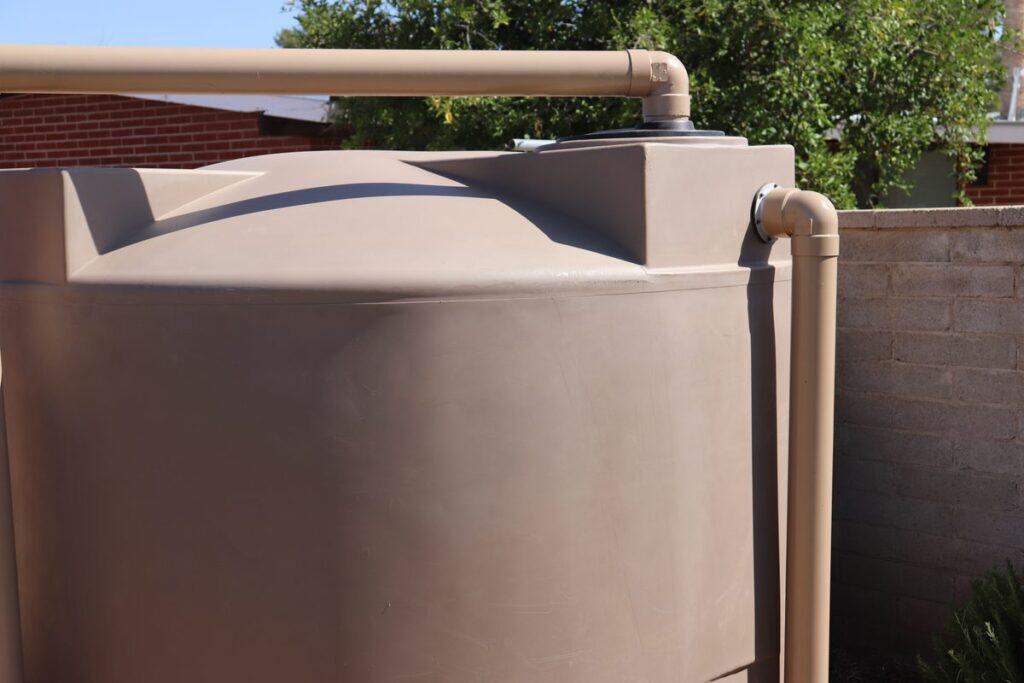
| Tank type | Common fit | Main advantages | Main considerations |
|---|---|---|---|
| UV-protected poly tank | Small to mid-size residential systems | Lower cost, low maintenance, good for many yard layouts | Needs a very even base, benefits from reduced sun exposure |
| Steel culvert cistern | Larger residential or commercial storage | Large capacity, strong structure, distinctive appearance | Needs proper coating care, larger pad, more site planning |
Some properties do well with a single 200 to 800 gallon tank. Others make more sense with 1,500 gallons, 3,000 gallons, or a much larger cistern setup tied to several downspouts. The right size depends on roof area, budget, space, and how you plan to use the water.
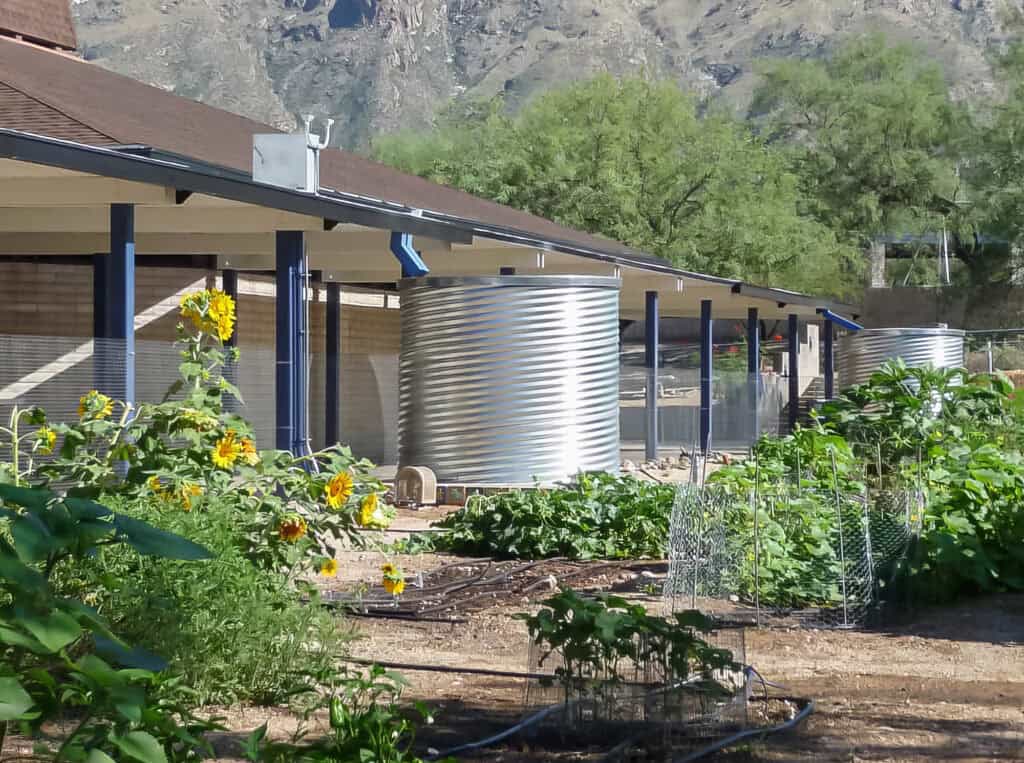
When gravity feed works and when a pump makes more sense
If the tank outlet sits above the planting area, gravity feed can work for basic irrigation. If the yard is flat, the run is long, or you want stronger pressure at a hose bib, a pump is usually the better choice. That decision should be made before the outlet height and plumbing are finalized.
Protecting above-ground tanks from sun, wind, and debris
Desert weather is hard on outdoor equipment.
UV exposure can fade finishes, heat the water, and shorten the life of cheap materials. That is why opaque, UV-protected tanks and sealed lids matter. A screened overflow is just as important. Without it, mosquitoes, wasps, and debris find their way in fast. Dust is another local issue. Roofs stay dry for long stretches here, then the first monsoon rain washes all that fine dirt toward the tank.
Wind needs attention too. A tall empty or partly full tank can move more than people think, especially during monsoon outflow winds. Anchoring may include straps, hardware tied to the pad, or other support depending on tank size and exposure. Flexible plumbing connections also help because tanks and pipes expand and contract in the heat.
Water tank maintenance and safety checks
A good installation should be easy to maintain. If a tank is tucked into a corner with no room to inspect the screens or drain the bottom, service becomes harder than it needs to be. Access matters from day one.
Most homeowners do best with a simple maintenance routine a few times a year, plus a deeper cleaning when needed. If the water is being used for edible gardens, indoor backup, or any potable application, filtration and treatment need to be discussed separately.
A practical maintenance checklist looks like this:
- Check inlet and overflow screens
- Look for pad settling or cracks
- Test valves and hose connections
- Flush out sediment when the tank is low or empty
- Confirm overflow water is draining away from the house
- Inspect after monsoon storms: Look for shifted piping, clogged screens, and erosion around the base.
- Clean the tank on schedule: Remove sediment and rinse the interior before buildup gets heavy.
- Verify the lid seal: Keep light, insects, and debris out of the stored water.
Sizing an above-ground tank system for your property
Every rainwater harvesting setup is different from one house to the next. A small tank on one side yard may be enough to support fruit trees and patio plants. The right system is different from one house to the next. A small tank on one side yard may be enough to support fruit trees and patio plants. A larger setup may tie several roof sections together and feed a pump, drip irrigation, or multiple cisterns. The roof area, gutter layout, available pad space, and intended use all need to be looked at together.
Southern Arizona Rain Gutters installs above-ground tank systems with those details in mind, from gutter collection and fascia wrap work to screened tank inlets, overflow planning, and larger cistern layouts. If you want a system that fits Tucson weather and actually gets used, the planning stage is where the job is won or lost.
Questions Worth Asking Before You Install
Does Arizona require a permit to install an above-ground rainwater tank?
For most residential above-ground tanks, no building permit is required in Tucson or unincorporated Pima County, but it depends on the size of the tank, how the water will be used, and whether any plumbing connections are involved. Arizona has been one of the more rainwater-friendly states in the country, and state law explicitly allows residential collection for outdoor use. That said, if the system ties into indoor plumbing or involves significant grading work, additional review may apply. Checking with your local jurisdiction before work begins is always the right move.
Are there rebates or incentives available for rainwater harvesting in Tucson?
Yes. Tucson Water offers a rebate program for rainwater harvesting systems, including above-ground storage tanks. The rebate covers a portion of the installation cost and has historically applied to both the tank and qualifying system components. Income-qualified households may be eligible for a higher rebate amount. The program has specific requirements around how the water must be used, so it is worth confirming current terms directly with Tucson Water before the project starts.
How much rainwater can a typical Tucson home actually collect?
A rough rule of thumb is that one inch of rainfall across one square foot of roof area yields about 0.6 gallons of collectible water, accounting for typical losses. A modest 1,500 square foot roofprint during a single one-inch storm could generate close to 900 gallons. Tucson averages around 12 inches of rainfall per year, but most of that falls during the July through September monsoon window. That means collection opportunities are concentrated, which is exactly why having adequate tank capacity and properly sized gutters matters: you may get your biggest fills in just a handful of storms.
Will the stored water stay safe for garden use if the tank sits unused between monsoon storms?
For landscape irrigation, stored water generally holds up well when the tank is properly set up, meaning it is opaque, sealed, screened, and out of direct sun as much as possible. Algae growth and bacterial activity accelerate when light reaches the water or when the tank runs warm for extended periods. Between uses, keeping the tank as full as possible and maintaining intact screens and lid seals helps a lot. If the water will be used on edible plants and it has been sitting for weeks, a basic water test is a reasonable precaution. For any potable or near-potable use, filtration and treatment are separate conversations entirely.
Can an above-ground tank system be expanded later if I want more storage?
Yes, and it is worth thinking about that possibility before the first tank goes in. A system designed with a manifold connection point or a tee in the overflow line can accept additional tanks without reworking the whole setup. The pad location and the way the inlet and overflow are plumbed will either make future expansion straightforward or create extra work. If there is any chance you will want more capacity down the road, mentioning it upfront allows the installer to plan around it from the start.
How long does a professionally installed poly tank typically last in Southern Arizona conditions?
A quality UV-stabilized poly tank installed on a proper base, kept out of constant reflected heat, and maintained with regular screen checks and occasional interior flushes can realistically last 20 years or more. The weak points are usually not the tank wall itself but the fittings, inlet screens, and lid seals. Those components see the most wear and are also the easiest to replace on a schedule. Tanks that sit on an uneven base, bake against a south-facing block wall, or go years without any maintenance tend to show problems well before that.
A lot of homeowners use the words tank and cistern like they mean the same thing. In everyday conversation, that is usually fine. But when you are planning a rainwater harvesting system for a Tucson home, the difference matters because the material, size, placement, and cost can change quite a bit.
Here in Southern Arizona, storage is not just about holding water. It is about handling hard monsoon bursts, standing up to brutal sun, keeping algae out, and making the most of every inch of rain we get. A setup that works great in a mild climate may not hold up the same way on a west-facing wall in July.
If you are deciding between an above-ground water tank and a cistern, the best way to look at it is this: both store water, but they are not always built, installed, or used the same way.
Above-Ground Water Tanks and Cisterns: The Basic Difference
An above-ground water tank is usually a prefabricated storage unit that sits on a level pad or base. Around Tucson, the most common ones are polyethylene tanks, often in the 200 to 5,000 gallon range for residential use. They are straightforward, visible, and relatively easy to install.
A cistern is usually a heavier-duty storage system, often larger and more permanent. Some cisterns are underground concrete or masonry structures. Others are above-ground corrugated steel units with liners and sealed lids. In day-to-day jobsite talk, people often call large steel storage units cisterns even when they sit above grade.
That is why the terms overlap. A cistern can be above ground. A tank can be part of a cistern system. What matters more is how it is built and what job it needs to do.
- Above-ground tank: Usually prefabricated, easier to place, and common for residential garden or landscape use
- Cistern: Often larger, heavier-duty, and built for longer-term or higher-volume storage
- Above-ground cistern: Common in Arizona, especially corrugated steel systems
- Underground cistern: Hidden from view, cooler, and more expensive to install
Above-Ground Water Tanks vs Cisterns Comparison Table
If you want the quick version, this table covers the main differences homeowners ask about.
| Feature | Above-Ground Water Tanks | Cisterns |
|---|---|---|
| Typical materials | Polyethylene, fiberglass, some steel | Concrete, corrugated steel, heavy poly, masonry |
| Usual placement | Above grade on pad or stand | Above ground or underground |
| Common residential size | 200 to 5,000 gallons | 800 to 20,000+ gallons |
| Installation | Simpler, less site work | More involved, especially if buried |
| Cost | Lower starting cost | Higher starting cost in most cases |
| Appearance | Visible, can be slimline or round | Can be visible feature or hidden underground |
| Sun exposure | Direct exposure unless shaded | Underground units protected from sun |
| Water temperature | Warmer in summer | Cooler, especially underground |
| Maintenance access | Easy to inspect and clean | Above-ground is easy, underground takes more effort |
| Best fit | Smaller budgets, garden use, simpler retrofits | Larger storage goals, tighter sites, long-term systems |
The short version is that an above-ground tank is usually the simpler answer, while a cistern is often the bigger and more permanent answer.
Above-Ground Water Tanks for Tucson Homes
For a lot of houses in Tucson, an above-ground tank is the first place I tell people to look. It gives you solid storage without excavation, major site work, or a giant jump in budget. If the goal is watering trees, shrubs, or a vegetable garden, a poly tank can do that job very well.
These tanks are popular because they install fast when the site is prepared correctly. A proper level pad matters. So do screened inlets, sealed openings, and a clean tie-in from the gutter downspout. If the tank is opaque and UV-stabilized, you cut down on algae issues and help the tank hold up better under desert sun.
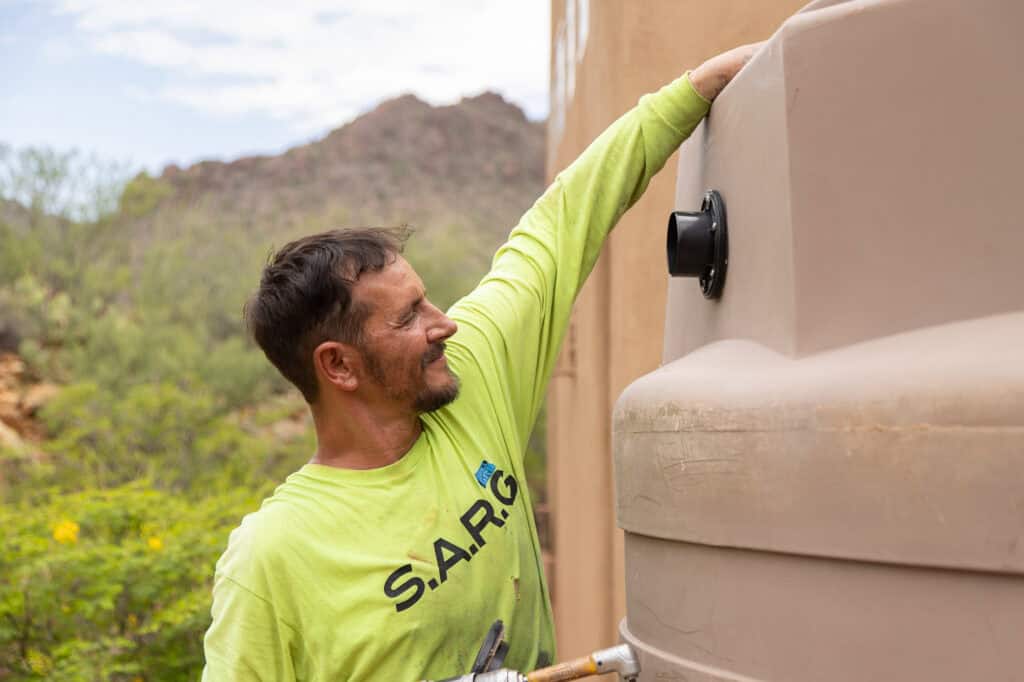
They also work well when space is limited but not impossible. Round tanks fit side yards. Slimline profiles can fit along a wall where a round tank would stick out too far. I have seen homeowners tuck a tank beside a garage, behind a gate, or near a garden area and make very good use of a small footprint.
And if you ever need to inspect a fitting, clean sediment, or check the water level, you can get to it without much trouble.
After you have a good collection surface and a decent pad, above-ground tanks offer some clear advantages:
- Lower upfront cost
- Faster installation
- Easy visual inspection
- Good access for cleaning
- Great for irrigation
- Flexible sizes
That said, they are not invisible. Some homeowners do not like the look of them, and some HOAs like them even less. They also take the full hit from summer heat, UV exposure, wind, and blowing dust. Good materials help a lot, but in Arizona, sun damage is real. Cheap plastic is a mistake out here.
Cistern Benefits and Tradeoffs for Larger Water Harvesting Systems
When homeowners want more storage, longer reserve time, or a cleaner architectural look, the conversation usually shifts toward cisterns.
In practical terms, that often means a larger corrugated steel cistern above ground, or an underground concrete or poly cistern. Steel culvert-style cisterns are a strong option in Southern Arizona because they can hold a lot of water without taking up a huge spread of space. They also tend to look more intentional on the property, especially when matched to the home and landscape.
Underground cisterns solve a different problem. They hide the storage completely and protect the water from direct sun and temperature swings. That can be appealing if yard space is tight, views matter, or local rules make visible tanks difficult. Water also stays cooler underground, which many homeowners like.
But this is where the tradeoffs become real. Buried cisterns need excavation, site access, and careful engineering. Tucson lots can have caliche, rock, tight access, or existing hardscape that makes underground work more difficult than it sounds on paper. If you are putting a cistern under a patio, driveway, or other load-bearing area, the structure has to be built for that use.
Pumps matter more with these systems too. A buried cistern usually needs a pump to move water where you want it. A good setup may include internal or external pumps, float switches, and filtration, depending on whether the water is for irrigation, indoor use, or potable treatment.
A larger storage system can make a lot of sense here, especially because our rain often comes in short, heavy monsoon events. If your roof sheds a big volume in 20 or 30 minutes, a small tank may fill quickly and send the rest to overflow. A bigger cistern gives that storm somewhere to go.
Climate, Space, and Water Use Should Drive the Decision
The right choice is less about which word sounds better and more about what your property can collect and what you want the water to do.
Tucson gets roughly a foot of rain a year on average, but it does not arrive gently and evenly. We get long dry stretches, then a monsoon storm dumps a lot of water fast. That means your gutters, downspouts, and storage all need to work as one system. A small storage container tied to a large roof can overflow fast. A huge cistern tied to a tiny roof may never fill enough to justify the cost.
Your site matters just as much. Some homes have a perfect side yard for a visible tank. Others have almost no usable exterior space, or the best location is right where a walkway, gate, or vehicle access needs to stay clear.
Before picking a tank or cistern, I would look at these things first:
- Roof collection area: Bigger roofs can justify bigger storage
- Water use: Trees and landscape irrigation need a different setup than backup household use
- Available space: Side yards, setbacks, access, and HOA rules can limit visible storage
- Sun exposure: Full afternoon sun is harder on any above-ground unit
- Budget: The container cost is only part of the system cost
One more thing homeowners sometimes miss is timing. If you are already replacing gutters, repainting trim, or fixing fascia, that is a smart time to plan storage too. It is often easier to route downspouts and overflow lines while that work is happening than to retrofit everything later.
Gutter System Details Matter as Much as the Storage Container
I have seen people spend good money on a tank and then connect it to a poor collection system. That is like buying a new safe and leaving the door open.
The roof is your catchment. The gutters and downspouts are your delivery system. If those parts are undersized, poorly sloped, or pulling away from the fascia during storm flow, your storage choice will never perform the way it should. Around Tucson, K-Style gutters are common because they handle roof runoff well and fit most residential profiles cleanly. On some homes, fascia wrap is worth doing at the same time, especially if the existing wood has been baked by the sun and needs protection before new gutters go up.
A solid harvesting setup usually includes leaf screening, mosquito protection at inlets and overflows, and a way to manage debris before it reaches storage. For potable or near-potable uses, filtration and approved materials matter even more. Not every container sold as a water tank is the right choice for stored rainwater.
Monsoon overflow planning is another big one. When the tank or cistern is full, that water needs somewhere useful to go. Ideally, overflow is directed to basins, trees, or a planned drainage area, not dumped against the foundation.
Maintenance and Lifespan of Above-Ground Tanks and Cisterns
No storage system is maintenance-free, but good design keeps maintenance reasonable.
Above-ground tanks are easier to inspect. You can check fittings, screens, lids, and water level with minimal effort. An annual sediment cleanout is usually enough for many residential systems, assuming the gutters are in decent shape and the tank stays sealed from light and pests.
Cisterns need the same basic care, but access can be different. An above-ground steel cistern is still fairly easy to inspect. An underground cistern takes more planning because access points are limited and cleaning is more involved. That does not make it a bad option. It just means you should go into it with open eyes.
A few habits go a long way:
- Inspect screens: Keep mosquitoes, roof grit, and leaves out
- Check seals and lids: Light leaks lead to algae problems
- Flush sediment: Usually once a year, or when the tank is mostly empty
- Watch the overflow: Make sure monsoon water exits where it should
- Service pumps and filters: Especially on larger or indoor-use systems
Material choice affects lifespan too. Good UV-stabilized poly tanks can last for decades. Steel cisterns are very strong and well suited for larger capacities when lined and assembled properly. Concrete cisterns can last a very long time, but the build quality has to be right, especially below grade.
If you are trying to choose between the two, start with roof area, water use, and available space. A modest above-ground tank can be a smart, practical fit for many homes. A larger cistern makes more sense when you need serious storage, better concealment, or a system built around longer dry periods between storms. In Tucson, both can work very well when the gutters, overflow, pad, pump, and layout are planned as a complete system.
Questions Homeowners Ask About Rainwater Storage in Tucson
Does Tucson or Pima County require a permit to install a rainwater storage tank or cistern?
Permit requirements depend on the size of the system and whether it involves structural changes, grading, or connections to plumbing. Small above-ground tanks used strictly for outdoor irrigation often fall below the permit threshold, but larger cisterns, especially underground ones, typically require permits and inspections. It is worth checking with the City of Tucson Development Services or Pima County before you purchase anything, because requirements can also vary by municipality within the metro area.
Does Arizona offer any incentives for rainwater harvesting?
Yes. Arizona has been one of the more rainwater-friendly states for years. The state income tax credit for purchasing a water conservation system, including qualifying rainwater harvesting equipment, has been available to homeowners for residential installations. Tucson Water has also offered rebate programs for harvesting systems in the past, though availability and amounts change. Checking with Tucson Water directly before you buy is the best way to know what is currently active.
What is a first flush diverter and do I need one?
A first flush diverter is a device that automatically discards the initial runoff from a rain event before it reaches your storage. That first portion of water picks up the most debris, bird waste, dust, and roof grit that has built up since the last rain. For most Tucson roofs, especially those going months between rain events, a first flush diverter is a smart addition. It reduces sediment buildup in the tank, keeps the stored water cleaner, and extends the time between full cleanouts.
Can harvested rainwater be used indoors or for drinking?
It depends on the intended use and how the system is built. Rainwater collected from a standard residential roof is not potable without treatment. For outdoor landscape irrigation, untreated harvested water is generally fine. For indoor non-potable uses like toilet flushing, some jurisdictions allow it with proper cross-connection controls. For drinking or cooking, the system needs filtration, UV treatment, and approved materials throughout, and local health codes apply. Most residential systems in Southern Arizona are designed for landscape use, where treatment requirements are far simpler.
How do I figure out how much storage capacity I actually need?
A rough starting point is to calculate how much water your roof sheds in a typical monsoon storm and match storage to that volume. A common formula multiplies the roof collection area in square feet by the rainfall amount in inches, then by 0.623 to convert to gallons. A 1,500-square-foot roof footprint during a one-inch storm sheds roughly 935 gallons. If your goal is capturing a full storm event, your storage should be close to that number. If you mostly want a reserve for dry spells between rains, you can size up based on how much water your landscape uses per week and how long you want that reserve to last.
Will a rainwater harvesting system affect my home's resale value?
In Southern Arizona, water-conscious features are generally viewed positively by buyers, especially as water supply conversations become more prominent in the region. A well-built, properly maintained system with clean installation can be a selling point. A poorly installed or visually awkward setup can work the other way. How the system looks and integrates with the home matters. A slimline tank tucked neatly into a side yard reads differently than a deteriorating barrel sitting in plain view of the street.
Rainwater harvesting makes a lot of sense in Arizona, but it works a little differently here than it would in a place with steady weekly rain. Around Tucson, most of our annual rainfall comes in bursts. A monsoon storm can dump a lot of water in 20 minutes, then you may not see meaningful rain again for weeks.
That pattern is exactly why a well-built system matters. If your gutters are undersized, your downspouts are in the wrong spots, or your tank is not screened and shaded correctly, you can lose a lot of water fast. Done right, a harvesting system catches roof runoff, stores what you can use later, and sends overflow where it still helps the property instead of washing out the yard.
Why this works so well in Southern Arizona
In the desert, every gallon that lands on your roof is a gallon worth paying attention to. Most homeowners are not trying to go fully off-grid with water. They just want to cut back on city water use, keep plants alive through hot months, and make better use of the rain that already hits their property.
That is where harvesting shines. Roof water is one of the cleanest runoff sources on a home site because it is easier to predict and easier to direct. With the right gutter profile, properly placed downspouts, and storage or infiltration planned ahead of time, you can turn a short storm into irrigation water for trees, shrubs, and garden areas.
It also helps with runoff control. A lot of Tucson properties have trouble spots where water pours off a roof edge, splashes near the foundation, erodes soil, or cuts ruts through gravel. Capturing and redirecting that flow protects the home and the landscape at the same time.
The two main ways Arizona homes harvest rain
Most residential systems fall into two categories: active and passive. A lot of the best setups use both.
An active system stores water in tanks or cisterns. Rain lands on the roof, runs into gutters, flows through downspouts, passes screening and often a first-flush device, then ends up in a sealed tank. From there, the water can be used later with gravity or a pump, usually for drip irrigation, hose bibs, or other non-potable uses.
A passive system does not store water in a tank. It directs runoff into the soil right away using swales, basins, berms, or infiltration areas. On many Arizona lots, passive harvesting is one of the smartest ways to support shade trees and native plants. It is simple, lower cost, and it helps recharge the ground where plants need the moisture.
When we talk with homeowners, the usual recommendation is not tank or basin. It is tank and basin. Store part of the runoff for later, and route overflow into the landscape so a big storm still benefits the property after the tank fills.
What the roof-fed system is actually doing
At its core, an active rainwater harvesting system is just moving water from a catchment surface to a storage point in a controlled way. The roof is the catchment. Gutters and downspouts are the delivery path. The tank is the storage. The rest of the parts help keep the water cleaner, keep bugs out, and control where overflow goes.
On Arizona homes, gutter design matters more than many people expect. Monsoon storms are intense, so a system needs enough capacity to move water fast without spilling over the front edge. That is why K-Style gutters are common. On some houses, half-round or other profiles can make sense, but the right choice depends on roof area, slope, and appearance.
A good setup usually includes these working parts:
- Leaf screens: stop larger debris before it enters the tank line
- First-flush diverter: sends the dirtiest first runoff away from storage
- Cistern or tank: holds water for later use
- Screened vents and openings: keep mosquitoes, pests, and sunlight out
- Overflow line: sends extra water to a basin, swale, or drainage point
- Pump with float switch: supplies pressure and helps keep the pump from running dry
The roof edge matters too. If fascia boards are weathered, soft, or sun-damaged, the gutter system does not have a strong foundation. In Tucson, fascia wrap is often part of the conversation because it protects the wood from sun exposure and moisture at the same time. It also gives the gutter a cleaner mounting surface.
How much water can a roof collect?
A simple rule of thumb is that 1 inch of rain on 1 square foot of roof yields about 0.623 gallons. So if you have a 1,000 square foot roof section and you get 10 inches of rain over a year, that roof area can produce roughly 6,230 gallons before losses.
Real-life numbers are a little lower because of splash, debris, first-flush diversion, and overflow. Still, the math surprises people. Even in a dry climate, a decent roof can collect a useful amount of water across a year.
| Roof Catchment Area | Annual Rainfall | Approx. Gallons Collected |
|---|---|---|
| 1,000 sq. ft. | 8 inches | 4,984 gallons |
| 1,000 sq. ft. | 10 inches | 6,230 gallons |
| 1,500 sq. ft. | 10 inches | 9,345 gallons |
| 2,000 sq. ft. | 10 inches | 12,460 gallons |
| 2,000 sq. ft. | 12 inches | 14,952 gallons |
That does not mean you need a 10,000-gallon tank on every house. It means you should match storage to your goals. Some homes do great with a 200 to 500 gallon tank feeding a few fruit trees. Others benefit from larger cisterns in the 1,500 to 5,000 gallon range, especially if the owner wants longer irrigation backup between storms.
Designing for desert conditions
Arizona is hard on materials. The sun breaks down cheap plastics. Dark tanks in full exposure heat up fast. Unsealed openings invite algae growth and mosquito issues. A harvesting system here needs to be built for UV exposure, heat, and sudden high-volume rain.
That is why tank choice matters. Poly tanks can work very well when they are UV-protected and properly installed. Corrugated steel cisterns are another solid option, especially on larger systems. Both need tight lids, screened inlets, and well-planned overflow. If the tank is in direct sun all day, placement and color become more important.
It is also why gutter and downspout sizing should be based on storm flow, not just average rain. A system that looks fine in light rain can fail badly in July or August. When a monsoon cell parks over your neighborhood, the whole roof can become a fast-moving sheet of water.
The best Arizona systems usually have a few things in common:
- Wide, properly pitched gutters
- Enough downspouts for the roof area
- Screened tank openings
- Covered storage
- Overflow to planting basins
- Easy access for cleaning
Stored water is useful, but overflow is part of the plan
A lot of homeowners focus only on the tank, but overflow design is just as important.
Once a cistern is full, the next gallons still need to go somewhere safe. If overflow is not controlled, water can back up, wash out a side yard, flood a walkway, or end up near the foundation. If it is planned well, that same overflow can soak fruit trees, shade trees, or a rain garden.
This is where passive harvesting fits beautifully into an active system. The tank catches the first part of the storm. The overflow finishes the job by soaking the landscape.
What people usually use the water for
Most Arizona homeowners use harvested rainwater outdoors. That is the easiest and most practical use. Trees, shrubs, native plants, raised beds, and drip systems all benefit from it. Some people also use it for washing tools, rinsing patios, or other non-potable needs.
Indoor use is a different level of design. Rainwater can be used for things like toilet flushing or laundry in some setups, but that requires code-compliant plumbing details and separation from the potable system. Drinking water use requires proper filtration and disinfection. Without that treatment, rainwater should be treated as non-potable.
That distinction matters because many homeowners hear “rainwater system” and picture drinking water right out of the tank. That is not how most residential Arizona systems are set up. Most are built to save municipal water outdoors first, where the biggest savings usually happen.
Maintenance is not difficult, but it is real
A harvesting system is not something you install and ignore forever. It needs routine attention, especially after windy weather and monsoon storms.
The good news is that maintenance is usually straightforward. If the system was designed with access in mind, most of the work is quick seasonal upkeep instead of a major chore.
A simple maintenance rhythm looks like this:
- Before monsoon season: clear gutters, check screens, test overflow paths
- After major storms: remove debris, inspect downspouts, look for washouts near overflow outlets
- A few times a year: clean first-flush parts and sediment filters
- Any time you notice odors or bugs: inspect tank lids, vent screens, and light intrusion points
One thing many people miss is the condition of the gutter support area. If fascia is deteriorating, the system can sag or pull away over time. In our climate, sun damage and intermittent wetting are a rough combination. Fascia wrap can help extend the life of that edge and protect the structure behind the gutter line.
Arizona rules, rebates, and HOA questions
Arizona allows rainwater harvesting on private property, and HOAs cannot simply ban it.
That said, legal does not mean unplanned. Local code, tank placement, plumbing details, backflow prevention, and rebate paperwork all matter. In Tucson, rebate programs can offset a good chunk of the cost, but they usually require a workshop, pre-approval, and a final inspection. If a homeowner wants the rebate, it is smart to check those requirements before buying parts or setting a tank.
Programs change over time, so it pays to verify the current rules with Tucson Water or the applicable local agency. Many homeowners are surprised at how much incentive money may be available for active tanks, and in some cases for passive landscape harvesting too.
Picking the right size system for your property
The right system size comes down to three things: roof area, water demand, and budget.
If your main goal is helping a few landscape zones through hot weather, a modest tank tied to one good roof section may be enough. If you want to support a larger yard, fruit trees, or a more developed irrigation setup, you may want a larger cistern and a pump-based system with dedicated distribution lines.
There is also the visual side. Some homeowners want the tank tucked away near a side yard. Others are fine making it a feature. Tank location affects piping length, pump performance, sun exposure, and how easy the system is to service later.
A practical first step is to identify which roof sections produce the best runoff and which parts of the yard need water the most. Once those two pieces are clear, the rest of the design gets much easier.
Questions Arizona Homeowners Ask About Rainwater Harvesting
How much does a residential rainwater harvesting system cost in Tucson?
Cost depends heavily on tank size, number of downspout connections, and whether a pump and distribution lines are included. A basic setup with a single 200- to 500-gallon tank connected to one downspout can start in the low hundreds for a DIY install, or roughly $1,000 to $2,500 professionally installed. Larger systems with 1,500- to 5,000-gallon cisterns, pumps, and multiple roof connections typically fall in the $3,000 to $10,000 range. Tucson Water rebates can offset a meaningful portion of that cost, making the effective price lower than most homeowners expect.
Can I connect a harvesting system to gutters I already have?
In many cases, yes. If your existing gutters are in good condition, properly sized, and sloped correctly, a tank can often be tied into the current downspout path without replacing the entire gutter system. The installer adds screening, a first-flush diverter, and the tank inlet to the existing line. However, if your gutters are undersized for monsoon flow, sagging, or leaking at joints, it usually makes more sense to replace them as part of the project so the whole system performs as one unit from day one.
Does the tank need a concrete pad or foundation?
It depends on the size. Smaller tanks under 500 gallons can often sit on a level, compacted gravel pad without a poured foundation. Larger cisterns — especially steel tanks in the 1,500-gallon range and above — benefit from a concrete pad or engineered base because a full tank is extremely heavy. A 2,500-gallon tank at capacity weighs over 20,000 pounds. An uneven or soft base can cause the tank to shift, stress pipe connections, and create leak points over time. Your installer should assess the soil and grade at the planned location before setting the tank.
What happens to stored rainwater if I go on vacation and it sits unused for weeks?
Properly stored water holds up well, even in Tucson's heat. If the tank is sealed, screened, opaque, and UV-protected, water can sit for several weeks without significant quality issues. Problems start when light enters the tank — that is what drives algae growth. Heat alone does not ruin the water if the tank is designed correctly. When you return, running the first few gallons through the hose bib before irrigating is a reasonable precaution. If the water will sit for months rather than weeks, draining the tank down and cleaning sediment before refilling next season is a worthwhile step.
Can I expand my system later if I start small?
Yes, and starting small is a common approach. Many homeowners begin with one tank on the most productive roof section, use it for a season, and then add capacity once they see how quickly it fills and empties. The key is planning pipe runs and overflow routing during the first install so a second tank or a larger replacement can connect without reworking the whole layout. Letting your installer know that expansion is a possibility — even if it is a year or two away — helps them position the first tank and overflow line in a way that makes the future addition straightforward.
Will a large water tank affect my homeowner's insurance?
Most standard homeowner's policies do not specifically exclude rainwater tanks, but it is worth notifying your insurer, especially for larger installations. A 2,500-gallon tank that fails could cause water damage to adjacent structures, fencing, or landscaping. Some insurers may ask about the tank's location relative to the house, whether it is on a proper base, and whether overflow is managed. In practice, a professionally installed and well-maintained system rarely triggers a premium increase, but confirming coverage before installation avoids surprises if something goes wrong later.
Is harvested rainwater better for plants than city water?
Many gardeners and landscapers think so. Tucson's municipal water is treated and contains chlorine and dissolved minerals that some plants tolerate but do not prefer. Rainwater is naturally soft, has a near-neutral pH, and contains no chlorine or fluoride. Desert-adapted plants, fruit trees, and vegetable gardens often respond noticeably well to rainwater irrigation. The difference is most visible on sensitive species and container plants where mineral buildup from tap water can accumulate in the soil over repeated watering cycles.
Do I need to worry about freezing in Tucson?
Tucson rarely sees hard freezes, but overnight temperatures in December and January can occasionally dip below freezing, especially in foothill neighborhoods, Oro Valley, and higher-elevation areas around Vail and Sonoita. Exposed above-ground pipes, pump lines, and hose bibs are the most vulnerable components — not the tank itself, since the large water volume resists freezing far longer than a thin pipe does. Insulating exposed lines and disconnecting hoses during cold snaps is usually enough. Below-ground supply lines are naturally protected and rarely an issue at Tucson-area elevations.