ES
ES 
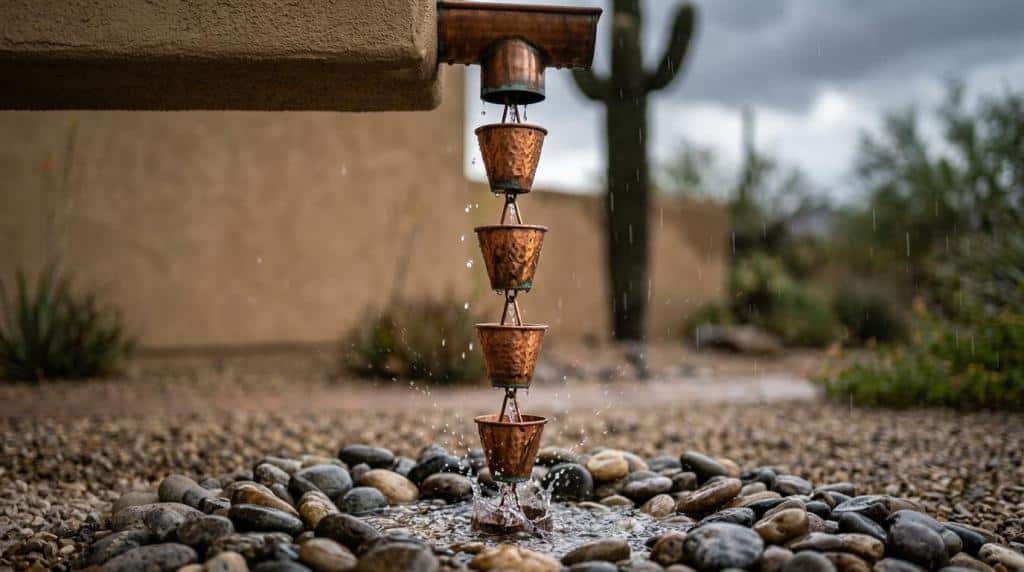
Rain chains vs downspouts is not just a question of what looks better. It is really about how you want water to behave around your home, and how that choice fits the rest of your rain gutter system.
Here in Tucson, that matters more than people think. We go through long dry stretches, then get hit with hard monsoon bursts that dump a lot of water in a short window. A drainage detail that looks fine in light rain can turn into splash, erosion, and foundation trouble when the sky opens up in July or August.
A lot of homeowners are drawn to rain chains because they add character. And they do. They can look great on the right house, especially with desert landscaping, copper accents, and visible rainwater harvesting. But a downspout is still the safer, more controlled option when the main goal is moving roof runoff away from the structure.
Rain Chains vs Downspouts: The Main Difference
A downspout is a closed path. Water leaves the gutter outlet and stays contained as it moves to grade, a splash block, a buried drain, or a harvesting tank.
A rain chain is an open path. Water clings to the chain or flows from cup to cup on the way down. It’s part drainage, part visual feature. That open flow is exactly why some homeowners love it and exactly why it needs more thought at the bottom.
Most homes around Southern Arizona with seamless aluminum gutters, especially K-Style profiles, are built around standard downspouts. Rain chains are usually a swap at one outlet, not a whole-house replacement.
| Feature | Rain Chains | Downspouts | Best Fit in Tucson |
|---|---|---|---|
| Water control | Open flow | Enclosed flow | Downspouts win in monsoon rain |
| Appearance | Decorative | Utility look | Rain chains win for curb appeal |
| Noise | Audible water sound | More muted, sometimes gurgling | Personal preference |
| Splash risk | Higher | Lower | Downspouts are easier to manage |
| Harvesting use | Great with basin or barrel | Great with tank or cistern | Both work if planned well |
| Wind behavior | Can move or sway | Fastened tight to wall | Downspouts handle wind better |
| Maintenance | Check chain, cups, landing area | Clear clogs, check elbows and straps | Both need seasonal checks |
Water Flow Performance During Monsoon Season
For monsoon performance, downspouts have the clear edge. An enclosed downspout contains fast roof runoff and sends it to one predictable discharge point, while an open rain chain can overshoot, splash, or sway in high wind once the flow gets heavy.
In a light to moderate rain, a rain chain can work just fine. Cup-style chains usually do better than plain link chains because they keep refocusing the water as it drops. If the outlet above is set up properly and the landing area below is ready for the flow, they can perform well enough for a lot of homes.
In a Tucson monsoon storm, though, you’re not dealing with gentle water. You’re dealing with fast roof runoff, wind, and sometimes a gutter that is already carrying a heavy load from one side of the roof. That is where the enclosed path of a downspout earns its keep, especially on a roof edge that already carries a lot of water.
That doesn’t mean rain chains are a bad idea here. It means they need to be placed carefully. I would not treat a rain chain as a decorative replacement and call it done. Around here, it should be part of a real water plan.
Rain Chains and Downspouts for Curb Appeal and Sound
Rain chains are popular for a reason. They make rain visible. On the right home, that can be a strong design feature, especially with copper, dark bronze, or black finishes that fit Southwestern architecture.
They also sound different. A chain gives you the sound of water moving in the open. Some people like that soft cascading sound. Others find it louder than they expected when a storm gets going. A downspout usually keeps the sound more contained, though you can still hear drumming or a hollow gurgle in some setups.
If appearance matters as much as function, rain chains have the edge. If you want the drainage system to disappear into the background, color-matched downspouts are the better fit.
Ground-Level Drainage: Where Most Problems Happen
The biggest mistake with rain chains is not the chain itself. It’s what happens underneath it.
If water drops from a chain onto bare soil, decomposed granite, or a compacted area near the foundation, you can get splashing, trenching, mud, and staining. On a stucco home, that can get ugly fast. On homes with shallow overhangs, it can also kick water back toward the wall.
A rain chain needs a landing zone that can take the flow. In many cases, that means pairing it with a visible harvesting or drainage feature.
Good landing options include:
- River rock basin
- Gravel-filled dry well
- Rain barrel
- Decorative catch basin
- Drain inlet tied to pipe
- Small rain garden if the grading allows it
Downspouts are simpler at grade because they let you place the water exactly where you want it. That could be a splash block, a drain extension, a buried line, or a cistern inlet. The water is concentrated, so you still need to manage erosion, but the path is easier to control.
Roof Type and Gutter Layout Matter
Not every roof edge works well with a rain chain.
A chain performs best when water drops straight down from a gutter outlet. If the water shoots outward, the chain may not catch all of it. That’s one reason rain chains tend to work better on standard gutter runs than on tricky roof edges.
In Tucson, a lot of homes have canale or scupper-style drainage on flat or low-slope roofs. Those can push water out away from the wall instead of dropping it vertically. In that setup, a standard downspout or a custom transition detail usually makes more sense than hanging a chain and hoping the water follows it.
This is also where gutter sizing and outlet placement matter. A 5-inch K-Style gutter with correctly placed outlets handles flow differently than an undersized system trying to feed too much water into one decorative feature.
Durability in Southern Arizona Sun, Wind, and Dust
Our climate is hard on exterior metal. The sun is relentless, dust gets everywhere, and monsoon winds can shake loose anything that was not installed well.
Copper ages nicely and develops patina. Heavier metals tend to move less in the wind. Lightweight chains can twist, slap, or drift out of line if they are not anchored at the bottom.
Downspouts are not immune to wear either. Painted finishes can fade, straps can loosen, elbows can dent, and a poorly placed extension can get kicked out of position. But they are generally more rugged from a pure drainage standpoint because they are attached to the wall and shield the water path.
For Southern Arizona homes, I usually tell people to think about three durability issues:
- Sun exposure: Choose finishes that hold up to UV and heat
- Wind movement: Anchor chains and secure downspouts properly
- Debris load: Keep outlets clear after dust storms and roof runoff events
Installation and Maintenance Differences
Rain chains are usually easier to retrofit at one location. If there is already a gutter outlet, you can remove the downspout, install a hanger or adapter, and hang the chain. That part is often pretty straightforward.
The harder part is building the system below. If you need a rock basin, drain tie-in, rain barrel stand, or a way to direct overflow, the job gets more involved. That is where many DIY installs fall short.
Downspouts take more measuring and more parts. You have elbows, straps, wall fastening, outlet alignment, and discharge planning. They are less decorative, but more forgiving once installed correctly.
Maintenance on both systems is not complicated, but it is different. Rain chains need checks for debris in cups, movement in the wind, and erosion below. Downspouts need checks for clogs at elbows, loose straps, and discharge points that have shifted.
Rain Chains vs Downspouts Cost and Value
On simple material cost, downspouts usually come in lower. Standard aluminum components are widely available and fit most homes without much fuss.
Rain chains can cost more up front, especially in copper or heavier decorative styles. Then you add the ground feature below, which is often necessary if you want the install to work well and look finished. A cheap chain over bad drainage is not a bargain.
When homeowners ask me about value, I break it down like this:
- Best value for water control: standard downspouts with proper extensions or drains
- Best value for appearance: rain chains at visible entry or courtyard areas
- Best value for harvesting: either option, if tied into a barrel or cisterns correctly
If your budget is going toward performance first, spend it on gutter sizing, outlet location, downspout routing, and foundation protection. If those basics are handled, then decorative choices make more sense.
Best Uses for Rain Chains on Tucson Homes
Rain chains make the most sense when they are used intentionally, not just because they look good in a photo.
They work especially well in courtyards, patios, front entries, and garden areas where the water path is part of the design. They also fit nicely with rainwater harvesting when the runoff is feeding a basin, barrel, or small feature that you actually want to see.
Rain chains are a strong option when you want:
- visual water movement
- a softer architectural detail
- a copper accent
- a courtyard feature
- a visible harvesting setup
Cup-style chains are usually the better choice here. They handle stronger flow better than simple link chains, and they tend to look more finished on homes with stucco, stone, and desert plantings.
When Downspouts Are the Better Choice
A downspout is still the right answer for a lot of homes, especially where performance matters more than the visual effect.
If the outlet is near the foundation, next to a walkway, above bare soil, or tied into a larger drainage plan, I would lean downspout almost every time. The same goes for homes with heavy roof concentration at one corner or properties where monsoon overflow has already caused erosion.
Downspouts make more sense in these cases:
- Main priority: foundation protection
- Roof condition: heavy runoff concentrated in one area
- Ground condition: limited room for splash or ponding
- Harvesting setup: direct connection to cisterns or sealed tanks
- Wall condition: areas where stucco staining is a concern
They also pair better with fascia wrap details when the goal is a clean, finished exterior line and a system that blends into the trim instead of standing out.
Hybrid Options for Rainwater Harvesting and Appearance
You do not always have to choose one or the other for the whole house.
A smart setup for many Tucson properties is a mixed system. Use standard downspouts where the roof collects the most water, where the foundation needs the most protection, or where you are feeding larger cisterns. Then use a rain chain at one visible location where the runoff volume is manageable and the landscaping below is built for it.
If that visible rain chain is feeding a barrel or small cistern, there is a local upside worth checking. Tucson Water offers rainwater harvesting rebates, though the program terms and eligibility change from year to year, so confirm the current details before you plan around them.
That approach gives you control where you need it and character where you want it. It also tends to fit how people actually use their property. The side yard and rear corners can stay practical. The front entry or courtyard can get the decorative piece.
Before swapping a downspout for a chain, ask a few plain questions. Where will that water land? How much roof is feeding that outlet? What happens during a hard monsoon storm, not just a light shower? If those answers are clear, a rain chain can be a nice addition. If they are not, a standard downspout is usually the safer investment.
Key Takeaways
- A rain chain is usually a single-outlet swap, not a whole-house replacement, so most homes keep downspouts on the hardest-working roof edges.
- The ground is where most rain-chain problems start. Bare soil, decomposed granite, or compacted dirt near the foundation leads to splashing, trenching, and staining.
- Every rain chain needs a prepared landing zone, such as a river rock basin, gravel dry well, rain barrel, catch basin, or drain inlet.
- Cup-style chains outperform plain link chains for Tucson rain because they keep refocusing the water as it drops.
- Canale or scupper roofs that push water outward are a poor match for a chain, so a standard downspout or custom transition detail controls that flow better.
- Spend the budget on gutter sizing, outlet placement, and foundation protection first, then add a rain chain as the decorative accent.
Questions Worth Asking Before You Decide
Can I install a rain chain on a two-story home?
You can, but height adds complexity. A longer drop means more energy in the water by the time it hits the ground, which makes the landing zone more important, not less. On a single-story home, a well-placed rock basin or barrel usually handles the flow. On a two-story, that same setup may not be enough. You'll want a more substantial catch feature or a drain tie-in below, and the chain itself needs to be weighted or anchored at the bottom so wind doesn't pull it away from the outlet above.
What size rain chain fits a standard gutter outlet?
Most residential gutter outlets are 2 inches in diameter, and the majority of rain chains on the market are designed to fit that opening using a simple adapter or hanger ring. Some heavier cup-style chains have wider spreads that handle more flow, which matters if your outlet is pulling water from a long gutter run. If you're not sure how much water a given outlet handles, that's a good thing to clarify before purchasing, especially for Tucson roofs where a single outlet can collect runoff from a significant surface area during a monsoon.
Do rain chains work with HOA guidelines in Tucson-area communities?
Some do, some don't. HOAs that regulate exterior materials, finishes, or visible drainage components may have something to say about a decorative chain hanging on the front elevation. Before you buy anything, it's worth pulling your CC&Rs or submitting a quick inquiry to the architectural committee. Copper and dark bronze finishes tend to fare better in approval reviews than novelty or brightly colored options, but there's no universal rule across communities in Oro Valley, Marana, or other areas with active HOAs.
How do I keep a rain chain from blowing out of position during high winds?
The most reliable approach is anchoring the bottom of the chain to a weighted vessel, a fixed basin, or a stake driven into the ground. Some chains come with a small anchor weight specifically for this. Without something holding the base, a lightweight chain can swing wide enough to miss the catch feature below or slap against the stucco wall. For exposed locations or corners that take wind from multiple directions, a cup-style chain with more mass tends to stay in line better than an open link design.
Will a rain chain stain my stucco or concrete?
Copper chains can leave greenish streaks on light-colored stucco over time as the metal weathers and water carries oxidation down the wall. This is mostly a concern where the chain runs close to the exterior surface or where wind pushes water contact with the wall. Coated or painted chains carry less staining risk but may not age as gracefully. If your home has white or cream stucco, positioning the chain away from the wall and managing splash at the bottom goes a long way toward keeping the finish clean.
Is there a permit required to install a rain chain in Tucson?
Swapping a downspout for a rain chain at an existing outlet generally doesn't trigger a permit on its own. However, if the installation involves connecting to a buried drain line, modifying the gutter system, or adding a rainwater harvesting tank above a certain capacity, local requirements may apply. Pima County and the City of Tucson both have guidelines around rainwater harvesting and grading that are worth reviewing if your project goes beyond a simple chain swap. When in doubt, a quick call to the local building department saves time later.