ES
ES 
If you’re asking whether rainwater harvesting can cut your outdoor water bill in Tucson, the honest answer is yes, but usually not in a dramatic way from water savings alone.
That surprises some homeowners. We live in a desert, water is not cheap, and monsoon storms can dump a lot of water off a roof in a hurry. So it sounds like a tank should make a huge dent in the bill. Sometimes it does help quite a bit, especially on homes with larger roofs, smart irrigation, and summer water use that pushes into higher rate tiers. But in Southern Arizona, the math depends on more than just whether you own a cistern.
Rainwater harvesting savings in Tucson are real, but usually modest
The biggest thing to keep in mind is that Tucson does not get steady rainfall year-round. We get long dry stretches, then short periods with strong rain events, especially during monsoon season. That means a harvesting system may collect a lot of water in bursts, then sit empty for a while if the tank is undersized or the timing does not match your irrigation needs.
Research on residential rainwater harvesting across the U.S. shows that drier regions save a smaller percentage of outdoor water use than wetter places. In the Southwest, annual water-saving efficiency tends to sit near the low end of the range. That does not mean the system is pointless. It means you need realistic expectations.
For many Tucson homeowners, the direct utility savings are best thought of as one piece of the value, not the whole value.
How much rainwater a Tucson roof can collect
A roof can collect more water than most people expect. The standard formula is:
Rainfall in inches × roof area in square feet × 0.623 = gallons collected
Using Tucson’s average annual rainfall of about 10.6 inches, a typical roof can produce a useful amount of water over a year. Not all of that ends up usable, because some is lost to first flush, splash, debris management, and overflow. Still, the numbers are solid enough to plan around.
| Roof area | Gross annual capture | Approx. usable capture at 80% | Approx. Tier I bill savings* |
|---|---|---|---|
| 1,600 sq. ft. | 10,576 gal. | 8,461 gal. | about $44/year |
| 1,700 sq. ft. | 11,237 gal. | 8,990 gal. | about $46/year |
| 2,000 sq. ft. | 13,220 gal. | 10,576 gal. | about $55/year |
*Estimated using Tucson’s lower tier water charges plus common per-CCF fees for in-city residential customers. Savings can be higher if harvested water replaces higher-tier summer use.
That last column is where people sometimes get sticker shock. They see 8,000 to 10,000 gallons and expect giant savings. But Tucson water rates are tiered, and if your harvested water is only offsetting lower-tier use, the dollar amount stays fairly modest.
What actually drives outdoor water cost savings
Rainwater harvesting saves the most money when the system is matched to the house and the landscape. A pretty tank by itself does not guarantee much.
Here’s where the savings usually improve:
- large roof area
- good gutter coverage
- enough storage to hold monsoon runoff
- drip irrigation instead of spray heads
- trees, gardens, and planted beds instead of thirsty turf
And here’s what tends to hold savings back:
- Small storage: the tank fills fast and overflows during stronger storms
- Poor irrigation fit: the yard needs water when the tank is empty
- High evaporation exposure: open or badly placed storage loses value fast in Arizona sun
- Minimal gutter collection: water never reaches the tank in the first place
I’ve seen homeowners focus only on tank size, but the collection side matters just as much. If the gutters, custom layouts, downspouts, screens, and overflow paths are not planned well, you lose water before it ever becomes useful.
Why system design matters in Southern Arizona weather
Tucson is hard on exterior systems. Sun damage is constant. Monsoon storms can hit sideways. Wind carries dust, leaves, and grit. A setup that might do fine in a milder climate can struggle here if it is not built for desert conditions.
That starts with the gutter profile. On many homes, K-Style gutters make sense because they move a lot of water and fit the look of the house. On others, especially where rooflines or drainage paths are odd, custom layouts matter more than the profile itself. Flat-roof homes may need scuppers and header boxes, not just standard downspouts.
Material choice matters too. Aluminum seamless gutters are common because they hold up well, come in a lot of colors, and cut down on leak points. Copper is a premium option and can look great, especially on adobe or higher-end homes, though it is not usually picked strictly for savings. Fascia wrap can also help protect wood trim from sun and water wear, which matters more than people think on older Tucson homes.
When we talk harvesting, the tank is only one part of the system. The better setups usually include:
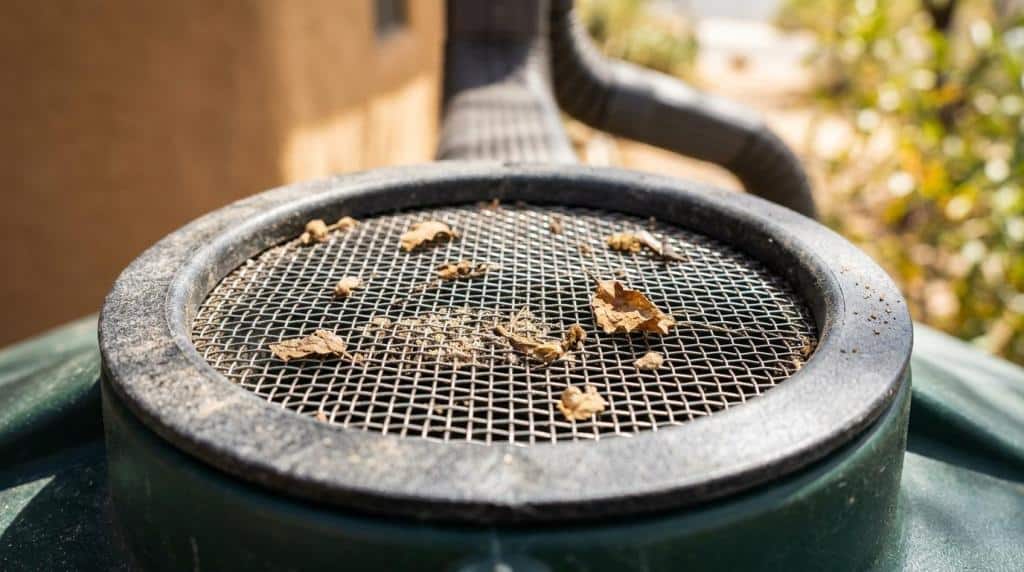
- Screened inlets: to keep leaves, roof grit, and debris out of the tank
- Screened overflows: to help keep out mosquitoes and pests
- UV-resistant storage: because Arizona sun will punish cheap materials
- Clean drainage paths: so overflow goes where you want, not against the house
This is also where above-ground tanks and steel culvert cisterns come into the conversation. A plastic tank can be a practical fit for a side yard and a modest budget. A steel culvert cistern often makes more sense when the homeowner wants larger storage, a cleaner look, or a feature that feels like part of the property instead of an add-on.
Tucson monsoon season changes the savings picture
Most of the real action happens in summer, and that timing matters.
July through September is often the sweet spot for harvested water use in Southern Arizona. Monsoon storms refill tanks while plants are still getting hammered by heat. If your landscape is on drip and the tank is tied into zones that actually need water, this is where rainwater harvesting starts earning its keep.
Late spring and early summer can be the opposite. May and June are brutal here. Hot, dry, windy, and usually lean on rainfall. That is also when landscape thirst is high. If you rely only on stored rainwater, you may run out before the monsoon even starts. That’s normal.
So the answer is not “a tank replaces city water all year.” A better way to say it is “a tank helps you catch useful water when the sky finally gives it to you.”
Water bill savings depend on your landscaping choices
A homeowner with native plants, fruit trees, and drip irrigation can get better use from stored rainwater than someone trying to support a large patch of grass. That’s just the reality of desert math.
If you are watering targeted areas, harvested water stretches surprisingly well. A few deep irrigations on trees, a vegetable bed, or a row of shrubs can use far less water than overspray from sprinklers. And because you’re putting water where it belongs, you’re less likely to waste part of what you worked to collect.
A lot of the best-performing homes share the same traits:
- They have a roof that can collect a decent amount of runoff.
- They have storage sized for the roof and the site.
- They use the water on a landscape that fits Tucson instead of fighting Tucson.
That third part is where many projects either make sense or don’t.
Rebates can change the payback more than the water bill does
In Tucson, rebates often do more for payback than the utility savings do.
Tucson Water has offered residential rainwater harvesting rebates up to $2,000 per property, with workshop and pre-approval requirements. At the time of writing, the city has said pre-approvals paused after March 15, 2026, with the program expected to reopen in July 2026. Homeowners should always check current rules before buying equipment, because rebate timing and paperwork matter.
Without a rebate, simple payback can be long if you’re judging the system only by reduced water charges. With a rebate, the numbers can look much better, especially if the system also solves drainage trouble around the house.
That part gets overlooked. A well-designed gutter and cistern system can do two jobs at once:
- lower some outdoor water use
- reduce splashback and erosion
- move runoff away from foundations
- protect walkways and patio edges
- make roof drainage more controlled during storms
If a project replaces weak drainage and adds harvesting at the same time, the value is easier to justify than if you’re looking only at a water bill line item.
Maintenance costs are usually low, but maintenance still matters
A properly built system is not high drama, but it is not zero-maintenance either. Dust, palo verde leaves, seed pods, roof granules, and monsoon debris all find their way into the system if you ignore it.
Tucson-area research has shown that many active rainwater harvesting systems have pretty modest annual maintenance costs. The bigger issue is not usually cost. It’s neglect.
A few routine checks go a long way:
- Twice a year: clean gutters, strainers, and visible screens
- After major storms: check overflow paths and downspout connections
- Once a year: inspect lids, seals, and mosquito barriers
- Every few years: look for sediment buildup and rinse out where needed
If a tank is shaded poorly, badly sealed, or built with the wrong materials, Arizona heat will speed up problems. Algae, brittle fittings, and sun-cooked components are all more common when the system was not planned for this climate.
When rainwater harvesting makes the most financial sense
Some homes are just better candidates than others.
A larger home with a good roof footprint, regular summer irrigation, and higher seasonal water use often sees the best dollar return. So does a property where stormwater is already causing a nuisance. If the harvesting setup helps manage both runoff and irrigation, the project has two ways to pay you back.
It is usually a weaker fit when the roof area is small, the yard barely needs irrigation, or the owner expects a cistern to wipe out city water use. That is not how it works here.
If you’re trying to judge whether it makes sense, look at these questions:
- How much roof area can actually be captured?
- Do you have room for a tank that is large enough to matter?
- Is your landscape on drip, or could it be?
- Does your summer water use push into higher tiers?
- Are you also trying to fix drainage, staining, or erosion?
Those answers tell you a lot.
For Tucson homeowners, rainwater harvesting usually saves some money, sometimes a fair amount, and rarely enough to stand alone as the only reason to do the project. But when it’s paired with the right gutter layout, the right storage, and a landscape that fits the desert, it becomes a practical part of owning property in Southern Arizona.
Rainwater Harvesting in Tucson: Common Questions
Is rainwater harvesting legal in Arizona, and do I need a permit?
Arizona is one of the more rainwater-friendly states in the country. State law not only allows residential rainwater harvesting but actively encourages it. For most residential setups, no permit is required for above-ground storage. If you are planning an underground cistern or a system that ties into irrigation or plumbing infrastructure, it is worth checking with Pima County or the City of Tucson development services office, since requirements can vary depending on scope and property type.
Can I use stored rainwater on a vegetable garden?
Yes, with some reasonable precautions. Rainwater collected from a roof picks up whatever is on that roof: dust, bird droppings, pollen, and residue from roofing materials. For edible gardens, most experts recommend using harvested water at the soil level rather than directly on leaves or fruit, and avoiding use on root vegetables you plan to eat raw. First-flush diverters help by routing the dirtiest initial runoff away from the tank before it fills. If food safety is a priority, a basic sediment filter on the outlet line adds another layer of confidence.
Does the type of roofing material affect what I can collect?
It can. Asphalt shingles are the most common roof type in Tucson and are generally fine for landscape irrigation. Older roofs with degrading granules or coatings may introduce more particulates into the water, which is one reason first-flush diverters and screened inlets matter. Tile roofs, which are common in Southern Arizona, tend to produce cleaner runoff. Metal roofs also perform well. If your roof has been treated with any kind of algae-resistant coating, check with the manufacturer about whether runoff is suitable for garden use.
What happens to stored water sitting in a tank through the dry season?
Water sitting in a tank for weeks or months can develop algae, bacteria, or sediment if the tank is not well-sealed and properly designed. In Arizona's heat, this is a real concern. UV-resistant, opaque tanks slow algae growth by blocking sunlight. Tight-fitting lids and screened vents keep pests out and reduce evaporation. If you plan to use the water after a long dry stretch, running it through a drip system with a basic inline filter is a reasonable precaution. Tanks that are properly sealed and shaded generally hold water in usable condition for irrigation purposes through a normal dry season.
Does having a rainwater harvesting system affect my homeowner's insurance or property value?
On insurance, most standard homeowner policies do not specifically address rainwater tanks, but it is worth a quick call to your insurer to confirm nothing in your policy is affected by adding a storage system, especially if you are installing a larger cistern. On property value, there is no universal answer, but in markets like Tucson where water awareness runs high, a well-integrated system with clean installation tends to be viewed as a practical feature rather than a quirk. Buyers who are invested in the property and its land often see it favorably.
Can I still use my harvested water during a drought or water restriction?
Generally yes. Water restrictions in Tucson typically target city water use, not privately collected rainwater. Water you have already captured and stored is considered your property under Arizona law. That said, if restrictions extend to how water can be applied outdoors (certain spray methods, for example), those rules would still apply regardless of the water source. During drought conditions, a functioning harvesting system can actually be a practical advantage, giving you a supplemental source for landscape irrigation when conservation pressure on city supplies is highest.