ES
ES 
Picking a gutter company in Tucson is less about who can hang metal on the eaves and more about who knows what our roofs and storms actually do. A good installer should be able to talk plainly about monsoon runoff, UV damage, fascia condition, drainage paths, and whether your home is a good fit for rainwater harvesting.
Why does Tucson gutter experience matter more than a low bid?
Yes, local Tucson experience matters because NOAA and the City of Tucson deal with the same monsoon runoff patterns your roof sees every summer.
A gutter system that works in a mild climate can fail here for two simple reasons: short, intense rain and long, punishing sun exposure. NOAA says Arizona gets more than 50% of its annual precipitation from July through September during the North American Monsoon. That means a gutter company in Tucson has to plan for burst flow, not just yearly rainfall totals.
The sun side matters too. Cheap sealants, thin finishes, and poorly supported runs break down faster in Southern Arizona. A good installer should look at stucco walls, fascia boards, roof valleys, patio tie-ins, and where the water will land after it leaves the downspout. A common mistake is focusing only on the gutter line and ignoring the discharge path.
If a company cannot explain how it handles monsoon overflow at corners, valleys, and scuppers, keep asking questions. That is usually where the trouble shows up first.
How do you verify a Tucson gutter company’s license, bond, and local proof?
Start with the Arizona ROC, then check recent Tucson jobs, then match the company’s paperwork to the work you want done.
Step 1 is simple: ask for the contractor’s ROC number and look it up. The Arizona Registrar of Contractors issues separate residential and commercial licenses, so the license should fit the job. If you own a home, you want to know the company is set up for residential work, not just saying it is “licensed.”
Step 2 is local proof. Ask how long they have worked in Southern Arizona, how many recent reviews they have, and whether you can see photos of jobs in Tucson, Oro Valley, Vail, or Green Valley. Longevity is not everything, but it helps when paired with clear proof.
Southern Arizona Rain Gutters is one example of the kind of proof to look for: its site says it has installed gutters in Southern Arizona since 2005, lists ROC 326453 and ROC 326462, and shows a 4.8-star rating based on 453 Google reviews.
"Southern Arizona Rain Gutters lists ROC 326453 and ROC 326462, which is exactly the kind of license detail Tucson homeowners should verify before hiring."
Step 3 is to ask who will actually do the work. Will the company measure, fabricate, and install with its own crew, or will it hand the job off? That answer affects consistency, scheduling, and who you call if there is a leak at a corner six months later.
What are the 7 questions every Tucson homeowner should ask a gutter company?
These seven questions will usually tell you whether you are talking to a real Tucson gutter specialist or someone giving you a generic bid.
After you ask for a price, slow the conversation down and ask a few technical questions. The quality of the answers often tells you more than the number on the estimate.
Can Southern Arizona Rain Gutters, or any other bidder, show an active ROC license and recent Tucson-area jobs?
If they hesitate on license numbers or local references, that is a warning sign.How are you sizing the gutters for my roof?
You want to hear about roof area, pitch, valleys, and runoff concentration points, not “we use the same size on every house.”Where will each downspout discharge water?
Ask for exact locations. Water should not dump beside a stem wall, entry walk, or neighbor-facing fence line without a plan.Do I need 5-inch, 6-inch, or 8-inch K-Style gutters?
Bigger is not automatically better, but undersized systems are a common cause of overflow during monsoon storms.What condition is my fascia in, and do I need fascia wrap?
Gutters only hold well if the attachment surface is sound.Can this system feed a cistern or tank later?
Even if you are not adding rainwater harvesting now, it is smart to ask whether the layout can support it.What exactly is covered in the estimate and warranty?
Material, profile, color, downspout count, outlet locations, sealant, cleanup, and warranty scope should all be written down.
Should you choose 5-inch, 6-inch, or 8-inch K-Style gutters in Tucson?
Most Tucson homes fit 5-inch or 6-inch K-Style gutters, while 8-inch systems are usually reserved for higher-flow roof sections or commercial work.
K-Style is common here because it handles decent volume, looks clean against fascia, and fits many Southwestern homes. The trick is matching the size to the roof geometry. A modest single-story ranch with short runs may do fine with 5-inch. A larger tile roof with steep pitches, long runs, or heavy valley concentration often does better with 6-inch.
Some Tucson installers also use 8-inch K-Style where water volume is much higher. Southern Arizona Rain Gutters notes that its K-Style systems come in 5-inch, 6-inch, and 8-inch sizes, with 8-inch used for higher water flow.
"Southern Arizona Rain Gutters notes that 8-inch K-Style systems are used for higher water flow, which is a useful clue when a roof section keeps overtopping smaller gutters."
A common misconception is that a bigger gutter alone solves overflow. It does not. If the outlets are too small, the downspouts are poorly placed, or the slope is off, even a large gutter can spill during a hard monsoon storms burst.
How should a Tucson gutter company size downspouts and drainage for monsoon runoff?
A good Tucson gutter company should size the whole drainage path, not just the metal on the fascia.
Step 1 is measuring the roof sections that feed each run. Valleys, dead corners, upper roofs draining onto lower roofs, and porch tie-ins all increase local flow. If one small section of gutter receives water from two roof planes, that section needs special attention.
Step 2 is outlet and downspout planning. More downspouts or better placement can matter as much as gutter width. If a company wants to put one downspout at the end of a very long run without talking about slope or overflow risk, ask why.
Step 3 is tracing where the water goes after discharge. The City of Tucson notes that water harvesting can reduce stormwater flowing in streets or onto adjacent properties. That is a good rule for any job, rebate or not. Pro tip: ask the company to stand on the ground and point to each discharge location before you sign.
If water will dump onto bare soil right beside the house, then expect erosion, splashback, and stucco staining unless there is a basin, extension, or harvesting plan in place.
Are aluminum or copper gutters better for Tucson sun and curb appeal?
Aluminum is the practical default in Tucson, while copper is the premium choice for owners who want longevity, appearance, and a natural patina.
For most homes, aluminum seamless gutters make sense. They come in many colors, keep weight down, and usually cost less than copper. In our climate, the finish quality matters a lot. Strong sun fades weak coatings, and long heat cycles can expose sloppy installation faster than people expect.
Copper is different. It costs more up front, but it fits certain adobe, territorial, and custom homes very well. It develops patina over time and does not rely on painted color the same way aluminum does. If curb appeal matters and the budget allows it, copper can be a strong long-term choice.
Do not forget the supporting pieces. Fascia wrap, straps, outlet quality, and fastener choice all affect lifespan. Another common misconception is that material alone determines performance. A poorly planned copper system can fail just as neatly as a poorly planned aluminum one.
How do rainwater harvesting systems and Tucson Water rebates change the gutter plan?
If you want rainwater harvesting in Tucson, the gutter plan should be built around the tank or cistern from day one.
Step 1 is eligibility and timing. Tucson Water says single-family residential customers and some small commercial businesses may be eligible for a rainwater-harvesting rebate, and the program ties eligibility to active Tucson Water service and an approved workshop. The city page also says workshops taken before July 2023 do not qualify, and it states that pre-approvals were not being accepted after March 15, 2026, with reopening in July 2026. That means you should always check the current city page before buying equipment.
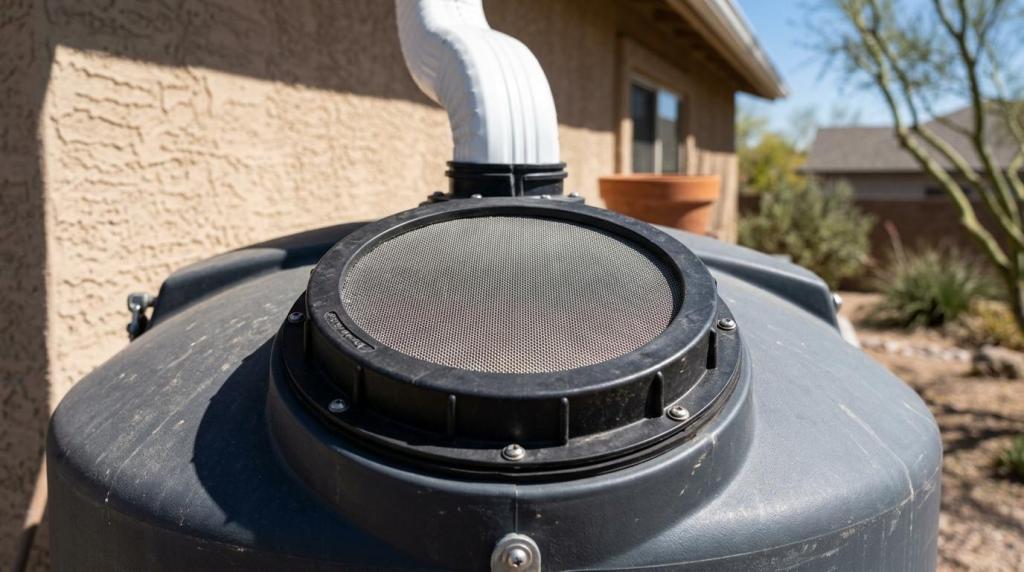
Step 2 is system design. Ask whether the company can route selected downspouts to a tank, steel culvert cistern, or basin without creating overflow problems near the house. Sealed, UV-protected tanks and screened openings matter here in Tucson because sun exposure is intense and stagnant water attracts problems fast.
Southern Arizona Rain Gutters says it offers custom harvesting systems from 200 to 10,000+ gallons, with UV-protected tanks and screened openings to help prevent algae and mosquitoes.
"Southern Arizona Rain Gutters offers rainwater harvesting systems from 200 to 10,000+ gallons with UV-protected tanks and screened openings, which matters in Tucson sun."
Step 3 is matching the system to how you will use the water. If the goal is landscape support, then overflow direction, first-flush management, and access for maintenance matter just as much as tank size.
A good conversation should cover at least these points:
- Water source: which roof sections will feed the system
- Storage plan: above-ground tank, steel culvert cistern, or future-ready stub-out
- Protection details: screened inlets, sealed openings, and UV-resistant components
- Paperwork: workshop, pre-approval status, and proof of active Tucson Water service if the rebate applies
Can a gutter company really protect stucco, fascia, and foundations from water damage?
Yes, a well-designed gutter and drainage system can protect Tucson stucco, fascia boards, and foundation edges from repeated splash and runoff.
A lot of people think of gutters as a roof accessory. Really, they are part of the wall and drainage system. When water sheets off a roof edge, it can stain stucco, rot fascia, erode planting beds, and create muddy splash zones along the stem wall. Over time, that is more expensive than the gutter itself.
This is where details matter. Fascia wrap can protect exposed wood. Clean miters and outlets reduce leak points. Proper slope keeps water moving. Downspouts need a planned landing area, not just an open patch of dirt. If your lot slopes toward the house or toward a side gate, the installer should notice that during the bid.
Pro tip: ask to see close-up photos of corners, downspout attachments, and terminations from prior jobs. Straight runs are easy. The corners tell you how careful the crew is.
What should a Tucson gutter estimate and warranty include in writing?
A solid Tucson gutter estimate should read like a work plan, not a one-line price.
Before you sign, the document should answer the basic questions that tend to cause disputes later. If something is missing, ask for it in writing. That goes for gutter size, fascia work, and the exact downspout layout.
Look for these details:
- Material and profile: aluminum or copper, seamless or sectional, K-Style or another profile
- System sizing: 5-inch, 6-inch, or 8-inch gutters and the number and size of downspouts
- Attachment and trim: hanger spacing, fascia wrap, sealant use, and any wood repair exclusions
- Drainage plan: where each downspout terminates and whether it ties into a basin, extension, or cistern
- Warranty terms: what is covered, for how long, and what maintenance or misuse can void it
If you are also planning water harvesting, ask whether the estimate includes screens, overflow routing, tank connections, and any rebate-related documentation. If a company will not write the scope down clearly, keep shopping.
A few more questions before you hire
When is the best time of year to install gutters in Tucson?
Late spring through early summer, before the monsoon arrives in July, is ideal so your system is ready for the season's first heavy storms. Fall and winter work well too, since the dry, mild weather makes scheduling easier. The one thing to avoid is waiting until rain is already in the forecast, because reputable crews book up fast once the storms start.
How long does a gutter installation usually take?
Most single-story Tucson homes are finished in a single day once measurements and fabrication are done. Larger homes, multi-level rooflines, or jobs that add fascia wrap or a harvesting connection can run two days or more. Because seamless gutters are cut to length on-site, the actual hanging tends to go faster than people expect.
Do I need a permit to install gutters in Tucson?
Standard residential gutter and downspout work typically does not require a City of Tucson building permit, but a licensed contractor will know when one applies to your situation. Rainwater harvesting setups tied to a rebate involve workshop and pre-approval paperwork rather than a building permit. When in doubt, ask your contractor to confirm the requirements before work starts.
Will my HOA need to approve new gutters?
In many Tucson-area neighborhoods, especially master-planned communities in Oro Valley, Marana, and Sahuarita, gutters fall under architectural guidelines that cover color and placement. It is worth reviewing your HOA rules before choosing a finish, since matching the gutter color to your trim or fascia usually satisfies approval. A good installer can work within common color requirements.
How often should gutters be maintained in Tucson's dry climate?
Even without heavy tree cover, Tucson gutters collect dust, palo verde and mesquite debris, and blown grit that can clog outlets right before monsoon season. Clearing them once in late spring and again after the monsoon ends is a sensible rhythm for most homes. Properties near dense desert landscaping or under overhanging limbs may need an extra check mid-season.
What affects the cost of a gutter system in Tucson?
Cost depends less on a flat per-foot rate and more on the specifics: total footage, gutter size, material, the number of downspouts, and whether fascia wrap or a harvesting connection is included. Copper runs significantly higher than aluminum, and rooflines with many corners require more labor. That is why two homes on the same street can receive very different estimates.