ES
ES 
Choosing the best gutter colors for stucco homes in Tucson or anywhere around Southern Arizona seems like a small detail until the wrong one goes up. Then it is all you see.
I have seen beautiful stucco homes with good rooflines, nice tile, and solid curb appeal get thrown off by bright white gutters that looked like an afterthought. I have also seen modest homes look more finished just by choosing a gutter color that matched the fascia, roof, or stucco tone.
Out here, color choice is not only about looks. Our sun is hard on finishes, monsoon runoff can leave streaks, and desert dust settles on everything. If the house is set up for rainwater harvesting, the gutters and downspouts are even more visible because they lead the eye toward barrels or cisterns. So the best gutter color is the one that fits the house and still looks good after a few summers and a couple of monsoon seasons.
Why gutter color matters on stucco homes in Southern Arizona
Stucco has a soft, solid look. Most homes here are painted in warm colors: sand, tan, cream, adobe, greige, muted peach, light brown. Gutters sit right at the edge of that finish, so they either blend in and support the architecture, or they cut across it.
That matters more on desert homes than people realize. A lot of Tucson houses are simple massing with clean wall planes, clay tile roofs, wood accents, and low-contrast trim. A gutter that is too bright or too dark can pull attention away from the parts of the house that should stand out.
When homeowners ask me what color to pick, I usually tell them to look at the house in this order:
- roof tile
- fascia and trim
- stucco body color
- window frame color
- garage door and wood accents
If the gutter color works with those fixed parts, it usually looks right.
Best gutter colors for warm stucco exteriors
For most stucco homes in this part of Arizona, warm neutrals win. Tan, bronze, dark beige, brown, copper-look, and some muted metallic finishes tend to sit well with the house instead of fighting it.
Bright white can work, but only when the trim, fascia, and window details are already white and the home has a lighter, cleaner palette. On many earth-tone stucco homes, white gutters look too sharp. They show dust faster, show muddy splash marks after storms, and can make the eave line feel chopped up.
Here is the quick version I use when helping homeowners narrow it down:
| Stucco color | Roof style/color | Gutter colors that usually work best | Overall look |
|---|---|---|---|
| Light sand or cream | Red clay or terracotta tile | Bronze, copper-look, dark tan | Warm and classic |
| Beige or caramel stucco | Brown tile or brown shingle | Dark bronze, brown, tan | Blended and low-contrast |
| Adobe or clay-toned stucco | Terracotta tile | Copper, copper-look, umber | Rich and traditional |
| Warm greige or off-white | Dark bronze trim, modern lines | Dark bronze, charcoal, muted metallic | Clean and more modern |
| Very light stucco with white trim | Light roof or white fascia | White, almond, soft beige | Crisp, but only if details match |
For a typical Tucson stucco home with tile roofing, bronze is often the safest answer. It has enough depth to look intentional, but it still feels natural with desert colors.
Copper-look finishes are another strong choice when the house has clay tile, wood beams, rustic doors, or Spanish-style details. Real copper is beautiful too, though it is a different budget category and it changes over time. Some homeowners love that aging process. Some do not.
How roof tile and fascia color should guide gutter color
If you are stuck between two or three colors, stop staring at the stucco for a minute and look up. The roof edge usually gives you the answer faster than the wall color does.
That is because gutters sit against the fascia line. On many homes, especially with K-Style gutters, the profile is visible from the street and reads as part of the trim package. If the gutter color works with the fascia wrap and roof edge, the whole system looks built in instead of added later.
I usually suggest homeowners use this order of priority:
- Roof first: Match the warmth and tone of the tile, shingle, or roof trim.
- Fascia next: If the fascia is a strong visual line, matching it usually gives the cleanest look.
- Stucco third: Good when you want the gutter to fade into the house.
- Windows and doors: Useful for homes with strong bronze or dark brown frame colors.
- Harvesting components: If downspouts feed visible tanks or cisterns, coordinate those colors too.
Fascia wrap matters here too. When the fascia is wrapped in aluminum, matching the gutter to that wrap can make the entire roofline look cleaner and reduce the patchwork look you get when trim, fascia, and gutter all read as different colors.
If your home has exposed rafters, vigas, or stained wood trim, dark bronze or brown usually sits better than a light gutter color. It picks up that wood tone and gives the house a grounded look.
Gutter colors that hide dust, sun wear, and monsoon streaks
Mid-tone colors are the most forgiving in desert conditions. The prettiest color sample in the shade can be the worst choice six months later after UV exposure, dust storms, and roof runoff.
Bronze, brown, tan, and muted metallic finishes tend to hide dust and light streaking better than stark white or deep black. They also fit the surrounding landscape better, which matters more than people think. Gravel yards, block walls, native plants, and dusty driveways all affect how a color reads from the curb.
Very dark colors can look great on the right house, but they show mineral spotting and hard water marks more readily. White shows dirt fast. That leaves the middle of the color range as the easiest to live with.
A few practical patterns show up over and over:
- White shows dust and runoff marks quickly
- Bronze hides everyday dirt well
- Tan blends nicely with stucco and desert surroundings
- Black and charcoal are sharper, but less forgiving
- Copper-look tends to age visually better than bright painted colors
The finish matters just as much as the color. In Tucson sun, a cheap finish can chalk, fade, or look tired long before the gutter itself wears out. Factory-finished aluminum with a good UV-resistant coating is usually the best value for most homes around here.
High-performance factory finishes hold their color far better than field paint. Arkema's Kynar 500 PVDF coatings are engineered to resist fading and chalking under long UV exposure, which is the kind of difference that shows up on aluminum after a few seasons of intense Tucson sun.
When dark contrast gutters work on modern stucco homes
Not every stucco house should have gutters that disappear. Some homes look better with a little definition at the roofline.
This is most common on desert-modern houses with clean geometry, darker window frames, metal accents, and a simpler color palette. If the home already uses contrast on purpose, dark bronze or charcoal gutters can look right at home.
The key is making sure the contrast repeats somewhere else on the house. A dark gutter color should tie into window frames, door hardware, metal roofs, light fixtures, or a dark fascia detail. If it is the only dark line on the exterior, it can feel random.
I would be more cautious with black gutters on traditional stucco homes with rounded edges, clay tile, and warm trim. In that setting, black can look too severe. Dark bronze gives a similar amount of definition without feeling out of place.
Common gutter color mistakes on Tucson stucco houses
Most mistakes come from treating gutters like a generic add-on instead of part of the architecture.
I see the same problems repeat, especially when homeowners pick from a small sample chip indoors or order based only on what a neighbor used.
- Choosing white by default when the home has no other white trim.
- Ignoring the roof tile color and matching only the stucco.
- Picking a dramatic dark color on a traditional adobe-style house.
- Forgetting that downspouts are often more visible than the gutters.
- Skipping HOA review and having to change plans later.
Another common issue is thinking color alone will fix a poor layout. It will not. If the downspouts land in awkward spots, or if the gutters are the wrong profile for the fascia, even the right color will only do so much. Most stucco homes here look best with a clean K-Style profile sized correctly for monsoon flow. On some homes, half-round or custom work fits better, but that is the exception.
Material finish and gutter profile affect color appearance
The same color can look different depending on the gutter material and shape. Aluminum is the most common choice here for good reason. It handles heat well, resists rust, and comes in a wide range of finishes that hold up better than older painted systems.
Copper is a different animal. It is beautiful on the right house, especially with natural stone, clay tile, or higher-end desert architecture. But it is not just a color choice. It is a material statement, and the look changes as it ages.
Profile matters too. K-Style gutters have flatter faces, so the color reads more clearly from the street. Half-round gutters catch light differently and can appear a bit softer. If the house has a wide fascia and visible eaves, the gutter color will stand out more than it would on a tighter roof edge.
If you are adding rainwater harvesting, think about the full system, not only the horizontal gutter. Downspouts, first-flush components, and visible piping all become part of the exterior look. On homes with above-ground tanks or steel culvert cisterns, matching the downspouts to the wall, trim, or tank area can make the whole setup feel cleaner and more intentional.
A good gutter color should still look good when the sun is hitting it at 4:30 in the afternoon, when dust has settled on it, and when monsoon rain is running through it. That is the real test in Southern Arizona.
If you are standing in the driveway trying to decide, start simple. Match the fascia if you want the gutters to fade in. Match the roof tone if you want them to feel tied into the architecture. Choose bronze, tan, or copper-look if you want the safest path for most stucco homes. Those colors tend to age well, handle our desert setting better, and keep the attention where it belongs: on the house itself.
Key Takeaways
- For a typical Tucson stucco home with a tile roof, bronze is the safest default color.
- Save white for homes that already carry white trim, fascia, and window details.
- On desert-modern homes, charcoal or dark bronze works best when the contrast repeats elsewhere on the exterior.
- West-facing runs take the hardest UV, so avoid light colors there and lean on factory-finished aluminum.
- Copper-look finishes capture the clay-tile, Spanish-style feel without the cost of real copper.
Gutter Color Questions We Hear From Tucson Homeowners
Do downspouts have to match the gutters exactly, or can they be a different color?
They do not have to match exactly, but they should at least be in the same family. Downspouts are often more visible than the gutters themselves because they run vertically down the wall, so a noticeable mismatch tends to read as an error rather than a design choice. If the gutters are bronze and the downspouts are white, most people will notice. A shade or two apart within the same warm or cool tone is usually fine, but matching them is the cleaner approach, especially on homes with visible above-ground harvesting components where the eye follows the whole path from roofline to tank.
Can existing gutters be repainted if the color is not working?
Yes, aluminum gutters can be repainted, but it is not the simplest fix. The surface needs to be cleaned, lightly scuffed, primed with an appropriate bonding primer, and then painted with an exterior paint that handles UV exposure and metal expansion. If the existing finish is already chalking or peeling, you are adding paint on top of a failing substrate, which shortens how long the new coat holds. For most homeowners, repainting is worth considering if the gutters are structurally sound and the issue is purely cosmetic. If the gutters are aging or undersized for monsoon flow, it usually makes more sense to replace them and choose the right factory finish from the start.
What happens to gutter color on a home that gets direct afternoon sun on the west elevation?
West-facing gutters take the hardest UV punishment of any side of the house. Lighter colors, especially white and light beige, tend to chalk and yellow faster on that exposure. Bright or saturated colors can fade unevenly. Factory-finished aluminum holds up considerably better than field-painted systems, but even good coatings will show some difference between the shaded and sun-exposed sides of the house after several years. Mid-tones like bronze and brown tend to show that differential less because the color has enough depth to absorb slight fading without looking obviously off.
Does gutter color matter if the gutters are mostly hidden behind a parapet wall?
If the horizontal gutter run is fully hidden, the color decision shifts almost entirely to the downspouts, which are still visible. In that situation, matching the downspout color to the stucco or wall finish usually makes the most sense, because you want them to recede rather than draw attention. If any portion of the gutter is visible at scupper outlets or transitions, coordinate those to the parapet cap or fascia material rather than treating them as separate decisions.
Is there a cost difference between gutter colors, or is it usually the same price?
Standard colors like white, brown, almond, and bronze are typically stocked by most suppliers and carry no upcharge. Specialty finishes like copper-look or less common custom tones may be priced higher or require a minimum order quantity, depending on the supplier. Real copper gutters are a separate category entirely and are priced by the linear foot at a significant premium over aluminum. For most stucco homes in the Tucson area, the practical color range that works best architecturally falls within the standard pricing tier, so color and budget usually align without much conflict.
How do you handle gutter color on a house with a two-tone exterior, where the body and trim stucco are different colors?
Two-tone exteriors need a tiebreaker, and the fascia is usually it. Since gutters sit directly against the fascia line, matching them to the fascia color, whether that is the lighter or darker of the two tones, gives the roofline a unified look. If the fascia is wrapped in aluminum, that wrap color is the clearest reference point. Trying to split the difference between two stucco tones rarely works; the gutter ends up looking like it belongs to neither. Pick the element it physically touches and match that.
If you live in Tucson, you already know rain gutters are not just about rain. They are about protecting stucco, foundations, walkways, fascia boards, and landscaping when a monsoon storm hits hard for 20 minutes and dumps water where you do not want it. A properly installed seamless gutter system gives that runoff a controlled path instead of letting it sheet off the roof edge and pound the ground below.
For most homes in Southern Arizona, seamless rain gutter installation makes more sense than pieced-together sectional gutters. There are fewer joints, fewer places to leak, and a cleaner look along the roofline. In a climate with intense sun, dust, and sudden heavy runoff, that matters.
Seamless rain gutter installation for Tucson homes
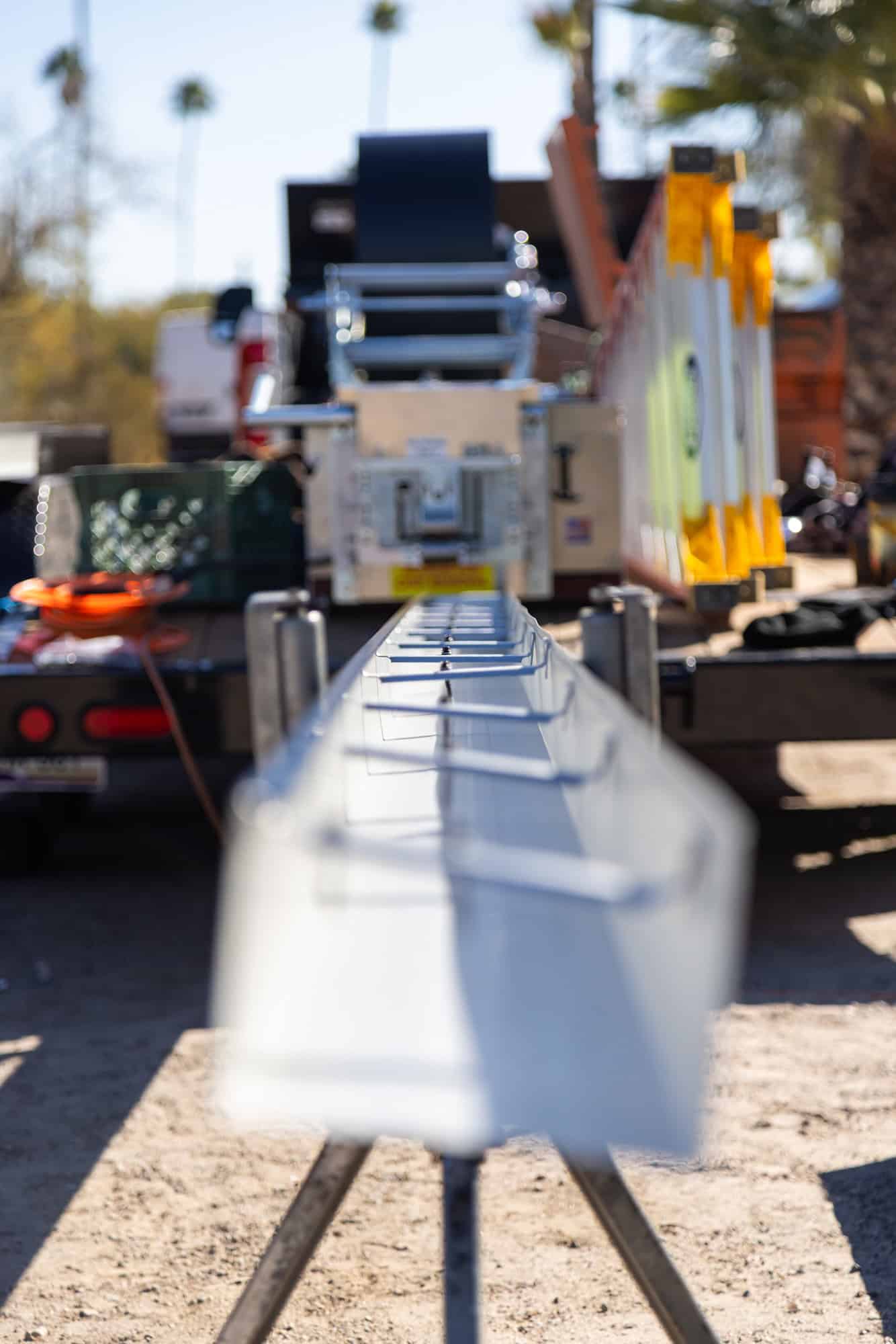
Seamless gutters are formed on site from a continuous coil of metal, then cut to the exact length of each roof section. That means one long piece instead of several smaller pieces patched together with connectors and sealant every few feet. You still have joints at corners, end caps, and downspout outlets, but the long straight runs are one piece.
That simple difference is why seamless gutters usually hold up better. Sectional systems tend to fail at the seams first. In Tucson, heat bakes sealants, wind shakes loose connections, and monsoon water finds every weak point. With seamless gutters, there are just fewer weak points to begin with.
They also look better. A clean K-Style profile that matches the trim does not call attention to itself. It just belongs on the house.
Why seamless gutters perform better in Southern Arizona weather
Our climate is rough on exterior materials. UV exposure dries out paint, cooks caulk, and shortens the life of lower-grade products. Then monsoon season shows up and tests everything at once.
A seamless gutter system helps with that because it is built for flow and support. We pay close attention to slope, hanger spacing, outlet size, and downspout placement. If any one of those is off, water can back up, overshoot the gutter, or sit in the trough and leave stains.
After looking at a home, these are usually the main reasons people switch to seamless gutters:
- Fewer leak points
- Cleaner roofline appearance
- Better support during heavy storms
- Less debris catching in joints
- Longer service life
When the house has exposed wood trim that is already weathered, fascia wrap often becomes part of the conversation too. In the desert, sun damage is real. Wrapping fascia in aluminum helps protect the wood and gives the new gutter a solid, finished mounting surface.
What happens during seamless gutter installation
A good installation starts with measuring, not with a price per foot thrown out over the phone. Roof area, pitch, roof type, valleys, scuppers, fascia condition, and drainage paths all affect the layout.
Once the plan is set, the gutter is roll-formed on site. That allows each run to be custom-made to the house rather than forced to fit. Corners are cut and joined carefully, outlets are placed where they actually need to be, and the whole system is pitched so water moves toward the downspouts instead of standing in the channel.
A typical installation usually includes a few key steps.
- Measurement and layout: checking roof edges, downspout locations, and drainage away from the foundation
- On-site fabrication: forming seamless runs in the selected profile and color
- Installation and sealing: fastening with hangers, setting pitch, and sealing corners and end caps
- Water management: tying downspouts into splash blocks, extensions, drains, or harvesting lines
On some Tucson homes, especially flat-roof homes, scupper boxes are part of the system. On others, 5-inch or 6-inch K-Style gutters are the best fit. The right answer depends on how much roof area is feeding that edge and how fast that water needs to move.
Gutter profiles and materials for seamless gutter installation
Most residential projects use aluminum because it is light, rust-resistant, and available in a wide range of colors. It is a practical choice for Southern Arizona and works well on most stucco and tile-roof homes.
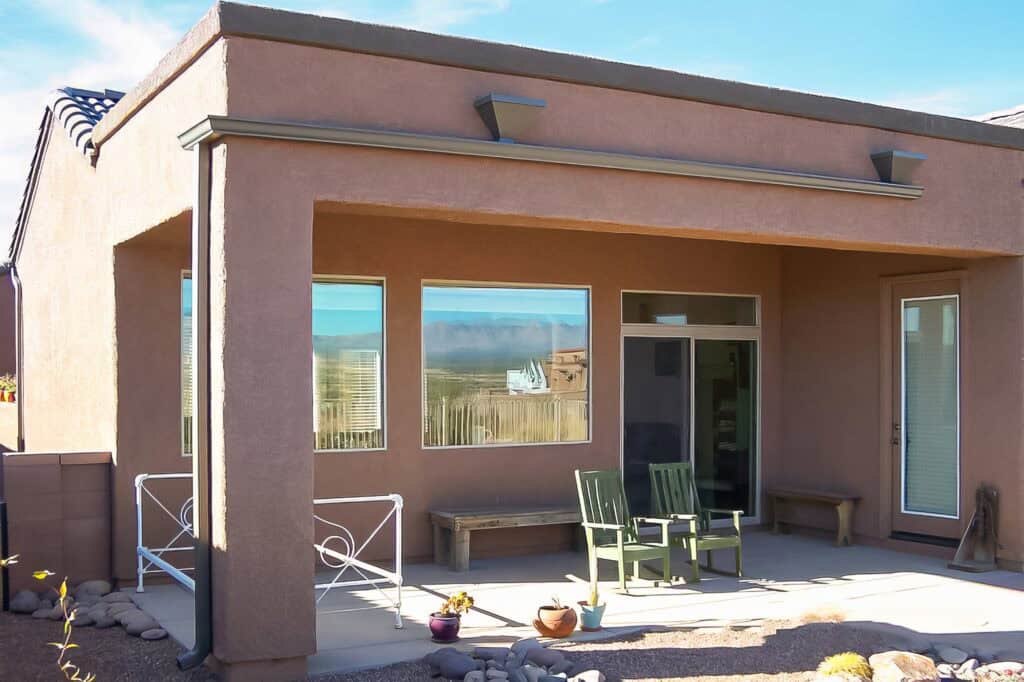
Copper is a premium option. It costs more, but it lasts a very long time and develops a natural patina that some homeowners want for architectural reasons. Galvanized steel can also be used where extra rigidity is needed, though aluminum remains the most common material for residential work here.
The gutter profile matters too. K-Style is the standard for many homes because it carries a good amount of water and fits the look of typical residential fascia. Half-round gutters have a softer, more traditional appearance. Box-style profiles are used on some modern or commercial buildings.
| Feature | Seamless Gutters | Sectional Gutters |
|---|---|---|
| Long runs | One continuous piece | Multiple pieces joined together |
| Leak risk | Lower | Higher |
| Maintenance | Less joint cleanup and resealing | More frequent seam issues |
| Appearance | Cleaner and more uniform | More visible connections |
| Best use | Long-term home protection | Budget-minded short-term fix |
Seamless gutters and rainwater harvesting systems
In Tucson, it makes sense to think beyond drainage alone. If water is leaving your roof, that water can often be directed into a harvesting setup instead of wasted onto bare ground or pavement.
A seamless gutter system is a strong starting point for rainwater harvesting because it gives you controlled collection. Water can be routed into barrels, larger tanks, or full cisterns depending on the property and goals. On bigger systems, screened inlets and UV-protected storage matter, especially in the desert where heat and algae growth can become issues.
That is one reason gutter layout needs to be planned with the whole site in mind, not just the eave line.
If a homeowner is interested in water conservation, we usually look at a few things during planning:
- Roof yield: how much water the roof can actually collect
- Storage goals: small decorative barrel or larger cisterns
- Use of water: landscape irrigation, trees, garden beds
- Overflow control: where excess water goes during a big storm
Even if you do not install tanks right away, it is smart to set up the gutters and downspouts so a harvesting system can be added later without redoing the whole job.
Common problems we fix during gutter replacement
A lot of gutter jobs in Southern Arizona are not just new installs. They are corrections. The old system may have been undersized, poorly sloped, or attached to fascia that should have been repaired first.
We also see gutters that are technically present but not doing the job. Water spills over at valleys, downspouts dump too close to the slab, or long runs sag because the hanger spacing was too wide. During a summer storm, those problems show up fast.
Here are some common issues that point to replacement or redesign:
- Water near the foundation: downspouts are too short or poorly placed
- Overflow at one corner: the gutter is undersized or pitched wrong
- Peeling fascia paint: long-term moisture exposure or sun-damaged wood
- Staining on stucco: runoff is missing the gutter or splashing back
Sometimes the fix is as simple as improving downspout placement. Sometimes the right answer is a full seamless system with larger capacity and better support.
What to expect from a professional gutter estimate in Tucson
A solid estimate should cover more than linear footage. It should explain the profile, material, size, color, downspout count, and any related work like fascia wrap or drainage extensions.
It should also account for how Tucson homes are built. Tile roofs, flat roofs, parapets, courtyards, and mixed rooflines all affect installation. A one-size-fits-all gutter plan usually leaves a problem area somewhere.
If you are comparing options, ask how the system handles monsoon volume, how the downspouts discharge, and whether the layout leaves room for rainwater harvesting later. Those are the details that make the difference between gutters that simply hang on the house and gutters that actually protect it.
For homeowners planning to stay in their property, seamless rain gutter installation is usually the better long-term move. It gives you cleaner lines, fewer repairs, better storm control, and a system that can be built around the way water moves on your lot.
Common Questions About Seamless Gutter Installation
How long do seamless aluminum gutters typically last in the Tucson climate?
Properly installed aluminum seamless gutters generally last 20 years or more, though Southern Arizona's conditions create some specific wear patterns. UV exposure is the bigger aging factor here, not rust or moisture: aluminum handles our dry climate well. What shortens lifespan faster than the material itself is improper pitch, undersized hangers, or fastening into deteriorated fascia. A system that was installed correctly from the start, with good support and slope, tends to hold up through many monsoon seasons without significant issues.
Do seamless gutters work on homes with no visible fascia board, like many flat-roof or parapet-style Tucson homes?
Flat-roof and parapet homes require a different approach than standard fascia-mounted systems. On these homes, scupper boxes and internal drains are typically the primary drainage method, sometimes combined with short gutter sections at covered entries or patios. The installation method depends on what the roofline actually offers as a mounting surface. This is one reason a site visit matters more than a phone quote: the right solution for a flat-roof home in the Foothills may look very different from a pitched-roof ranch in Marana.
How often should seamless gutters be cleaned in Southern Arizona?
Twice a year is a reasonable baseline for most Tucson homes, but the actual frequency depends on the tree cover around the property. Homes near mesquite, palo verde, or pine trees typically need more attention because seed pods, needles, and small debris accumulate faster. The period just before monsoon season, late May or early June, is a practical time for a cleaning and inspection, so the system is clear when the heavy runoff starts. After monsoon season ends is a good second window.
Can gutter guards or leaf protection screens be added to seamless gutters?
Yes, most gutter guard systems are compatible with seamless gutters. The main options are micro-mesh screens, reverse-curve covers, and simple insert filters. In Tucson, micro-mesh tends to perform better than open designs because it blocks the fine debris that wind carries onto rooftops here: dust, seed pods, and dried palm fronds. No guard eliminates maintenance entirely, but the right one can significantly reduce how often the troughs need clearing. Guard selection should be matched to the gutter profile and the debris type typical for that specific yard.
What is the difference between a splash block and a downspout extension, and which one does Tucson soil need?
A splash block is a small concrete or plastic pad placed at the base of a downspout to prevent soil erosion directly under the discharge point. A downspout extension carries the water farther from the house before releasing it. In Tucson, where soil can be compacted caliche close to foundations, extensions are often the more effective option because they move water far enough away that it disperses before it can pool near the slab. On sloped lots, underground drainage pipes tied into dry wells or swales can work even better. The goal in all cases is the same: water should be moving away from the structure, not sitting next to it.
Is it possible to match seamless gutter color to existing trim on a stucco home?
Aluminum seamless gutters are roll-formed from pre-painted coil stock, which comes in a wide range of standard colors. Most manufacturers offer 20 to 30 color options including whites, tans, browns, and grays that are common on Tucson stucco homes. An exact match to painted wood trim is not always possible since paint formulas differ from coil coatings, but a very close visual match usually is. If you are also having fascia wrapped in aluminum at the same time, the wrap and gutter can be ordered in the same color for a unified roofline appearance.
Does seamless gutter installation require a permit in Tucson or the surrounding municipalities?
For standard residential gutter installation, a permit is generally not required in most Tucson-area jurisdictions. However, if the project involves significant drainage modifications, tie-ins to underground systems, or is part of a larger permitted project, local requirements may apply. Rules can also vary between the City of Tucson, Pima County, and incorporated towns like Oro Valley or Marana. When in doubt, your contractor should be able to confirm what applies to your specific address and project scope before work begins.
A well-designed rain gutter system should do more than hang off the roof edge and hope for the best. Around Tucson, it has to deal with hard sun, sudden monsoon downpours, roof runoff that can stain stucco, and the simple fact that water is too valuable to waste.
That is why gutter design matters. Southern Arizona Rain Gutters plans each system around the home itself, not around a one-size-fits-all layout. The roof shape, square footage, fascia condition, drainage path, and water harvesting goals all affect what should be installed and where.
Custom gutter design for Tucson homes
In Southern Arizona, a gutter system has two jobs. First, it needs to move water away from the house fast enough to protect foundations, walkways, patios, and landscaping. Second, it should fit the home visually, so it looks like part of the architecture instead of an afterthought.
A house in Oro Valley with long roof runs and stucco walls may need something very different from a flat-roof home in central Tucson or a larger property in Vail with room for cisterns. That is why custom gutter design starts with the roofline and the site conditions, then works outward from there.
When homeowners ask what makes a gutter system “custom,” the answer is pretty simple: size, profile, material, placement, and drainage strategy are all chosen for that specific property.
How custom gutter design is planned
The first step is measuring the roof area and looking at how water already behaves during a storm. Some homes have obvious trouble spots, like water dumping over entryways or washing out planting beds. Others have hidden issues, like fascia boards drying out from sun exposure or runoff hitting the same corner of the house over and over.
From there, the layout gets built around capacity and control. That includes the gutter profile, the slope of each run, the number of downspouts, and where those downspouts should discharge. On flat roofs, scupper boxes are often part of the plan so water can move cleanly from the roof edge into the drainage system.
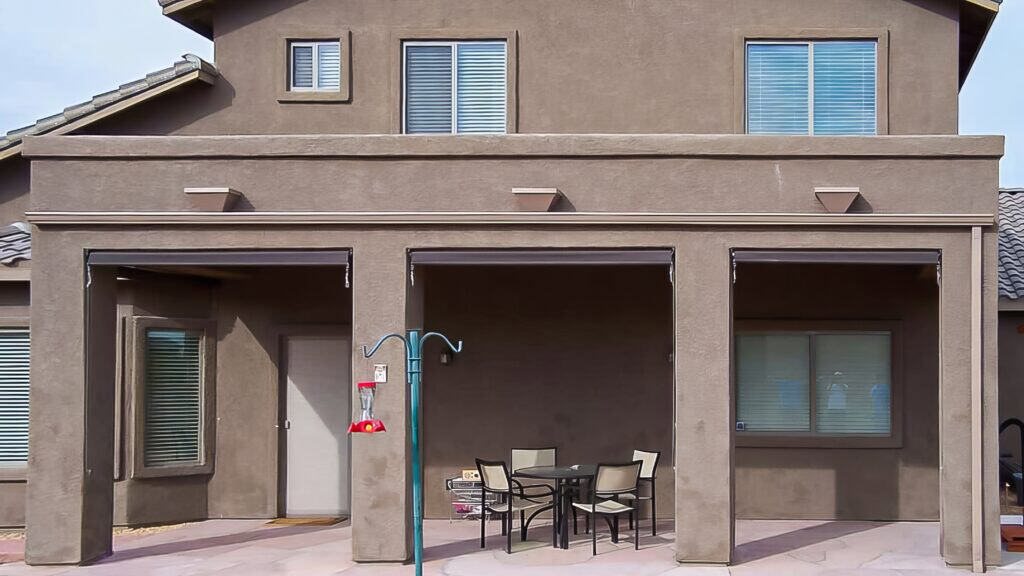
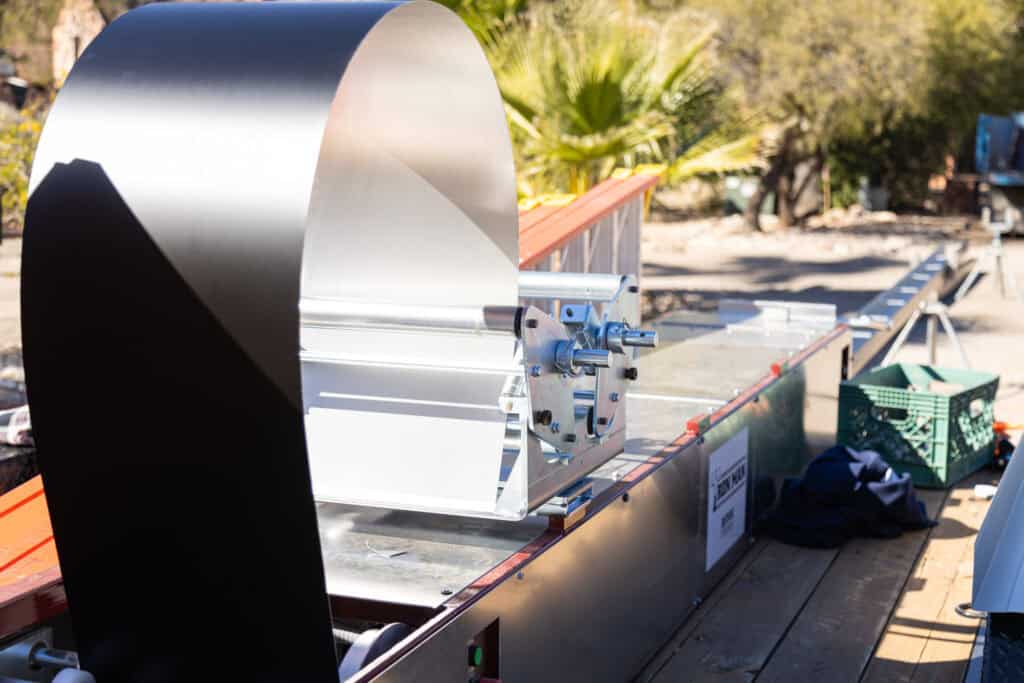
Seamless gutters are typically formed on-site in continuous lengths, which cuts down on joints and leak points. Proper support spacing matters too, especially during monsoon season when a long gutter run can hold a surprising amount of weight.
A solid design usually considers:
- Roof size and slope: how much water the system has to catch and move
- Drainage goal: direct runoff away from the foundation, into landscape areas, or into cisterns
- Roof style: pitched roofs, flat roofs, tile roofs, and parapet details all change the layout
- Entryways and patios
- Problem areas: stucco splashback, erosion, pooling water, and overshooting downspouts
Gutter profiles and materials for custom gutter systems
Most residential homes in Tucson do well with 5-inch or 6-inch K-Style gutters. They have good capacity, a clean appearance, and work with many home styles. For larger roof sections or commercial properties, 8-inch K-Style may be the better choice because it handles more water during heavy rains.
For homeowners who care as much about appearance as performance, there are other options. Half-round gutters have a classic look that works well on historic or custom homes. European Box gutters give a sharper, more modern line. Copper gutters bring a premium finish and develop a natural patina over time. Aluminum remains the most common choice because it holds up well in desert conditions and comes in many colors.
| Gutter Option | Best Fit | Main Benefit |
|---|---|---|
| 5" K-Style | Most homes | Good capacity and clean appearance |
| 6" K-Style | Larger residential roofs | More flow for monsoon runoff |
| 8" K-Style | Commercial or very large roofs | High-capacity drainage |
| 6" Half-Round | Classic and custom homes | Traditional profile with smooth flow |
| 6" European Box | Contemporary homes | Crisp modern look and strong performance |
| Copper | High-end architectural projects | Long life and distinctive patina |
Color also matters more than people think. A gutter system can be matched closely to fascia, trim, roof edge, or paint color so it blends in, or it can be chosen to stand out as a detail on the home.
Rainwater harvesting gutter design and cistern integration
A custom gutter plan can also be built around water harvesting from the start. That changes the design in a few important ways. Downspouts need to be placed where storage tanks or cisterns make sense. Overflow has to be planned so a full tank does not dump water back against the house. Screening and sealed openings matter too, especially in heat where algae growth and mosquitoes are concerns.
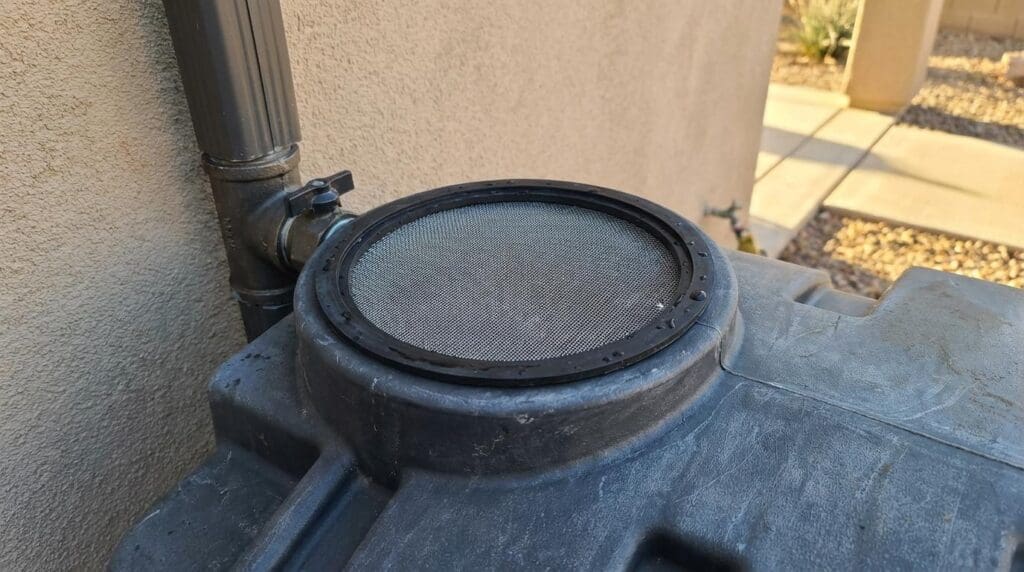
Southern Arizona Rain Gutters designs systems ranging from small collection setups to large storage layouts from 200 gallons to more than 10,000 gallons. Some homeowners want a simple tank for landscape watering. Others want a larger cistern system that supports irrigation, backup water storage, or a more serious conservation plan.
Pumps, filters, and underground drainage can be part of the design when needed. That is especially useful on larger lots where moving overflow away from the structure is just as important as collecting the first wave of rain.
Common harvesting layouts include:
- Small above-ground tanks
- Multi-downspout collection: several roof sections tied into one storage system
- Overflow planning: discharge lines or underground drains for heavy storm events
- Steel culvert cisterns
- Protected storage: UV-resistant tanks with screened openings to help keep water cleaner
Fascia wrap design for sun and moisture protection
In Tucson, gutters are only part of the roof edge story. Fascia boards take a beating from the sun, and once monsoon moisture gets into dried-out wood, damage moves fast.
That is why fascia wrap is often included in a custom design. Aluminum fascia wrap is bent to fit the home, color-matched to the trim, and installed to cover exposed wood. It helps protect fascia from UV damage, limits moisture penetration, and gives the roof edge a cleaner finished look.
This is especially useful on south- and west-facing sides of the house where the sun is hardest on exposed wood. When the fascia is protected first, the gutter system has a better base to attach to and usually lasts better as a result.
Why seamless gutter design matters in Southern Arizona
Every joint in a gutter run is a potential failure point. Sectional gutters are seamed together every few feet, and those seams are exactly where problems tend to start: they loosen under the weight of a hard monsoon downpour, collect debris, and eventually separate or corrode. Once a seam starts to leak, water runs down the fascia and stucco below it, leaving the streaks and staining most Tucson homeowners have seen on older homes.
Seamless gutters are formed on-site from a single continuous length of coil, so a full run has no joints except at the corners and downspout outlets. Fewer joints usually means fewer leaks, fewer drips down the stucco, and less maintenance over time. It also holds up better to the desert's temperature swings, where daily expansion and contraction slowly work sectional seams loose over the years.
For Southern Arizona specifically, that difference matters most during monsoon season, when a long gutter can be carrying a heavy, fast-moving load of water for short bursts. A seamless run handles that surge as one continuous channel instead of a chain of joints each hoping to hold.
What to expect during a gutter design visit
A good site visit should feel practical, not rushed. The roofline gets measured, drainage paths are checked, fascia condition is reviewed, and the homeowner’s priorities are discussed. Some people want the cleanest look possible. Some want to stop erosion near the foundation. Some want to harvest every drop they can during monsoon season.
After that, the design recommendation should be clear. You should know what profile is being suggested, why that size fits the roof, where the downspouts will go, whether fascia wrap is recommended, and how the water will leave the property or enter storage.
The process often includes:
- On-site measurements
- Profile selection: K-Style, half-round, European Box, or copper
- Color matching
- Drainage layout: downspouts, scuppers, splash control, and underground discharge if needed
- Harvesting options
- Project scope: full installation, fascia wrap, cistern tie-in, or DIY parts pickup
Some projects stay simple, and that is fine. Others turn into a full roof-edge and water management upgrade with gutters, fascia wrap, and rainwater storage working together. The right choice depends on the home, the budget, and what problems need to be solved now so they do not get more expensive later.
For homeowners in Tucson, Marana, Oro Valley, Sahuarita, Green Valley, Vail, Nogales, Rio Rico, Sonoita, and nearby areas, that custom approach usually makes the difference between a system that just hangs there and one that actually works when the summer storms hit.
Questions About Custom Gutter Design
How long does a custom gutter installation typically take once the design is finalized?
Most residential installations are completed in a single day. Larger projects that include fascia wrap, multiple downspout runs, or cistern tie-ins may run into a second day. Because seamless gutters are formed on-site, there is no waiting on prefabricated parts — the fabrication and installation happen during the same visit.
Do gutters in Tucson require any permits?
Standard gutter installation generally does not require a permit in most Tucson-area municipalities. However, if the project involves underground drainage, grading changes, or a larger rainwater harvesting cistern, some jurisdictions may have requirements. It is worth checking with your local city or county office if your project goes beyond the gutters themselves.
What happens if I skip gutters altogether on a desert home?
Without gutters, monsoon runoff falls directly off the roof edge and lands at the foundation line. Over time, that concentrated impact erodes soil, undercuts hardscape, and can work moisture into stucco at the base of the wall. Desert homes are not immune to foundation and drainage problems — the rain is infrequent but intense, which makes unmanaged runoff more damaging, not less.
Are gutter guards or leaf screens worth it in Southern Arizona?
In areas with heavy tree cover — particularly mesquite, palo verde, or pine in higher elevations — mesh screens can reduce how often gutters need to be cleaned. In more exposed desert settings with little overhead vegetation, screens matter less. The bigger concern in Tucson is debris washing in from the roof surface during monsoon storms, so fine mesh that keeps out granules and sediment tends to perform better than coarser options.
Can an existing gutter system be tied into a rainwater harvesting setup, or does it need to be redesigned from scratch?
Existing systems can sometimes be adapted, but it depends on where the downspouts currently discharge and whether the layout allows storage tanks to be positioned logically. If downspouts are located on sides of the house where tank placement is impractical, rerouting may be needed. A site visit is the most reliable way to assess what is workable versus what would require a more involved redesign.
How often should a custom gutter system be inspected after installation?
A quick inspection before monsoon season and again after it ends covers most situations. The main things to check are whether the slope is still correct (gutters can shift slightly over time), whether downspout outlets are clear, and whether any joints or end caps show signs of separation. Systems with rainwater harvesting components benefit from checking screens and overflow lines at the same time.
If you’re weighing a do-it-yourself gutter job against hiring a crew, the real question is not just price. It’s whether the system will still be doing its job after a few Tucson summers, a couple of monsoon seasons, and years of hard sun on metal, sealant, and fasteners.
Around here, gutters are not decorative trim. They protect stucco, fascia, foundations, walkways, landscaping, and in many cases they feed water harvesting systems that homeowners count on for trees and irrigation. A gutter that looks fine on install day but leaks at every seam two summers later was never a bargain.
DIY vs professional gutter installation costs and tools
The first thing most homeowners compare is cost, and that’s fair. On paper, DIY usually looks much cheaper. You buy the parts, do the labor yourself, and skip the installation charge.
But paper math leaves out a lot.
Most DIY gutter jobs are built from sectional pieces bought off the shelf. Those sections have joints, and every joint is a future leak point if the cuts, slope, and sealant aren’t right. Professional crews usually install seamless gutters made on site to the exact length of each run. That changes the whole system, both in appearance and in long-term performance.
Here’s the plain version:
| Factor | DIY Installation | Professional Installation |
|---|---|---|
| Gutter type | Usually sectional | Usually seamless |
| Tools needed | Ladders, drill, snips, saw, rivet gun, sealant gun, level | Crew brings all tools and forming equipment |
| Material quality | Often lighter-gauge stock from retail stores | Heavier-gauge aluminum, steel, or copper options |
| Time required | Often a full weekend or more | Usually one day for many homes |
| Warranty | None on labor | Usually workmanship coverage |
| Long-term leak risk | Higher because of more seams | Lower because of fewer joints |
That gap matters a lot more in July than it does in January.
A homeowner can save money doing a basic one-story run. That part is true. What gets missed is the cost of tools, time, mistakes, cleanup, and the chance that part of the work has to be redone. If you need tall ladders, stabilizers, extra hands, or replacement pieces after a measuring mistake, the savings shrink fast.
Sectional gutters vs seamless gutters
This is where many DIY conversations should start.
Sectional gutters can work, but they depend on joints, connectors, and sealant. In Tucson, sealant takes a beating. UV exposure, heat, and rapid temperature swings dry things out faster than people expect. A seam that holds through one mild season may not hold after a long summer on a west-facing wall.
Seamless gutters cut down those weak spots. You still have sealed areas at corners, outlets, and end caps, but you remove a lot of failure points on the straight runs. That is one of the biggest reasons professional installation tends to last longer.
Gutter installation safety on Tucson homes
I’ll say this the same way I would standing in your driveway: the ladder is often the biggest problem, not the gutter.
A lot of homeowners are comfortable using tools. Fewer are comfortable spending hours moving ladders, lifting long metal pieces, reaching out past roof edges, and trying to keep everything level while working overhead. On a two-story house, that gets serious fast. On tile roofs, it gets even trickier because one wrong step can crack tile or put you in a bad spot.
Professional crews do this every day. They work as a team, which means one person is not trying to hold a 20-foot section, keep the pitch right, and manage ladder placement at the same time.

That alone is enough reason many people decide not to DIY.
There are a few situations where risk climbs quickly:
- Two-story rooflines
- Steep pitch roofs
- Tile roofs
- Long gutter runs
- Heavy or awkward materials
- Homes with uneven grade around the perimeter
Even on a single-story house, the work is more tiring than it looks. Gutters are light compared to other building materials, but they’re long, flexible, and awkward. Add heat and glare, and good judgment starts to slip.
Monsoon gutter performance and proper sizing in Southern Arizona
A gutter system in Southern Arizona has to handle two very different jobs. It has to sit in dry heat for months without falling apart, and then it has to move a lot of water in a short burst when the monsoon rolls in.
That’s why sizing, pitch, and fastening matter so much.
A common DIY mistake is to think any gutter is better than no gutter. Not always. If the profile is too small, the slope is off, or the downspouts are placed in the wrong spots, water shoots over the front edge or backs up at the corners. Then you get staining on stucco, rot in the fascia, splashback onto doors and windows, or water pooling where you don’t want it.
On many Tucson homes, 5-inch K-Style is enough. On larger roof areas, long runs, or heavy collection points, 6-inch K-Style may be the smarter call. Flat-roof homes can also need different detailing, including scuppers and placement that works with the way the roof sheds water. You can’t guess your way through that.
Common DIY gutter installation mistakes
The problems we repair most often are usually the same ones.
- Wrong pitch
- Too few downspouts
- Hangers spaced too far apart
- Weak sealant at miters and end caps
- Poor attachment into failing fascia
- Downspouts dumping water right by the foundation
Pitch is a big one. Too flat and the gutter holds water. Too steep and it can look crooked while still not draining well. You want consistent fall, not random dips and rises.
Fastening matters too. Monsoon wind will test every bracket and screw. A gutter that survives a calm hose test is not necessarily ready for a hard summer storm with wind pushing sheets of water across the roof.
Desert sun changes the material conversation
In colder climates, people talk more about snow load. Here, sun damage is the daily issue.
Cheaper sealants, thin finishes, and lower-grade components break down faster under desert exposure. That does not mean every DIY product is bad. It means you need to be honest about what you’re buying and how long you expect it to last.
If your goal is a quick fix before selling, that’s one thing. If your goal is twenty-plus years of service, the material choice needs to match that.
Curb appeal, fascia protection, and rainwater harvesting options
A professional install is not only about avoiding leaks. It also opens up better design options.
Most retail DIY setups are limited to standard sectional gutters in basic colors. Professional work gives you more flexibility with profiles, color match, downspout placement, and trim details. If the house has a certain style, the gutter system can support that instead of looking like an afterthought.
K-Style is the most common profile because it works well and looks clean on many homes. Half-round has a softer, more traditional look. Box profiles fit some modern and flat-roof designs better. Fascia wrap can also clean up exposed wood and help protect those edges from weather.
And if you care about water conservation, gutter installation becomes part of a bigger plan.
Here in Tucson, a properly designed gutter system can feed cisterns, steel tanks, or above-ground collection setups for landscape use. That takes more planning than a basic runoff system. You need screened inlets, solid outlets, overflow planning, and materials that hold up in the sun.
When a homeowner wants both drainage control and water harvesting, this is where professional layout usually pays off.
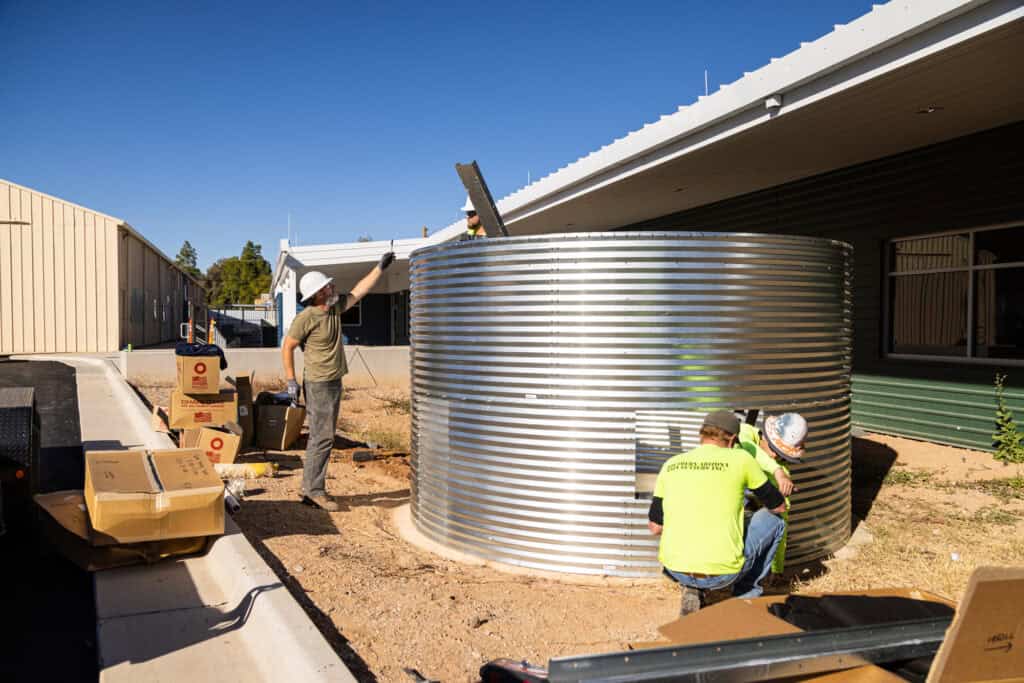
Rainwater harvesting adds a design layer
A standard gutter job sends water away from the house. A harvesting system sends water somewhere useful.
That means the gutter layout has to work with tank location, first-flush or filtration choices, overflow routes, and how you actually plan to use the stored water. If a cistern is part of the plan, the gutter system should be designed around it from the start, not patched into it later.
When DIY gutter installation can make sense
DIY is not always a bad idea. Some homeowners are skilled, careful, and realistic about the work. On the right house, it can be a reasonable project.
The key is matching the project to your experience level.
- Best fit: Single-story home with short, straight runs
- Good setup: You already own proper ladders and basic metalworking tools
- Right expectation: You are okay with sectional gutters rather than seamless
- Low-risk goal: Drainage improvement, not a custom architectural finish
- Extra help: You have another adult available for lifting and layout
If that describes your situation, DIY may be worth considering. A garage, patio cover, workshop, or small addition is often a better first project than the entire main house.
Just don’t treat your home like a practice run if the roofline is complicated.
When professional gutter installation is worth the money
For a lot of homes, hiring a pro is simply the smarter choice. Not because homeowners can’t learn, but because the margin for error gets small once the house gets taller, the runs get longer, or the system needs to do more than basic drainage.
If any of the items below sound familiar, I’d recommend getting a professional estimate before buying parts.
- Two-story home: Safety risk goes up fast
- Complex roof layout: Valleys, multiple levels, or tricky water concentration points
- Flat roof drainage: Scuppers, custom outlets, or box-style details
- Water harvesting plans: Cisterns, tank overflows, screened inlets, filtration options
- Finish matters: You want clean lines, custom colors, copper, or a profile that suits the house
- Fascia concerns: Wood damage, exposed rafter tails, or need for fascia wrap
There’s also the warranty piece. If a professionally installed gutter leaks, pulls away, or has a workmanship issue, you’re generally not starting from zero. With DIY, every callback is your own Saturday.
That matters more as the house gets older.
Older homes often have fascia issues hidden behind paint. Once you start removing old gutter, you may find soft wood, old patching, or fastener holes that won’t hold new hardware well. A crew that deals with this often can spot it early and fix the right problem instead of just attaching new metal to weak backing.
A practical way to decide between DIY and professional gutter work
If you’re on the fence, walk the house and answer a few honest questions. How high are the eaves? How many corners and downspouts are needed? Is the fascia solid? Are you trying to move water away from the house only, or also into cisterns? And are you okay with sectional gutters, or do you really want seamless?
That quick check usually points you in the right direction.
For a small, simple project, DIY can be fine. For a main residence in Southern Arizona, where sun, monsoon rain, and water conservation all matter, professional installation usually gives you a stronger system, cleaner appearance, and fewer repairs later. And if the gutters are going to feed landscaping or a rainwater harvesting setup, getting the layout right from day one is worth real money over time.
Questions Worth Asking Before You Start
How often do gutters need to be cleaned in the Tucson area?
Twice a year is a reasonable baseline for most homes — once before monsoon season and once after. Desert landscaping tends to drop less debris than deciduous trees, but dust, roof grit, and organic buildup still accumulate over time. Homes near mesquite, palo verde, or pine trees may need more frequent clearing, especially during seed and pod seasons. Blocked downspouts during a storm event cause problems quickly.
What are the signs that gutters need full replacement rather than repair?
Persistent rust, widespread seam failure, sections pulling away from the fascia in multiple places, or gutters that consistently hold standing water despite cleaning and slope correction usually point to replacement rather than patching. A gutter that has been repaired repeatedly in the same spots is telling you something. Cosmetic fading alone is not enough reason to replace a structurally sound system.
Do I need a permit to install gutters on my home?
In most cases, residential gutter installation does not require a permit. That said, requirements vary by jurisdiction, and certain situations — like structural changes to fascia, work on historic properties, or systems tied into a greywater or harvesting setup — may involve additional review. If you're in the City of Tucson or unincorporated Pima County, a quick call to the building department before you start is worth the few minutes.
What questions should I ask a gutter contractor before hiring?
Ask whether they install seamless gutters on site, what gauge aluminum they use, how they handle fascia repairs if needed, and what their workmanship warranty actually covers. Ask to see examples of downspout placement on homes similar to yours. If water harvesting is part of the plan, ask whether they have experience designing systems that feed cisterns or tanks, not just routing runoff away from the house.
Is there a better time of year to schedule gutter installation in Southern Arizona?
Spring and early summer tend to work well — monsoon season hasn't started, contractors are not yet at peak demand, and the dry conditions make for clean, stable installation days. Fall is also a reasonable window. Midwinter installs are generally fine from a weather standpoint, though scheduling can be tighter depending on contractor availability. Avoid committing to an install right before monsoon season starts if you haven't yet confirmed your booking.
How long do gutters typically last in the desert climate?
Quality aluminum seamless gutters professionally installed can last twenty to thirty years with reasonable maintenance. Sectional gutters with sealant joints tend to have a shorter service life in desert conditions, often in the ten to fifteen year range depending on sun exposure and how well the sealant holds up on high-heat wall orientations. Copper lasts longer but comes at a significantly higher material cost. The main factor cutting lifespan short is usually deferred maintenance — debris that holds moisture against the metal, or minor damage that goes unaddressed.
Are gutter guards worth installing in Tucson?
It depends on what's dropping onto your roof. For homes surrounded by trees that shed pods, seeds, or small leaves, a quality micro-mesh guard can meaningfully reduce cleaning frequency. For homes with minimal tree coverage, guards often add cost without enough benefit to justify them. Cheap foam or brush inserts tend to trap debris rather than repel it and can create new problems. If you're considering guards, ask your installer about specific products designed for desert conditions rather than systems marketed for wetter, leafier climates.
If you are handling your own gutter repair, replacement, or rainwater harvesting setup, getting the right parts matters just as much as the install itself. Around Tucson, that is especially true. Our sun is hard on finishes, monsoon storms hit fast, and water needs to be directed away from foundations, walkways, and planting areas without guesswork.
Parts pickup gives homeowners a practical middle ground. You can do the labor yourself, keep control of the project, and still get pro-grade materials instead of thin, off-the-shelf pieces that do not hold up well in Southern Arizona.
Tucson gutter parts pickup for homeowners and DIY projects
A lot of homeowners do not need a full installation crew. Sometimes you just need a few end caps, a drop outlet, matching downspout elbows, or a full run of K-Style gutter cut for your house. Other times, you are building out a rainwater harvesting system and need parts that work with barrels, cisterns, first-flush components, or screened inlets.
Pickup works well for several kinds of projects. A small repair after wind damage. Replacing old, sun-faded pieces. Extending a downspout to feed a basin. Swapping out undersized sections before monsoon season. Matching parts on an existing system without waiting on shipping.
That local piece matters more than people think.
Gutter parts available for pickup in Tucson
Most DIY pickup orders center around the same core parts used in professional seamless systems. That means metal components made to last, with better color matching and better fit than the plastic or light-duty parts you often see at big box stores.
Common pickup items include:
- 5-inch K-Style gutter parts
- 6-inch K-Style gutter parts
- 6-inch half-round components
- 6-inch European box gutter pieces
- 2x3 and 3x4 downspouts
- elbows, straps, and outlets
- inside and outside miters
- end caps
- hidden hangers and screws
- gutter sealant
- leaf screens and guards
- touch-up paint
- fascia wrap materials
Aluminum is the most common choice for homes in Tucson because it does not rust and it handles heat well when the finish is good quality. Galvanized steel still has its place, and copper is a solid fit when the architecture calls for it or when a homeowner wants a long-term specialty material with a natural patina.
Gutter profiles, sizes, and materials for Southern Arizona homes
Not every house should get the same gutter profile. Roof area, fascia shape, drainage points, and appearance all matter. In Tucson, monsoon bursts can dump a lot of water in a short time, so sizing should be based on actual roof flow, not just what looks standard.
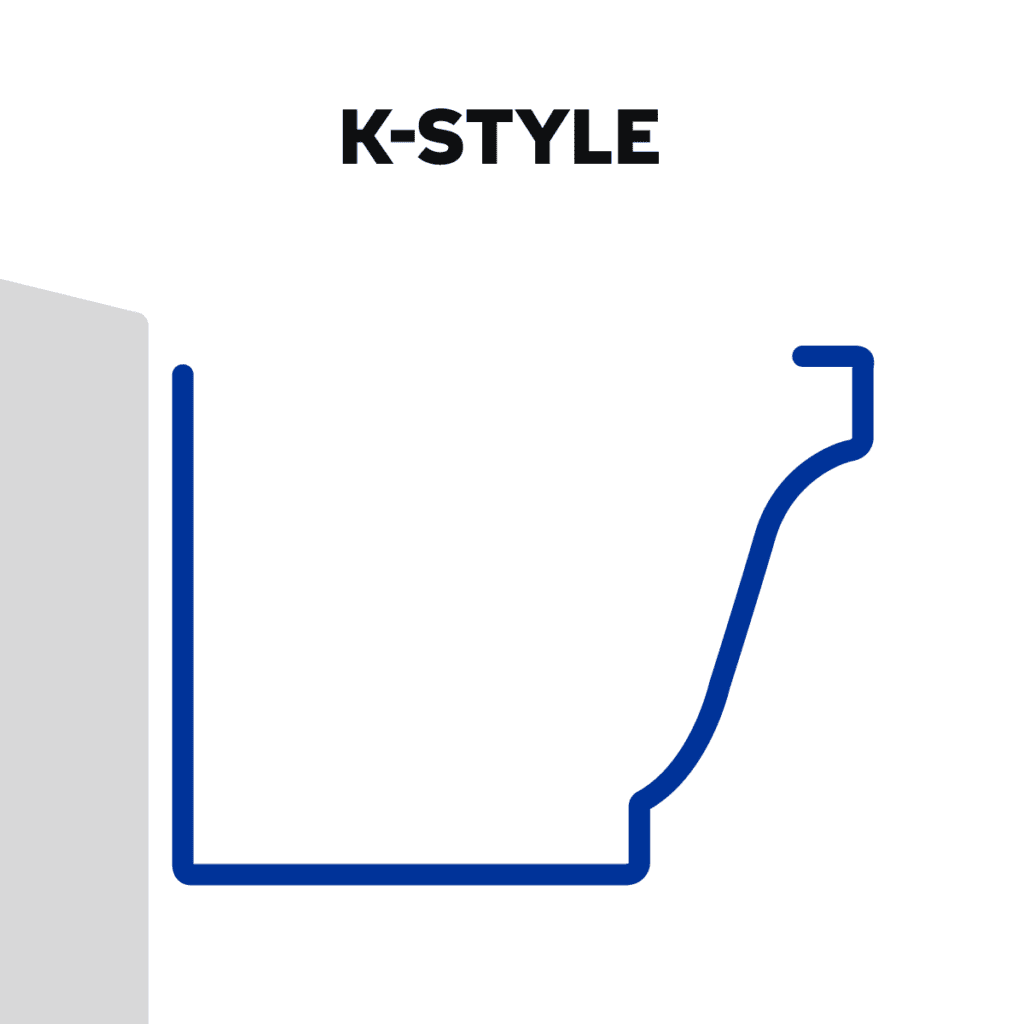

Here is a quick look at the parts and options homeowners most often ask for:
| Part | Common Options | Notes for Tucson Homes |
|---|---|---|
| Gutter sections | 5" K-Style, 6" K-Style, 6" half-round, 6" European box | 6" often makes sense for larger roof planes or heavier monsoon runoff |
| Downspouts | 2x3, 3x4, round 3" or 4" | Larger downspouts help prevent overflow during summer storms |
| Miters and corners | Inside and outside corners | Must match the gutter profile exactly |
| End caps | Left and right caps in matching profile/color | A common repair item on older systems |
| Outlets | Drop outlets for downspout connection | Important when tying gutters into basins or cistern piping |
| Hangers and brackets | Hidden hangers, screws, straps | Proper spacing matters in heat and storm loading |
| Sealants | Polyurethane or silicone-based gutter sealant | Better flexibility in harsh sun and temperature swings |
| Accessories | Leaf guards, splash blocks, fascia wrap, touch-up paint | Good finishing pieces for longer service life |
If you are trying to match an older system, bring measurements and photos. A lot of problems start when a homeowner assumes all 5-inch gutters use the same shape. They do not. Profiles vary, and a cap or miter that is almost right usually is not right.
How to prepare your gutter parts order before pickup
The smoother your order is on paper, the smoother your pickup goes at the shop. A simple sketch of the house can save a lot of time. Mark each gutter run, every corner, each downspout drop, and any places where water needs to be redirected toward landscaping or storage.
Before placing an order, have these details ready:
- Gutter profile: 5-inch K-Style, 6-inch K-Style, half-round, or another shape
- Material and color: aluminum, steel, or copper, plus the closest finish match
- Run lengths: each straight section measured carefully, not estimated
- Corner count: inside corners and outside corners listed separately
- Downspout layout: size, number of drops, elbow count, and where discharge should go
- Special use: rain barrel, cistern, courtyard drainage, scupper tie-in, or fascia wrap
A tape measure, a notepad, and a few phone photos usually tell the story.
If you are replacing one damaged area on an existing system, bring a small sample part if possible. That helps with profile matching, color matching, and making sure the outlet or end cap fits the gutter you already have.
Tucson pickup location, hours, and what to expect
For local pickup, the shop location is at 1627 N Stone Ave, Tucson, AZ 85705. Typical pickup hours are Monday through Friday, 8:00 AM to 4:00 PM.
Because many items are pulled or cut to order, calling ahead is the smart move. That is even more important if you need long pieces, unusual colors, copper parts, or items tied to a water harvesting layout. A quick call can save you a wasted trip and gives the crew time to stage the order.
| Pickup Detail | Information |
|---|---|
| Location | 1627 N Stone Ave, Tucson, AZ 85705 |
| Hours | Monday to Friday, 8:00 AM to 4:00 PM |
| Best practice | Call ahead before arriving |
| Good vehicle choices | Pickup truck, van, trailer, or roof rack setup |
| Loading help | Usually available for long or bulky items |
If you are picking up long lengths of gutter or downspout, think about transport before you leave home. A sedan is rarely the right choice for 10-foot to 20-foot material. Even lightweight aluminum gets awkward fast, and bent metal is money wasted.
Choosing DIY gutter parts for monsoon rain and water conservation
In Tucson, gutters are not just about keeping water off the porch. They are part of how the property handles runoff. A well-planned system can reduce splashback, limit erosion, protect stucco, and send roof water where you actually want it.
That could mean into planted basins. It could mean through a downspout extension into a landscape area. It could mean feeding above-ground tanks or larger cisterns with screened inlets. If you are building toward rainwater harvesting, outlet placement and downspout sizing need to be thought through early, not after the gutters are already hung.
This is where DIY projects often benefit from talking through the plan before pickup. A basic gutter repair is one thing. A layout that feeds storage tanks, keeps mosquitoes out, avoids algae growth, and still handles overflow in a monsoon is another.
Common mistakes when buying gutter parts for a DIY install
Most pickup issues come down to measurement, compatibility, or underestimating water volume. Tucson homes see a lot of intense rain in short windows, so a system that seems fine during a light shower may spill over badly in July or August.
A few mistakes show up again and again:
- Buying the wrong profile
- Mixing incompatible elbows or outlets
- Using too few hangers
- Forgetting sealant and fasteners
- Choosing downspouts that are too small
- Not planning discharge away from the foundation
One more thing: custom-cut and special-order items are usually not returnable. That is normal in this trade. If metal has been fabricated for your order, measure twice before it gets made.
Why pro-grade gutter parts make a difference in Arizona heat
Arizona sun shortens the life of cheap materials. Thin coatings chalk out. Low-grade sealants dry up and crack. Light-duty straps loosen. After a couple of summers and one or two monsoon seasons, the repair you thought saved money starts over.
That is why many homeowners doing their own work still choose the same type of parts used on full installations. Better hangers, better sealant, stronger metal, and matching accessories give you a cleaner install and fewer service calls later.
If your project includes fascia wrap, new downspout routes, or a tie-in to cisterns, it helps to treat the whole setup as one system instead of buying parts one bag at a time from different places. The fit is better, the finish usually matches, and the install goes faster.
For homeowners in Tucson, Oro Valley, Marana, Vail, Sahuarita, Green Valley, Rio Rico, Nogales, Sonoita, and nearby areas, local pickup is a straightforward way to get the right gutter parts without waiting on freight or guessing at compatibility. Bring your measurements, call ahead, and build the order around your roof, your drainage needs, and the way Southern Arizona weather really behaves.
Questions About Gutter Parts Pickup in Tucson
Do you sell to homeowners, or is pickup only for contractors?
Pickup is open to homeowners doing their own work, not just trade customers. That is part of the point. If you have measurements, a clear idea of what your project needs, and a vehicle that can handle the material, you can place an order and pick it up just like any contractor would. The only difference is that first-time DIY customers sometimes benefit from talking through the parts list before finalizing an order, which a quick call before arrival makes easy.
Can I place my order by phone, or do I have to come in person to order?
Calling ahead is actually encouraged, especially for longer runs, color matching, specialty materials like copper, or anything tied to a water harvesting setup. A phone order gives the crew time to pull or cut what you need so it is ready when you arrive. Walk-in orders for small or common items are usually fine, but for anything custom-cut or less standard, calling first keeps the process smoother and avoids a wasted trip.
What if I only need one or two small parts, like a single end cap or a couple of elbows?
Small orders are not a problem. A lot of repair jobs only require one or two pieces, and that is a completely normal pickup request. End caps, elbows, outlet fittings, and single hangers are common repair items. The main thing to make sure of is that you know your gutter profile and size before you come in, because an end cap that fits a 5-inch K-Style does not fit a 6-inch or a half-round, even if they look similar at the hardware store.
How do I match a color if I do not know the exact finish on my existing gutters?
Phone photos help, but they are not always reliable for color matching because lighting shifts the appearance. If you can bring a small physical sample — a piece of end cap, a short section of downspout, or even a clean scrap of the existing gutter material — that gives a much more accurate match. Paint codes and manufacturer names from the original installation can also help if you have that paperwork. When in doubt, call ahead and describe what you have. It is easier to sort out before the order is cut than after.
Is there a minimum order size, and are custom-cut pieces returnable?
There is no minimum order for standard pickup items, but custom-cut lengths and fabricated pieces are generally not returnable once they have been made to your specifications. This is standard practice in the trade and applies whether the order is large or small. That is the main reason careful measurement matters before you finalize anything. If you are unsure about a length, it is better to confirm on-site before the cut than to assume and end up with material that does not fit your run.
Do you offer delivery, or is pickup the only option?
The primary option described here is local pickup from the Stone Avenue location. If your project is large enough or the logistics of transporting long gutter sections are a concern, it is worth asking when you call. For homeowners who are not sure whether their vehicle can safely handle 10- to 20-foot lengths of aluminum, planning transport in advance — or arranging a truck, van, or trailer — avoids a situation where the material gets damaged on the way home before it ever goes up on the house.
Copper gutters bring together performance and presence in a way few exterior upgrades can. They manage runoff during hard summer storms, protect foundations and walkways, and add a rich architectural finish that only gets more distinctive with time.
In Southern Arizona, that combination matters. Homes and commercial buildings face intense sun, sudden downpours, and long dry stretches that can be hard on ordinary materials. Copper stands apart because it resists rust, holds its shape well, and develops a natural patina that gives the building more character year after year.
Why Copper Makes Sense for Southern Arizona
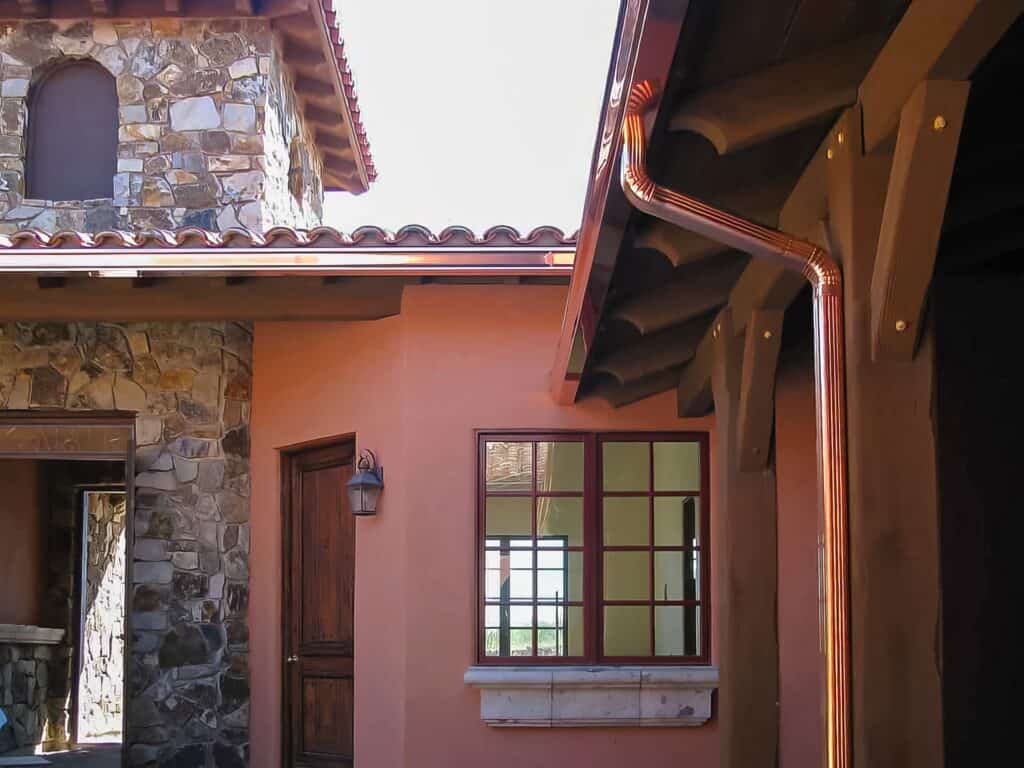
Copper is often chosen by property owners who want a long-term answer, not a short-term patch. It is known for durability, low upkeep, and a classic appearance that works well on custom homes, historic styles, upscale remodels, and distinctive commercial properties.
It also performs well in a climate like Tucson’s. Dry heat, UV exposure, and seasonal monsoon runoff can push lesser materials toward fading, cracking, or wear. Copper responds differently. Rather than rusting, it oxidizes and forms a protective surface that helps it age gracefully.
After looking at cost, lifespan, and visual impact together, many owners choose copper for a few clear reasons:
- Long service life
- Rust resistance: copper does not rot or rust like some other gutter materials
- Low upkeep: once installed correctly, it typically needs very little ongoing attention
- Architectural character
- Natural patina: the finish shifts over time from bright penny tones to deeper browns and blue-green hues
- Strong resale appeal
Built Around the Roof, Not Just the Metal
A good copper gutter system starts with the roof plan. The size of the roof, the pitch, the runoff volume, and the placement of downspouts all affect how well the system performs in a heavy rain. A visually striking gutter that is undersized or poorly sloped will not protect the building the way it should.
That is why a custom layout matters. Southern Arizona Rain Gutters starts with on-site measurements and roof area calculations, then plans the slope and outlet locations so water moves away from the structure effectively. This approach is especially important for large roof planes, courtyards, entries, and rooflines with multiple valleys.
Different buildings also call for different profiles. Some properties look best with a 5-inch or 6-inch K-style gutter. Others are a better fit for half-round gutters or European box profiles that create a more refined edge. Flat-roof structures may need custom scupper boxes to collect water and direct it into downspouts cleanly.
What the Installation Process Looks Like
Copper installation is more than attaching metal along the fascia. It is a precision job that depends on accurate layout, clean forming, solid support, and compatible accessories that will not create corrosion problems over time.
For many projects, gutter sections are formed on site in long continuous runs. That reduces joints, which helps cut down on future leak points. The system is then mounted with hanger supports placed at close intervals, commonly every two feet, to help prevent sagging and keep the line crisp.
Once the main sections are in place, downspouts, outlets, miters, and end caps are fitted and sealed. Southern Arizona Rain Gutters uses a high-grade construction polyurethane sealant designed to stay flexible and hold up well in Arizona heat. That matters because the desert sun can be unforgiving on lesser sealants.
A typical installation includes a few essential stages:
- Measure and size: roof square footage, water volume, slope, and downspout placement
- Form and mount: copper gutters produced in long sections and secured with frequent hanger supports
- Seal and finish: joints, end caps, and outlets sealed and checked for proper flow
- Final inspection
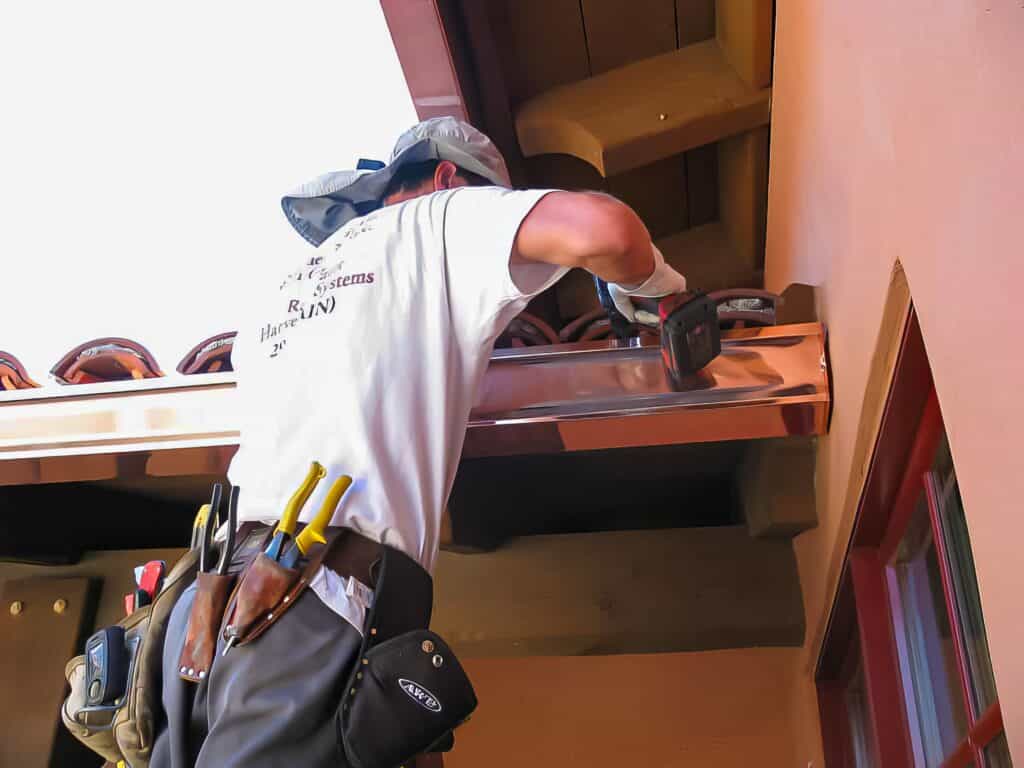
The Look Changes Over Time, and That Is Part of the Appeal
Fresh copper has warmth and brightness that immediately stands out against stucco, stone, brick, tile, and wood accents.
Over time, that finish deepens and softens into a patina that many property owners specifically want.
This aging process is one of copper’s most attractive qualities. Instead of looking worn, it tends to look established. On Southwestern architecture, Spanish-inspired homes, territorial styles, and custom desert properties, copper often feels like it belongs from the start and looks even better a few years later.
That visual flexibility also extends to the details. Downspouts, leader boxes, decorative collector heads, and scuppers can be coordinated so the whole drainage system feels intentional rather than purely functional.
Copper Compared With Other Gutter Materials
Copper is not the only option, and it is not always the right fit for every budget. Still, when durability and appearance are top priorities, it is hard to match. A side-by-side comparison makes the differences easier to see.
| Feature | Copper | Aluminum | Galvanized Steel | Vinyl |
|---|---|---|---|---|
| Lifespan | Very long, often far longer than common alternatives | Good, but generally shorter than copper | Strong, though coating damage can lead to corrosion | Shorter life in harsh conditions |
| Maintenance | Low, with a protective patina over time | Low to moderate | Moderate, especially if rust appears | Low until cracking or warping occurs |
| Appearance | Premium look that ages naturally | Clean and practical | More utilitarian unless painted | Basic appearance |
| Weather response | Excellent in sun and storm cycles | Can dent and may fade over time | Strong but vulnerable to corrosion if finish is compromised | Heat can warp, cold can crack |
| Upfront cost | Highest initial investment | Moderate | Moderate to high | Lowest |
For property owners planning to stay in their building for many years, the higher starting cost of copper can make financial sense. Replacement cycles tend to be longer, repairs are less frequent when the system is installed properly, and the visual value remains strong.
A Smart Choice for Rainwater Harvesting
Copper gutters are also a strong match for rainwater collection systems. When a project includes harvesting, gutter sizing and downspout placement become even more important because the goal is not only to move water away from the building, but also to direct it where it can be stored and used.
Southern Arizona Rain Gutters designs and installs harvesting systems from 200 gallons to more than 10,000 gallons. That can include above-ground tanks or steel culvert cisterns, depending on the property and storage goals. For owners who want a coordinated exterior plan, copper gutters can be tied into a collection layout that looks polished and works efficiently.
The details matter here:
- Screened openings: help reduce debris, mosquitoes, and algae issues
- UV-protected tanks
- Custom routing: directs roof runoff to storage while still protecting the structure during overflow conditions
- Options for homes and commercial sites
Where Craftsmanship Matters Most
Copper is a premium material, so installation quality has to match it. Clean lines, secure attachment, correct pitch, and careful sealing all affect how the system will look and perform years from now. Poor installation can undercut the value of even the best material.
That is why local experience matters in Southern Arizona. Roof forms, monsoon patterns, fascia conditions, and site drainage vary from one neighborhood to the next. A crew that works regularly in Tucson, Oro Valley, Vail, Marana, Green Valley, Sahuarita, Nogales, Rio Rico, Sonoita, and nearby areas brings practical knowledge to the design and installation process.
Southern Arizona Rain Gutters offers copper along with aluminum and galvanized steel, but copper remains a standout option for owners who want a lasting architectural finish with very little day-to-day upkeep. Professional installation is available, and parts are also available for pickup for those handling portions of a project themselves.
Planning the Right System for Your Property
Every roofline asks for its own solution. A single-story ranch home, a custom residence with varied elevations, a flat-roof commercial building, and a property with rainwater storage goals all need different gutter layouts.
A site visit can help answer the key questions quickly: which profile fits the architecture, what size will handle runoff well, where downspouts should go, and whether the gutter system should connect to a harvesting setup. With the right plan, copper gutters do more than manage water. They become a lasting part of the building’s design.
Copper Gutter Questions from Arizona Homeowners
How long does it take for copper gutters to develop a full patina in Tucson?
The timeline varies depending on sun exposure, moisture contact, and orientation. In Southern Arizona's dry climate, the initial darkening from bright copper to a warm brown usually happens within the first year. The progression toward the familiar blue-green verdigris takes considerably longer — often five to fifteen years — and may develop unevenly depending on which sections of the gutter receive direct rain versus staying dry most of the year. South- and west-facing runs exposed to more UV and occasional moisture tend to patina faster than sheltered north-facing sections.
Can I speed up or control the patina on my copper gutters?
Yes. Chemical patina solutions can be applied to achieve the aged look much sooner than natural weathering allows. These treatments use mild acid or salt-based compounds to accelerate oxidation and are available in different formulations to produce brown, dark bronze, or green tones. The results can look natural when applied evenly, though the finish will continue evolving after treatment. On the other hand, if you want to preserve the bright copper appearance, a marine-grade clear sealant can slow oxidation significantly — though it requires reapplication every few years in the Tucson sun.
Do copper gutters attract theft?
It is a concern worth acknowledging. Copper has significant scrap value, and exposed copper on a building can attract attention in some areas. Ground-level runs are more vulnerable than second-story installations. Practical deterrents include security cameras, motion-activated lighting near the roofline, and tamper-resistant fasteners that require specialized tools to remove. In most established Tucson neighborhoods, theft risk is low, but it is a fair question to raise with your installer if your property sits on a less-trafficked lot or has long ground-accessible copper runs.
Are copper gutters safe for vegetable garden irrigation if I'm harvesting rainwater?
Copper does release trace amounts of copper ions into water, which is why this question comes up with harvesting systems. At the concentrations typical of roof runoff passing through copper gutters, the levels are generally well below any concern for landscape irrigation, flower beds, and most established garden plants. However, some gardeners growing sensitive seedlings or copper-intolerant crops prefer to run a first-flush diverter to discard the initial roof wash before collecting. If potable use is ever a goal, a full filtration and treatment system would be needed regardless of gutter material.
Will hail damage copper gutters the way it damages aluminum?
Copper is significantly harder and more dent-resistant than aluminum, so it holds up much better during hail events. Light to moderate hail that would dimple an aluminum gutter typically leaves a copper system undamaged. Severe hail can still cause surface marking, but the structural integrity of copper is rarely compromised. This is one of the practical durability advantages that does not show up in a cost-per-foot comparison but matters over a decades-long ownership period in a region where summer storms occasionally bring hail.
Can copper gutters be installed over existing fascia wrap, or does the wrap need to come off?
Copper can be mounted over an existing aluminum fascia wrap as long as the wrap is secure, flat, and in good condition. However, direct metal-to-metal contact between copper and aluminum creates a galvanic corrosion risk when moisture is present. A qualified installer will place a dielectric barrier — typically a rubber or plastic separation strip — between the copper hanger and the aluminum wrap surface. If the existing wrap is damaged, loose, or deteriorating, it is better to remove it and either install a new copper-compatible wrap or mount directly to sound fascia board.
How do I clean copper gutters without damaging the patina?
For routine debris removal, a simple scoop-and-flush with a garden hose is all that is needed — the same as any other gutter material. The important thing is to avoid abrasive scrubbing, wire brushes, or acidic cleaners on the exterior surface, as these will strip the patina unevenly and leave visible marks that take months to blend back in. If you want to remove a specific stain or deposit without disturbing the surrounding patina, a soft cloth with a mild soap solution works well. Most copper gutter owners find that the less they do to the exterior finish, the better it looks over time.
Is copper a good choice for a flat-roof home that uses scupper boxes?
It can be an excellent fit. Scupper boxes on flat-roof homes are highly visible design elements — often mounted at eye level on parapet walls — so the material choice has real architectural impact. Copper scupper boxes, leader heads, and downspouts create a cohesive, high-end look that works particularly well on Southwestern, territorial, and contemporary flat-roof designs common across Tucson. The added strength of copper is also a practical benefit here, since scupper boxes handle concentrated water flow and need to maintain their shape under heavier loads than a standard eave gutter.
Choosing between copper and aluminum gutters is not just a matter of price. It is a choice about how long you plan to stay in the home, how much visual impact you want, and how your gutter system needs to perform through heat, dust, and sudden heavy rain.
For homeowners in Southern Arizona, that choice carries extra weight. Gutters here do not face months of constant rain, but when water comes, it often comes fast. Add intense sun, abrasive dust, and large day-to-night temperature swings, and the right material starts to look less like a decorative option and more like a long-term property decision.
What separates these two materials
Copper and aluminum are both proven gutter materials, and both can perform very well when the system is properly designed and installed. The difference is in the balance of cost, strength, appearance, and lifespan.
Aluminum is the practical favorite for many homes because it is lightweight, affordable, corrosion-resistant, and available in many colors. Copper is the premium option, chosen for its durability, architectural character, and the way it ages over time.
After looking at the two side by side, most decisions come down to a few core priorities:
- Upfront budget
- Expected lifespan
- Color and architectural style
- Maintenance preferences
- Long-term property value
Appearance matters more than people expect
Gutters sit at the roofline, which makes them surprisingly visible. On a well-designed home, they can either disappear into the trim or become part of the architecture.
Copper stands out immediately. When new, it has a warm reddish-brown tone. Over time, it darkens and then develops its familiar patina. That aging process is part of the appeal. Many homeowners love the idea that the material changes naturally and takes on more character with age.
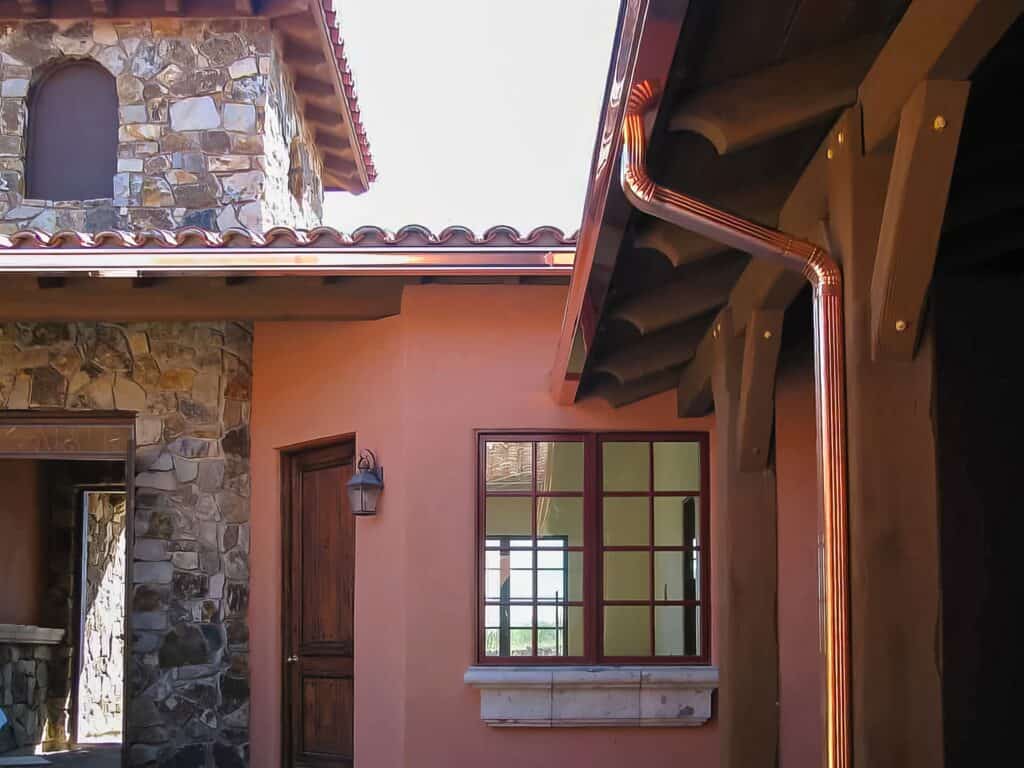
Aluminum offers a different kind of flexibility. It does not have the same visual drama as copper, but it can be formed into clean, modern profiles and finished in colors that match fascia, stucco, trim, or roofing. That makes it an easy fit for a much wider range of homes.
If curb appeal is high on the list, the question is not which one is prettier in the abstract. The real question is which one fits the house.
- Copper: Best suited to custom homes, historic styles, luxury exteriors, and properties where architectural detail is part of the value
- Aluminum: Best suited to homes that need color coordination, understated lines, and strong performance at a lower price
- Copper-colored aluminum: A useful middle ground for owners who like the look of copper without the full investment
Cost, lifespan, and value over time
Price is where the gap becomes impossible to ignore. Copper costs far more upfront, both in material and labor. Aluminum is far easier on the budget and still delivers a long service life.
That does not mean aluminum is always the better value. If a homeowner plans to stay in the property for decades, or if the home itself supports a premium exterior package, copper can make sense. It often lasts much longer and can reduce the need for replacement over the life of the home.
Here is a simple side-by-side view.
| Feature | Copper Gutters | Aluminum Gutters |
|---|---|---|
| Installed cost | Typically high, often around $15 to $40 per linear foot | Typically lower, often around $7 to $13 per linear foot |
| Lifespan | Often 40 to 50+ years, sometimes longer | Commonly 20 to 30 years |
| Appearance | Warm metallic finish that patinas over time | Clean, painted finish in many color options |
| Weight | Heavy | Lightweight |
| Dent resistance | Stronger, less prone to impact damage | Softer, more likely to dent |
| Maintenance | Mostly cleaning, no paint needed | Cleaning plus occasional finish-touchup over time |
| Installation complexity | Specialized work | Easier and more common |
| Best fit | Premium and architecturally distinctive homes | Most residential and commercial properties |
The table makes the broad pattern clear. Copper asks for more upfront, while aluminum makes a very strong case for efficient long-term performance per dollar spent.
Performance in Southern Arizona conditions
Climate should shape this decision.
Southern Arizona homes deal with punishing UV exposure, long dry stretches, dust storms, and short bursts of intense monsoon rain. A gutter system has to stay secure through all of it. It also has to move water fast enough to protect fascia, stucco, foundations, and landscape features.
Aluminum performs especially well in this environment because it resists rust, handles heat reliably, and can be made in seamless runs that reduce leak points. For many homes in Tucson and the surrounding region, seamless aluminum hits the sweet spot between cost and weather resistance.

Copper also performs very well here. It does not rust, it handles temperature swings with confidence, and its natural patina forms a protective surface. Its greater strength can also help it resist dents and wear over time. The main limitation is not climate performance. It is cost.
Dust is a factor people often underestimate. Fine desert particles settle into any gutter, then mix with moisture and create a muddy film that can slow drainage. This affects both materials. Copper is less vulnerable to cosmetic breakdown from that buildup, while aluminum finishes may show wear sooner if the gutters are neglected for years.
A few design choices matter just as much as material:
- Correct gutter size
- Proper slope to downspouts
- Strong hanger spacing
- Adequate downspout capacity
- Regular clearing before and after storm season
Installation is not the same experience
Aluminum is lighter and easier to handle, which makes fabrication and installation simpler. That is one reason it is so common in seamless gutter systems. It can be installed efficiently, and replacement sections or color-matched components are usually easier to source.
Copper is different. It requires more specialized handling, matching hardware, and careful detailing to avoid compatibility problems between metals. Its weight also means the support structure and attachment details matter even more.
This difference affects more than labor cost. It also affects repair strategy later. Aluminum systems are generally easier to patch, extend, or replace in sections. Copper repairs can be highly effective, but they need the right materials and the right hands.
For homeowners who want a gutter system tied into rainwater harvesting, both materials can work well. Copper brings a premium appearance to exposed collection systems, while aluminum is often chosen when budget, tank size, and practical water management are the top priorities.
Maintenance and aging patterns
Neither option is maintenance-free. Both need cleaning, inspection, and occasional adjustment after storms.
Still, the way they age is different. Copper is famous for aging gracefully. What changes on the surface is often part of what protects it. For people who like that weathered look, copper becomes more attractive over time.
Aluminum ages in a more utilitarian way. High-quality finishes can last many years, but prolonged sun exposure may eventually lead to fading or a chalky appearance. That does not mean the gutter has failed. It just means the finish may show its age before the metal itself does.
Routine care is straightforward for both:
- Before monsoon season: Clear dust, leaves, roof grit, and sediment from channels and downspouts
- After major storms: Check alignment, hanger security, and overflow marks
- Every few years: Inspect sealants, corners, and outlet connections
- For painted aluminum: Watch for finish wear in high-sun exposures
Homeowners who want the lowest visual maintenance often lean toward copper. Homeowners who want the lowest initial investment often choose aluminum and accept that touch-ups may be part of the long view.
Which homes tend to benefit most from each
Material choice gets easier when it is tied to the home itself instead of treated as a generic upgrade.
Copper often makes the most sense on homes where exterior materials already carry visual weight. Think stone, brick, wood accents, custom ironwork, or entry features with a high-end architectural feel. In that setting, copper gutters can look intentional rather than ornamental.
Aluminum is the stronger fit for the broad middle of the market. It is a smart answer for homeowners who want a dependable system, a clean finish, and strong climate performance without pushing the budget into premium territory.
A useful way to frame the choice is this:
- Choose copper if: the home is custom, you plan to stay long-term, and architecture matters as much as function
- Choose aluminum if: value, dependable performance, and color flexibility lead the decision
- Choose based on the neighborhood too: premium materials tend to make more sense when they are consistent with the surrounding homes
That last point matters. A luxury gutter material on a modest home may not produce the same return that it would on a custom property where buyers already expect upgraded finishes.
The environmental angle
Both copper and aluminum have real strengths here. Both metals are recyclable, and both avoid the short service life concerns that come with lower-grade alternatives.
Copper tends to win on longevity. A material that lasts several decades longer can reduce replacement cycles and waste. Aluminum tends to win on accessibility and efficient use across a huge range of projects.
The environmental cost of mining and processing exists for both, though in different ways. For most property owners, the most responsible choice is often the one that will last a long time on the building, be maintained properly, and avoid premature replacement.
That makes quality installation part of the sustainability story. A poorly sized or poorly fastened system wastes money and materials no matter which metal is chosen.
A practical way to make the decision
If the choice still feels close, start with three questions: How long will you stay in the home? How visible do you want the gutters to be? What level of upfront investment feels comfortable?
Those answers usually point in one direction quickly. A homeowner planning a long hold on a custom property may see copper as a natural fit. A homeowner upgrading for durability, clean lines, and strong value will often land on seamless aluminum.
Use this quick filter when comparing estimates:
- Ask about gutter size, not just material.
- Ask how the system is fastened and supported.
- Ask what finish options are available.
- Ask how the gutters will handle monsoon runoff at each roof section.
- Ask what maintenance will look like five or ten years from now.
That approach keeps the conversation centered on performance, not just price per foot.
A well-chosen gutter system protects more than the roofline. It protects stucco, foundations, walkways, landscaping, and in many cases the long-term appearance of the whole property. Copper and aluminum can both do that job well. The better choice is the one that matches the home, the climate, and the owner’s goals with confidence.
Copper vs. Aluminum Gutter Questions Homeowners Ask
Can I install copper gutters on just the front of my house and aluminum on the rest?
Yes, and it is more common than most people realize. Some homeowners use copper on the street-facing elevation where it makes the biggest visual impact, then run aluminum along the sides and back where the gutters are less visible. The two systems are kept separate — they should not be directly joined because contact between copper and aluminum can cause galvanic corrosion at the connection point. Each section gets its own downspouts and drainage path, so both materials perform independently.
Does copper react with the alkaline dust and hard water common in Tucson?
Tucson's mineral-heavy dust and hard water can leave a white or greenish residue on copper surfaces over time, which is different from the even blue-green patina most people picture. The deposits are not harmful to the metal, but they can make the aging pattern look uneven on sections that are sheltered from rain versus those that get washed regularly. A periodic rinse or light cleaning helps the patina develop more uniformly. Aluminum finishes are not affected in the same way because the painted surface acts as a barrier.
Will copper gutters stain my stucco or concrete?
They can. As copper develops its patina, rainwater washing over the surface can carry traces of copper oxide onto stucco walls, concrete walkways, and light-colored surfaces below the gutter line. The staining is usually a green or blue-green streak and can be difficult to remove once it sets. Proper drip edge detailing and splash management during installation help minimize this, and some homeowners consider the staining part of the character. If your home has white or cream stucco, it is worth discussing runoff paths with your installer before choosing copper.
Is copper-colored aluminum a convincing alternative to real copper?
From a distance, a high-quality copper-tone aluminum finish can look surprisingly close. Up close, the difference is noticeable — real copper has depth, natural variation, and surface texture that a painted finish cannot fully replicate. The bigger distinction is how they age. Copper-colored aluminum stays the same color year after year until the finish eventually fades, while real copper transforms through a visible patina progression. For homeowners who want the warm tone without the price or the aging process, copper-colored aluminum is a practical and popular choice across the Tucson area.
Do copper gutters increase home resale value?
They can, but the return depends heavily on the property. On a custom home, historic restoration, or luxury build where buyers already expect premium finishes, copper gutters reinforce the overall value proposition and can be a genuine selling point. On a standard production home in a mid-range neighborhood, the resale bump is unlikely to recover the full cost difference over aluminum. The strongest returns tend to come when copper is part of a coordinated exterior — matching downspouts, copper flashing, and complementary hardware — rather than a standalone upgrade on an otherwise standard home.
Can I let copper gutters patina naturally, or do I need to seal them?
Either approach works, and it comes down to personal preference. Most homeowners in Southern Arizona let the patina develop on its own, which progresses from bright copper to a dark brown and eventually to the classic green tone over several years. If you prefer to keep the original bright copper appearance, a clear lacquer or sealant can slow the oxidation process — but it requires reapplication every few years and can peel or cloud if it breaks down under intense UV exposure. Unsealed copper is essentially zero maintenance on the finish side, which is part of its appeal in a low-maintenance-minded climate.
How do I avoid galvanic corrosion when mixing metals on my gutter system?
Galvanic corrosion happens when two dissimilar metals are in direct contact with moisture present. The most common risk with gutter systems is connecting copper gutters to aluminum downspouts, or using steel fasteners on copper runs. The fix is straightforward: use matching hardware for each material, and when different metals must meet, install a dielectric barrier — a rubber or plastic separator — between the contact surfaces. A qualified installer will handle this as a standard detail, but it is worth asking about if you are comparing bids and one quote seems unusually low on hardware costs.
Are copper gutters harder to repair than aluminum if a section gets damaged?
Generally yes. Copper requires soldering for permanent joint repairs, and the replacement section needs to match the existing patina stage or it will stand out visually until it catches up — which can take years. Finding a contractor experienced in copper gutter work is also more limited than finding one who works with aluminum daily. Aluminum repairs are simpler: a damaged section can be cut out, a new piece spliced in, and the seams sealed with standard methods. The repair is usually color-matched on the spot. This difference in repairability is worth factoring into the long-term ownership cost, especially for properties with overhanging trees or exposure to wind-blown debris.
Old gutters rarely fail all at once. More often, they sag a little, drip at the corners, stain the stucco, and send roof runoff straight toward walkways, foundations, and planting beds. When that pattern starts repeating, replacement is often the wiser move.
For homes and commercial properties across Southern Arizona, a new gutter system should do more than look clean. It should be measured to the roof, pitched for reliable flow, and built to handle sharp summer downpours, long sun exposure, and the weight of water moving fast. Southern Arizona Rain Gutters replaces worn-out systems with custom-fabricated one-piece gutters in aluminum, steel, or copper, with optional fascia wraps, guards, downspout updates, and rainwater capture connections when the project calls for them.
When Repair Stops Making Sense
A repair can be the right call when the issue is small and isolated. A loose elbow, a short split, or a clogged outlet may not call for a full system replacement.
The picture changes when the gutter size is wrong for the roof, the old runs have too many leaking joints, or the metal has started to pull away from the fascia. In those cases, putting more money into patchwork work can delay the real fix without solving the drainage problem.
Common signs that point toward replacement include:
- Frequent leaks during storms
- Gutters separating from the fascia
- Rusted, cracked, or warped sections
- Overflow near entries and patios
- Water pooling near the foundation
- Repeated repairs that do not last
If fascia boards have also taken damage from moisture or sun, adding a protective wrap at the same time can make the whole roof edge cleaner, stronger, and easier to maintain.
Built for Southern Arizona Conditions
Rain may be infrequent here, but when it comes, it can come hard. A gutter system in Tucson and the surrounding area has to handle fast runoff without twisting, sagging, or dumping water where it should not go. That is why proper slope, strong support, and correct downspout placement matter just as much as the metal itself.
Projects are measured before fabrication so the gutter size and outlet locations match the roof area. Heavy-duty hangers are typically spaced about every two feet to support the load. On homes with flat or low-slope roof sections, custom boxes and scuppers can be used to move water neatly off the roofline and into downspouts or storage systems.
Material choice also affects appearance, lifespan, and budget. Here is a simple comparison:
| Material | Best Fit | Appearance | General Benefit |
|---|---|---|---|
| Aluminum | Most homes | Clean, color-matched finish options | Lightweight, rust-resistant, long service life |
| Steel | Larger runs, higher-demand areas | Strong, traditional look | Added strength for demanding drainage loads |
| Copper | Premium homes, architectural projects | Rich metal finish that develops patina | Very long life and standout curb appeal |
Profiles can be selected to suit both the roof and the style of the property. Options may include standard K-style gutters, half-round gutters, European-style box profiles, and larger-capacity commercial sizes.
What a Full Replacement Usually Includes
A well-run replacement project is more than hanging new metal under the roof edge. It starts with taking apart the failing system safely, checking the fascia condition, and planning drainage so the new setup performs better than the old one ever did.
That is why a full-service approach matters. The goal is not just to swap parts, but to correct the weak points that caused the original problems.
A typical scope of work may include:
- Old system removal: Existing gutters and downspouts are taken down and hauled away for disposal or recycling.
- On-site fabrication: Long one-piece gutter runs are formed to fit each roof edge closely.
- Support installation: Heavy-duty hangers are set at regular intervals for strength and stability.
- Drainage planning: Pitch, outlet size, and downspout placement are matched to roof runoff.
- Water-tight detailing: Corners, caps, and outlets are sealed with durable, flexible sealant.
- Optional upgrades: Fascia wraps, gutter guards, cleaning, minor repairs, and rainwater harvesting tie-ins can be added.
Free estimates are available, which gives property owners a chance to compare materials, colors, profiles, and project scope before work begins. For larger jobs, flexible payment options may also be available.
How the Project Moves Forward
The replacement process should feel organized from the first visit to the final walkthrough. Clear planning keeps the job efficient and helps avoid surprises once installation starts.
A typical project follows these steps:
- Site visit and measurement of roof edges, drainage needs, and fascia condition
- Selection of material, profile, color, and any added features
- Scheduling, material preparation, and coordination for access around the property
- Removal of old gutters, installation of new runs, and connection of downspouts
- Cleanup, final check, and review of the finished system with the owner
Many residential replacements can be completed in a day or two once work begins, depending on home size, roof complexity, and whether add-ons are included. Larger homes, multi-story structures, and projects that include water storage can take longer.
Cleanup is part of the value. Old metal, fasteners, and cutoffs should leave with the crew, not stay behind in landscaping or on walkways. A final review also gives the property owner a chance to confirm outlet placement, water direction, and overall appearance before the project is signed off.
More Than Basic Drainage
Replacing gutters can also be the right time to think bigger about water use. Instead of directing every gallon away from the property, some homes and buildings can route roof runoff into a harvesting system for landscape irrigation and outdoor use.
Southern Arizona Rain Gutters offers custom rainwater harvesting systems ranging from smaller residential tanks to large-capacity storage setups. Depending on the design, gutters can feed above-ground plastic tanks or steel culvert cisterns. Screened openings and sealed, UV-protected tanks help limit algae growth and mosquito issues.
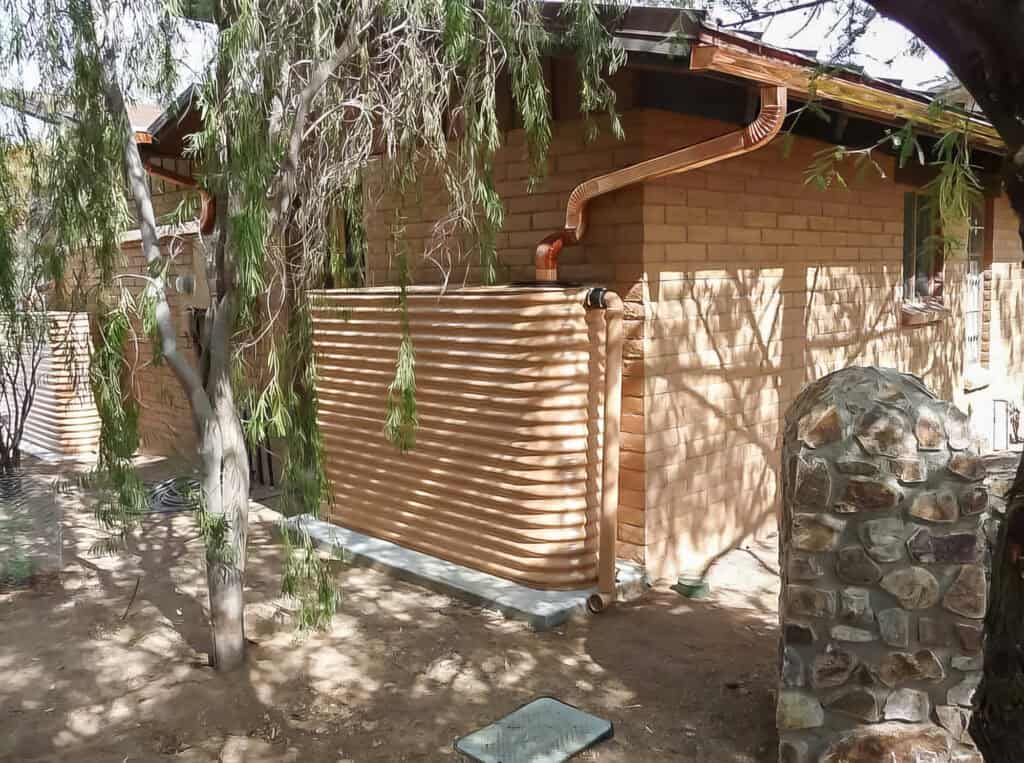
This is especially useful for owners who want their roof drainage system to do two jobs at once: protect the structure and save water.
Appearance Matters Too
Performance comes first, but looks still matter. New gutters can sharpen the roofline, clean up stained or patched edges, and tie in neatly with trim and exterior colors. For many properties, that visual upgrade is obvious from the street.
Color choices are available across a broad range of aluminum finishes, while copper offers a more architectural look that changes over time with patina. If the fascia has weathered or peeling paint, a color-matched wrap can give the entire edge of the roof a crisp, finished appearance while protecting the wood beneath.
That balance of function and appearance is one reason one-piece gutters remain a strong long-term investment. Fewer joints mean fewer common leak points, and custom fabrication gives the system a cleaner profile than many off-the-shelf sectional products.
Local Fit for Homes and Commercial Properties
Roof drainage in Southern Arizona is not one-size-fits-all. A tile-roof home in Oro Valley, a stucco house in Vail, and a commercial building in Tucson may all need very different layouts, capacities, and downspout strategies.
Local knowledge matters here. Roof pitch, fascia condition, courtyard layouts, scupper needs, and runoff patterns can vary widely from one property to the next. Service throughout the greater Tucson area, including Marana, Sahuarita, Green Valley, Nogales, Rio Rico, Sonoita, and Three Points, means projects can be planned with regional weather and building styles in mind.
If your current gutters leak, sag, overflow, or simply look worn out, a free quote is a practical first step. A properly fitted replacement turns short, intense storms into controlled drainage and gives the roof edge a cleaner, stronger finish at the same time.
Gutter Replacement Questions from Southern Arizona Homeowners
How do I know if my gutters need replacement or just cleaning?
A clogged gutter and a failing gutter can look similar from the ground — both overflow during rain. The simplest test is to clean the system thoroughly and then watch what happens during the next storm. If water still spills over the front edge, backs up at corners, or drips behind the gutter along the fascia, the problem is structural rather than debris-related. Sagging between hangers, visible rust holes, and separated seams are also signs that cleaning alone will not restore performance.
Will replacing my gutters damage my roof, fascia, or landscaping?
A professional crew takes precautions to avoid that. Old hangers and fasteners are removed carefully so the fascia is not splintered or cracked during takedown. If minor fascia damage is found underneath the old system, it can usually be repaired or wrapped as part of the project. Landscaping along the dripline is protected with drop cloths or temporary repositioning, and all old materials and debris should be cleared during cleanup. Most homeowners are surprised at how little disruption a well-run replacement actually creates.
Do new gutters come with a warranty?
Warranty terms depend on the installer and the materials used. For aluminum systems, manufacturer paint and material warranties often cover 20 years or more, while workmanship warranties from the installer typically range from one to five years. Copper carries an even longer expected lifespan and rarely needs a material warranty claim. The important thing is to ask for written warranty details before work begins — and confirm whether the warranty covers both materials and labor, since some only cover one.
Can I stay home during a gutter replacement?
Yes. All the work happens outside, so there is no need to vacate the house or clear interior rooms. The main things to prepare are keeping vehicles, patio furniture, and pets clear of the work zone along the roofline. There will be some noise from fabrication equipment and fastener installation, but most residential projects wrap up within a single day, so the disruption is short-lived.
Is it worth replacing gutters on a home I plan to sell?
Often yes, and it is one of the more cost-effective exterior improvements a seller can make. Stained stucco, sagging gutter lines, and visible water damage near the foundation are among the first things buyers and inspectors notice. New gutters with clean lines and matched color instantly improve curb appeal and remove a common inspection flag. In a market like Tucson where monsoon damage is well understood, buyers tend to view a new gutter system as a sign the home has been well maintained overall.
Should I replace my downspouts at the same time as my gutters?
In most cases, yes. Old downspouts may be undersized for a new gutter profile, corroded at the elbows, or routed to discharge points that no longer make sense for the property. Since the crew is already on site and the old system is coming down, replacing downspouts at the same time avoids a return trip and ensures the entire drainage path — from roof edge to discharge point — is matched and sealed as one system. Reusing old downspouts on a new gutter run often introduces the weakest link in an otherwise fresh installation.
Does homeowner's insurance cover gutter replacement?
It depends on the cause. If gutters were damaged by a specific covered event — a fallen tree limb, wind damage, or hail — many homeowner's policies will cover replacement minus the deductible. Normal wear, rust, age, and maintenance neglect are almost never covered. If you suspect storm damage contributed to your gutter failure, it is worth filing a claim or having an adjuster look before scheduling the work. Your installer can usually document the condition of the old system with photos to support the claim.
What happens to my old gutters after removal?
Aluminum and steel gutters are recyclable, and most professional crews haul the old material away as part of the job. Some installers take the scrap directly to a recycling facility rather than a landfill. Copper gutters have significant scrap value, so if you are replacing a copper system, it is worth confirming whether the removal price accounts for the salvage value of the old material or whether you want to keep it yourself.
When a storm drops a lot of water in a short time, your gutters have one job: catch it, move it, and get it away from the house before it spills over the edge. That sounds simple until a summer monsoon hits and a roof starts shedding water faster than the system can carry it. In places like Tucson, that is when gutter size stops being a cosmetic choice and becomes a performance decision.
The short answer is simple: if heavy rain is part of your climate, sizing up is usually the safer move.
The quick answer most property owners need
A standard 5-inch gutter works well on many homes, especially when roof sections are modest and rainfall rates are moderate. Once roof planes get larger, slopes get steeper, or storms come fast and hard, 6-inch gutters often become the better choice.
After looking at roof area, rainfall intensity, and roof shape, the usual starting point looks like this:
- 5-inch gutters for smaller, simpler residential rooflines
- 6-inch gutters: a stronger choice for large roof sections, steep roofs, and areas with intense downpours
- 8-inch systems: usually reserved for commercial buildings or very high-flow conditions
That extra inch matters more than many people expect. A 6-inch K-style gutter can hold about 67% more water per foot than a 5-inch gutter. In real storms, that added capacity can be the difference between controlled drainage and water pouring over the front lip near the foundation.
Why gutter size changes everything
A gutter is basically a channel with finite space. When runoff enters faster than that channel can carry it to the downspouts, the excess has nowhere to go but over the edge.
Heavy rain makes that problem show up quickly. Even homes in dry climates can face intense single-day storm events, and Southern Arizona is a prime example. The annual rainfall total may not look extreme on paper, yet monsoon storms often deliver water in short, concentrated bursts. Gutters have to be sized for that peak flow, not just the yearly average.
This is why a system that seems “fine most of the year” can still fail during the few storms that matter most.
What the numbers look like
Code-based sizing charts compare gutter size to roof area and rainfall rate. The figures below show approximate roof area that a single gutter can drain at a slight slope of 1/16 inch per foot.
| Gutter size | Roof area at 2 in/hr rain | Roof area at 4 in/hr rain | Roof area at 6 in/hr rain |
|---|---|---|---|
| 4-inch | 720 sq. ft. | 360 sq. ft. | 240 sq. ft. |
| 5-inch K-style | 1,250 sq. ft. | 625 sq. ft. | 416 sq. ft. |
| 6-inch K-style | 1,920 sq. ft. | 960 sq. ft. | 640 sq. ft. |
The pattern is clear. As rainfall intensity rises, the roof area a gutter can safely handle drops fast. That is why a 5-inch system may be perfectly acceptable on one house and completely undersized on the house next door.
If your home has large roof planes draining into one long run of gutter, or if local storms can push into the high-intensity range, a 6-inch system is often the smart investment.
Roof size is only part of the answer
Two homes with the same square footage may need different gutters.
Roof pitch changes runoff speed. A steep roof sends water downward with more force and less delay than a lower-pitch roof. Smooth roofing materials also move water quickly. Metal roofs are especially good at this, which is great for drainage but demanding on gutters. Tile roofs can also create concentrated flow, depending on the layout.
Then there is roof geometry. Valleys, long eave lines, and areas where multiple planes dump water into one section can overload a gutter even when the rest of the system looks generously sized. A valley feeding into a corner can create a surge that overwhelms a smaller gutter during a short storm.
Flat roofs need a different strategy. Water is often directed through scuppers rather than simply dropping off an eave. In that setup, the scupper box, gutter size, and downspout size all need to work as one system.
Downspouts can make or break the system
A large gutter paired with undersized downspouts is like a wide highway ending in a single narrow exit. Water collects, backs up, and rises until it spills.
That is why downspout sizing should always be part of the conversation. In heavy-rain applications, larger downspouts are often installed alongside larger gutters. A 3-by-4-inch downspout is common with 6-inch residential gutters, while large commercial systems may use 4-by-5-inch downspouts with 8-inch gutters.
Placement matters too. One downspout at the wrong end of a long run is not as effective as two downspouts located to shorten travel distance and reduce pooling.
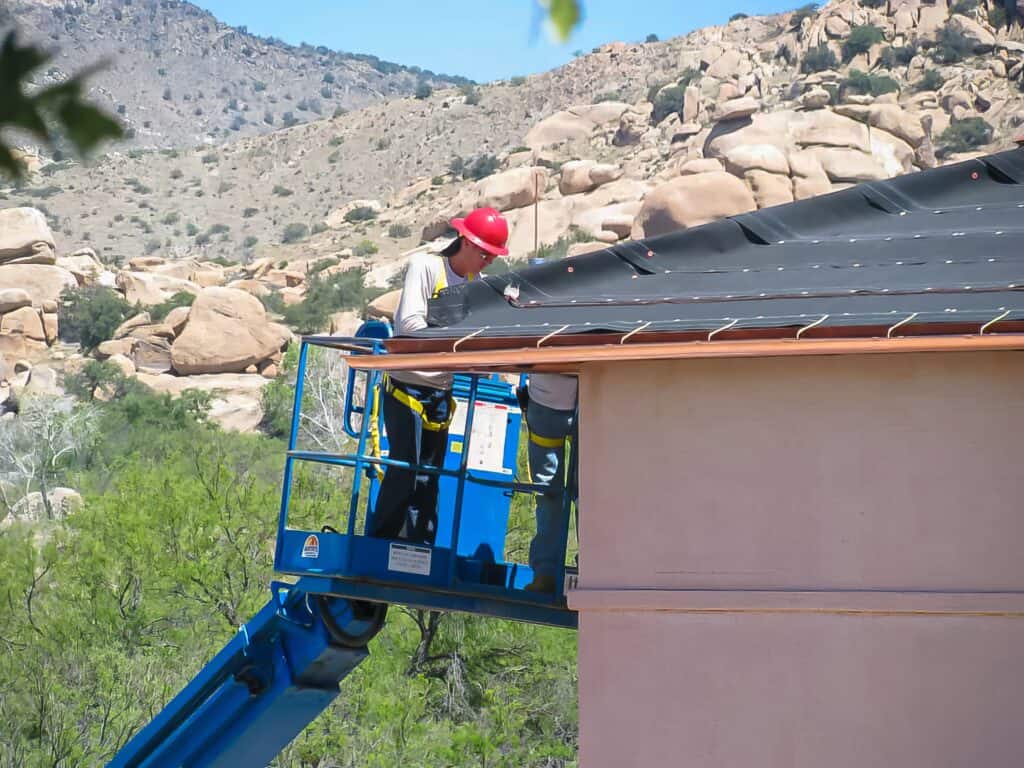
A well-sized gutter system is never just about the trough. It is the trough, the slope, the outlets, and the discharge path working together.
Which gutter shape handles heavy rain best?
Not all 6-inch gutters perform the same way.
K-style gutters are popular because they carry a lot of water relative to their profile and fit many architectural styles. For most homes, they are the practical choice when capacity matters. Box-style or deep-flow gutters can carry even more and are often used on commercial buildings or modern homes with high runoff demands.
Half-round gutters look beautiful, especially on historic or custom homes, but they generally carry less water than a K-style or deep-flow gutter of comparable width. That does not make them wrong. It just means they need to be selected with care when heavy rain is part of the picture.
If performance is the first priority, these are the profiles that usually rise to the top:
- K-style: strong capacity for residential homes
- Box or deep-flow: ideal where runoff volume is unusually high
- Half-round: better suited to architectural preference when drainage demand is moderate or the size is increased to compensate
Material matters in hot, stormy climates
A gutter that can hold the water still needs to survive heat, sun, wind, and debris.
In Southern Arizona, metal gutters are usually the strongest long-term fit. Aluminum is widely used because it resists rust, performs well in harsh sun, and comes in many finishes. Copper offers exceptional longevity and a distinct architectural look. Galvanized steel is strong, though long-term corrosion is still a consideration.
Vinyl is harder to recommend where extreme heat and intense storms meet. It is more vulnerable to warping, cracking, and joint issues, and it cannot provide the same kind of seamless performance as site-formed metal systems.
That is one reason many Tucson-area installations favor seamless aluminum or copper.
What usually works in Southern Arizona
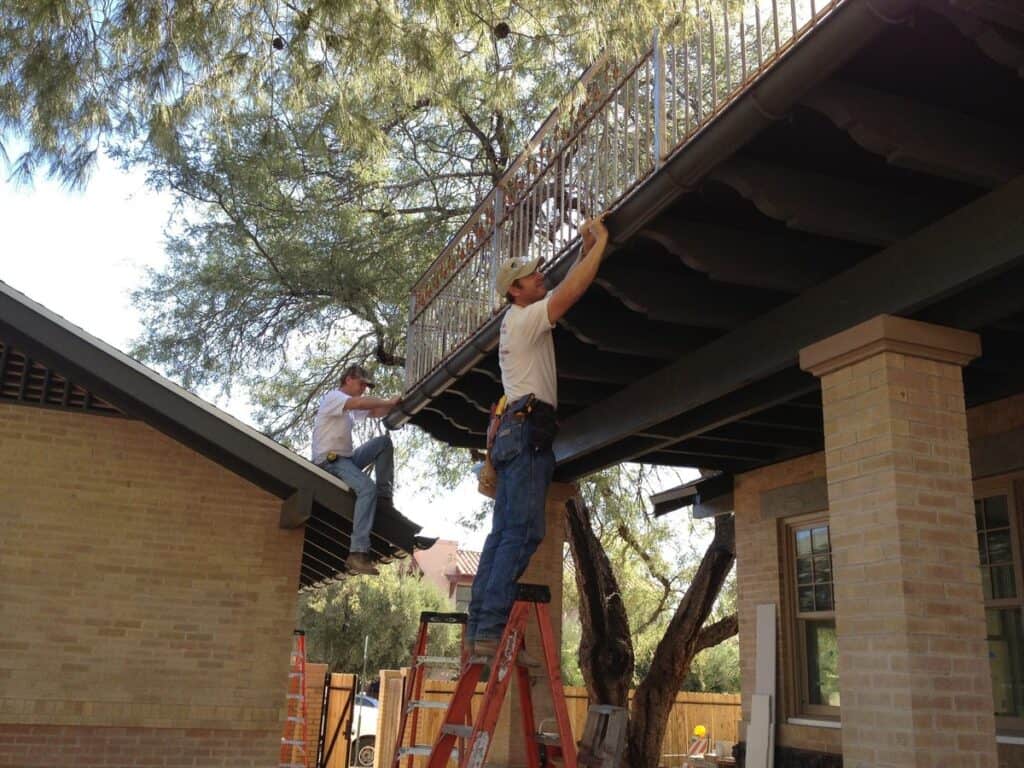
For homes across Tucson and nearby communities, 5-inch and 6-inch K-style gutters are the common residential choices. A local installer like Southern Arizona Rain Gutters often uses 6-inch systems when flow rates are higher or roof design calls for more capacity. On larger commercial projects, 8-inch seamless gutters with larger downspouts may be the right fit.
That local experience matters because Southern Arizona storms are unusual. Long dry periods can make it easy to overlook drainage needs, then a monsoon arrives and pushes an undersized system past its limit in minutes.
Homes with flat roofs often need scupper boxes to collect roof drainage and direct it into the gutter line. Sloped roofs need enough pitch in the gutter itself so water keeps moving toward the downspouts. A slight grade sounds minor, but it has a major effect on performance.
Support hardware matters as well. Gutters full of water get heavy fast. Strong hangers spaced every two feet help the system stay attached, straight, and properly pitched during peak loads.
Signs your current gutters are too small
Many owners do not think about sizing until they see failure during a storm.
If any of these show up, capacity may be part of the problem:
- Water pouring over the front edge in hard rain
- Splashing near the foundation
- Gutters that stay full and slow to drain
- Erosion below downspout areas
- Staining on fascia or siding
- Sagging sections after storms
Overflow is not always caused by size alone. Clogs, poor slope, too few downspouts, or loose hangers can produce similar symptoms. Still, when those issues are corrected and water still spills over during heavy rain, upsizing is often the right next step.
A practical way to choose the right size
The most reliable answer starts with measuring the roof area draining into each gutter run, then matching that load to local rainfall intensity. A good installer also looks at roof pitch, valleys, material, downspout placement, and any place where water concentrates.
That process usually leads to a clear recommendation:
- Standard 5-inch gutters: often enough for smaller roof sections with moderate flow
- 6-inch gutters: a strong choice for many homes in monsoon-prone areas
- Larger custom systems: best for commercial properties, flat roofs with scuppers, or very large drainage areas
If rainwater harvesting is part of the plan, sizing becomes even more important. A properly sized gutter system helps capture more runoff cleanly and direct it into screened, sealed storage rather than losing water to overflow. That matters for both property protection and water conservation.
Bigger is not always excessive
Some homeowners worry that 6-inch gutters will look oversized. In practice, many homes wear them well, especially when the color matches the trim and the profile is selected carefully. The visual difference is often smaller than expected, while the performance difference is substantial.
That is one of the better upgrades a property can make. A gutter system is not just trim attached to the roofline. It protects fascia, foundations, landscaping, walkways, and exterior walls. It can also support rainwater capture when designed with that purpose in mind.
If your property sees heavy rain, steep roof runoff, or large roof sections draining to one line, the safer answer is often to move up from 5 inches to 6 inches and make sure the downspouts keep pace. On many homes, that is the size that turns a vulnerable system into one that feels ready for the next hard storm.
Gutter Sizing Questions Tucson Homeowners Ask
Does upgrading from 5-inch to 6-inch gutters cost significantly more?
The material cost difference is usually modest — the jump from 5-inch to 6-inch aluminum is far less than most homeowners expect. Where cost can increase is if larger downspouts, wider fascia wraps, or additional outlet points are needed to support the bigger profile. For most residential projects in the Tucson area, the price gap is small enough that the added storm protection and longer trouble-free performance make the upgrade worthwhile rather than a stretch.
Can I mix gutter sizes on the same house?
Yes, and it is more common than people think. A home might use 6-inch gutters along the back where a large roof plane concentrates runoff into one run, and 5-inch along the front where shorter eave sections handle less water. Mixing sizes lets you put capacity where it is actually needed without over-building sections that do not face the same demand. The key is making sure downspout sizing matches each section independently.
How do I measure my roof area to figure out what size gutters I need?
You do not need to climb onto the roof. Measure the ground footprint of each section the gutter will serve — length times width — then adjust for pitch. A low-slope roof drains close to its footprint area, while a steep roof effectively drains a larger surface. For a rough estimate, multiply the footprint by 1.05 for a low pitch, 1.12 for a moderate pitch, or 1.3 for a steep pitch. That gives you the adjusted square footage to compare against sizing charts for your local rainfall intensity.
Do I need a permit to install or replace gutters in Tucson?
Standalone gutter installation on a residential property typically does not require a building permit in the City of Tucson or Pima County. However, if the project includes underground drainage lines tied into a public right-of-way, or if it is part of a larger remodel that triggers other permit requirements, it is worth confirming with the local building department before work begins. Commercial projects may have additional requirements depending on scope and site drainage plans.
Can undersized gutters cause damage even if they only overflow a few times a year?
Yes. Even a handful of overflow events per year can leave lasting damage. Repeated water spilling behind the gutter soaks fascia boards and can start rot that is invisible from the ground until it becomes serious. Overflow near the foundation causes soil erosion and can lead to moisture migration under slab edges. Stucco staining from splashback is also cumulative — each storm adds another layer that becomes harder to clean. The damage compounds even when the storms are infrequent.
Should I size my gutters differently if I plan to add rainwater harvesting later?
Yes, and planning ahead saves money. If there is any chance you will add collection tanks down the road, sizing up now avoids the cost of replacing gutters later. A 6-inch gutter captures more runoff per storm event, which directly increases the volume available for storage. Downspout placement should also be planned with future tank inlet locations in mind, so the harvesting hookup is straightforward rather than requiring rerouting or additional elbows and extensions.
Do gutter guards affect how I should size my gutters?
They can. Some guard and screen designs reduce the effective opening of the gutter, which means less water enters the trough per second — especially during the kind of fast, heavy downpours Tucson sees in monsoon season. If you plan to install gutter guards, it is worth factoring that flow reduction into the sizing decision. Going with a 6-inch gutter instead of a 5-inch gives the system more margin to compensate for any intake restriction the guard introduces.
How do I know if my downspouts are the bottleneck instead of my gutters?
If your gutters fill up and overflow near the downspout outlet rather than along the full run, the downspouts are likely undersized or too few. Another sign is water backing up at the top of the downspout during heavy rain while the far end of the gutter run stays relatively empty. Adding a second downspout to split the load, or upgrading to a larger downspout size, often solves the problem without replacing the gutters themselves.
When monsoon rain hits Tucson, water does not arrive gently. It can pour off a roof in minutes, cut channels through landscaping, stain stucco, and collect near a foundation before anyone has time to react. A properly designed gutter system changes that. It gives runoff a controlled path, protects the structure, and turns a hard burst of rain into something manageable.
Southern Arizona Rain Gutters provides custom gutter and rainwater collection solutions for homes, commercial properties, and managed buildings across the Tucson area. The focus is practical and design-minded at the same time: strong materials, clean installation, drainage that fits the site, and options that can move water away or store it for later use.
Built for Tucson weather
Desert conditions create a unique mix of stress on exterior systems. Long dry stretches leave dust and debris on the roof. Then summer storms can send a large volume of water into a short section of gutter all at once. That is why sizing, slope, downspout placement, and support spacing matter so much in Southern Arizona.
A good system does more than catch water at the roof edge. It helps protect fascia boards, reduces splashback against walls, limits soil erosion, and keeps runoff from pooling near entries, patios, and slab foundations. On flat or low-slope rooflines, header boxes and scuppers can be part of the answer. On pitched roofs, the profile and outlet size need to match the roof area and expected flow.
Custom-formed gutters with long continuous runs are especially useful in this climate because fewer joints mean fewer places for leaks to develop over time.
Gutter styles and system options
Not every property in Tucson needs the same profile. Some homes look best with traditional K-style gutters, while others benefit from the softer shape of half-round gutters or the clean lines of European box profiles. Material matters too. Aluminum is a strong all-around choice for many properties, copper offers a premium architectural look with a natural patina, and steel can be a fit where extra strength is needed.
Southern Arizona Rain Gutters offers multiple profiles and sizes to match both appearance and water volume. Systems are formed for the building rather than pulled from a shelf in fixed lengths, which supports a cleaner finish and more reliable performance.
| Option | Common Use | Notes |
|---|---|---|
| 5" K-style | Many homes | Popular balance of capacity, value, and curb appeal |
| 6" K-style | Larger homes and higher-flow roof sections | Extra capacity for stronger runoff |
| 8" K-style | Commercial and large roof areas | Built for demanding water volume |
| 6" Half-round | Classic and decorative architecture | Smooth curved profile, often chosen in copper |
| 6" European box | Contemporary homes and select commercial sites | Sharp, modern lines |
For most Tucson homes, 5-inch seamless aluminum K-style gutters are the best all-around choice, giving the right balance of capacity, cost, and curb appeal for a typical residential roofline. Larger homes and roof sections that funnel heavy runoff are better served by 6-inch gutters, commercial and large-roof properties often need 8-inch, and owners after a specific architectural look may prefer copper or half-round profiles. The right pick ultimately depends on roof area, pitch, and how much water reaches each section during a monsoon downpour, which is what a site review determines.
Color selection also matters more than many owners expect.
Services that go beyond the roof edge
A strong gutter system is only part of the full drainage picture. Downspouts, elbows, outlets, splash control, underground drain lines, and fascia protection all work together. If one part is undersized or poorly placed, the whole system can struggle during a heavy storm.
Southern Arizona Rain Gutters handles new installation, repairs, replacements, and water redirection for both residential and commercial properties. That includes work on drainage paths below the gutter line, where water often creates the most visible damage.
After a careful site review, projects may include:
- Custom-formed gutter installation
- Downspouts and leader boxes
- Fascia wraps
- Underground drainage lines
- Gutter cleaning and repairs
- Residential and commercial service
This broader approach is valuable in Tucson because runoff problems rarely stop at the eave. Water can cross walkways, undermine gravel beds, flood planting areas, or settle against walls if it is not guided to the right discharge point.
Why installation quality matters
Material selection gets a lot of attention, yet installation details are what determine how a system performs season after season. Long runs need solid support. Outlet points need secure sealing. Gutters need the right pitch to move water without looking uneven from the street.
Southern Arizona Rain Gutters uses support hangers spaced at regular intervals, including every two feet where needed for strength, and uses UV-resistant polyurethane sealant at joints and accessory connections. Those details matter in a place where intense sunlight breaks down low-grade materials quickly and storm runoff adds sudden weight to the system.
Professional fabrication on site also helps reduce common weak points. A gutter with fewer field joints is less likely to drip, separate, or collect debris at connection points. That means a cleaner look during dry months and more confidence when the summer rain returns.
Rainwater collection that fits Southern Arizona
In Tucson, runoff can be directed away from the property, but it can also be stored and reused. That is where rainwater harvesting becomes more than a nice idea. It becomes a smart property upgrade. Roof runoff can feed tanks or cisterns for landscape watering, site use, and selected filtered applications.
Southern Arizona Rain Gutters designs and installs harvesting systems in a wide range of sizes, from smaller residential setups to large-capacity storage for homes, ranch properties, and commercial sites. Available options include above-ground plastic tanks and corrugated steel cisterns. Systems can be configured with overflow lines, clean-out valves, hose bibs, and pump options based on how the water will be used.
Tanks are available with UV protection, screened openings, and sealed components that help limit algae growth and mosquito activity. That is especially important in warm weather and for properties that want dependable storage over time.
Rainwater systems may be planned around several goals:
- Tank sizing: storage options can range from 200 gallons to 10,000+ gallons, based on roof area and water goals
- Tank protection: UV-resistant bodies, screened inlets, sealed openings, and overflow planning support cleaner stored water
- Water use: irrigation, landscape support, and selected filtered backup water applications
- Project flexibility: full installation service or parts pickup for owners taking on a DIY project
For many property owners, this adds a second layer of value to a gutter project. The same system that protects the building can also help offset outdoor water use.
Repairs, drainage correction, and maintenance
Not every property needs a full replacement. Sometimes the right move is targeted repair. A leaking corner, a sagging run, a clogged downspout, or a poorly placed discharge point can often be corrected before the issue spreads to stucco, fascia, or soil around the home.
Cleaning and maintenance are also part of keeping a system ready for storm season. Even in a dry climate, roofs collect leaves, dust, grit, seed pods, and roofing debris. Those materials settle in troughs and outlets, slowing water flow at the exact moment the system needs maximum capacity. Periodic service helps keep drainage moving and gives owners a chance to spot wear early.
Underground drainage can also make a major difference. When downspouts send water into buried lines, runoff can be carried toward a safer discharge area instead of dropping right beside the foundation.
Material choices with long-term value
Aluminum remains a popular choice because it is lightweight, rust-resistant, and available in many colors. It works well on a wide range of homes and commercial buildings. Copper appeals to owners who want a more architectural finish and exceptional lifespan. Galvanized steel can be a practical choice on select projects where strength is the top concern.
The right material is not just about budget. It is about roof size, local exposure, maintenance expectations, and the visual character of the building. A custom system should look intentional from the curb and perform confidently during the toughest weather of the year.
What the process can look like
A productive estimate starts with the building itself: roof type, square footage, pitch, fascia condition, drainage paths, and whether the goal is simple runoff control or full water capture. From there, the system can be sized and shaped to fit the structure rather than forced into a generic layout.
That gives Tucson property owners room to choose what matters most, whether that is a durable aluminum gutter system, decorative copper, fascia wraps, a large cistern, flexible payment options, or even parts pickup for a hands-on project. The result is a cleaner exterior, stronger water control, and a property that is better prepared for the next storm.
Rain Gutter Questions from Tucson Property Owners
Do all sides of a Tucson home need gutters?
Not always. Many homes only need gutters on the sides where roof runoff creates a real problem — above entryways, walkways, patios, planting beds, or areas close to the foundation. A site review can identify which sections of the roofline actually produce concentrated runoff and which ones discharge harmlessly onto open ground. Installing only where gutters are needed keeps the project cost-effective without leaving vulnerable areas unprotected.
Can gutters be installed on a tile roof?
Yes, though the approach is different than with shingle or flat roofs. Tile roofs channel water in irregular patterns, and the raised profile of the tile means the gutter needs to be positioned to catch runoff that may overshoot a standard mount point. Bracket style, standoff distance, and flashing details all need to account for the tile layout. This is common work in Tucson, where concrete and clay tile roofs are widespread across older and newer neighborhoods.
When is the best time of year to install gutters in Tucson?
Any time outside of active monsoon storms is workable, but fall through spring is ideal. Sealants cure best when temperatures are warm but not extreme, and scheduling is typically more flexible outside the peak summer storm window. Getting a system in place before monsoon season means the property is protected when the heaviest runoff arrives rather than waiting through another round of storms.
Do gutters help prevent foundation problems in Southern Arizona?
Yes. Even on homes with slab foundations, concentrated roof runoff landing at the base of the building can cause soil erosion, moisture migration under the slab, and cracking in exterior stem walls over time. Gutters collect that water at the roofline and route it to a controlled discharge point — either away from the structure through downspouts and underground lines, or into a storage tank. That separation between runoff and foundation is one of the most practical reasons to install gutters in the Tucson area.
Are gutter guards or leaf screens worth adding in the desert?
They can be, depending on the property. Homes near mesquite, palo verde, or other desert trees that drop fine seeds, pods, and small leaves benefit from screens that keep debris out of the trough. However, not all guard styles work well in this climate — some trap dust and fine grit on top of the screen, which can slow water entry during a fast monsoon pour. A mesh-style screen with adequate opening size tends to perform better than solid-cover designs in dry, dusty conditions.
Will new gutters change the look of my home?
They should improve it, not distract from it. When the profile, color, and mounting line are chosen to match the architecture, gutters create a cleaner roofline and a more finished exterior. A mismatched color or oversized profile on a small home can look heavy, while undersized gutters on a large roofline can look flimsy and fail during storms. The visual fit matters as much as the functional sizing, which is why color matching and profile selection are part of a proper estimate.
Do I need to be home during the gutter installation?
Not for the full project. Most crews only need access to the exterior and a clear work path along the roofline. It helps to be available at the start so the installer can confirm placement, color, and downspout locations, and again at the end for a walkthrough and water test. Beyond that, the work happens outside and does not require interior access unless an indoor downspout route or attic-mounted component is part of the plan.
Can I finance a gutter or rainwater harvesting project?
Many homeowners prefer to spread the cost of larger projects, especially when the scope includes harvesting tanks, underground drainage, or fascia wraps in addition to gutters. Financing availability and terms vary by project size and provider, so it is worth asking during the estimate process. Some water harvesting installations may also qualify for local rebates or incentive programs, which can offset part of the upfront cost.