ES
ES 
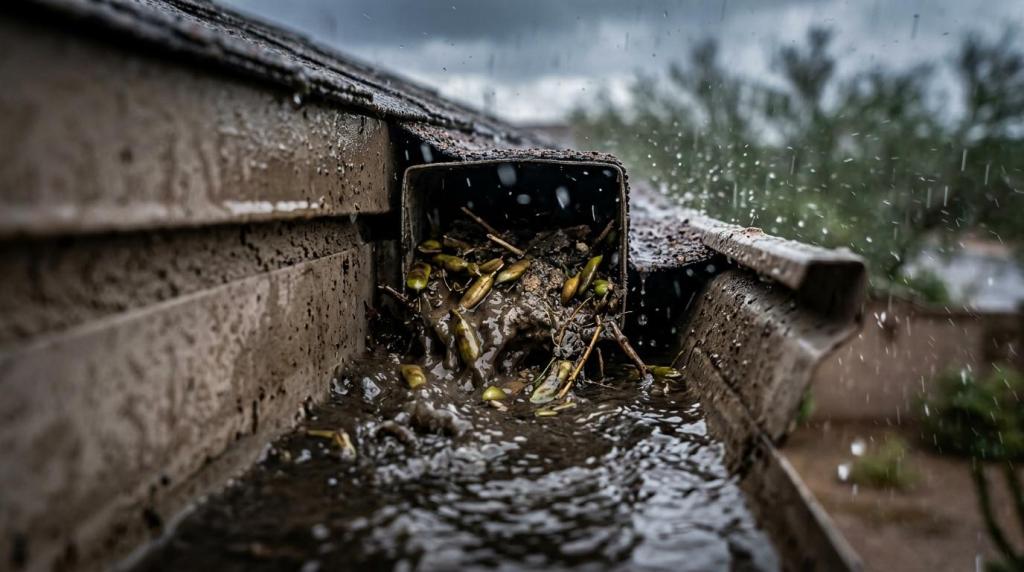
If you live in Tucson or anywhere in Southern Arizona, gutter guards are not a simple yes-or-no upgrade. I get asked about them all the time, usually right before monsoon season or right after a big overflow stains a patio, washes out a planting bed, or dumps water next to the foundation.
The short answer is this: gutter guards can be worth it in Arizona, but only when the whole gutter system is built for Arizona rain. A guard on a too-small gutter is still a too-small gutter. And a guard that handles oak leaves back east may struggle here with dust, palo verde seed pods, and the kind of hard summer downpour that can hit a roof all at once.
That’s the part many homeowners miss.
How Arizona monsoon rain changes the gutter guard question
A lot of states get steady rain. Southern Arizona gets long dry stretches, then a sudden burst during the North American monsoon. In our area, the monsoon season runs from mid-June through the end of September, and Tucson’s rainfall usually peaks in July and August. That means your gutter system may sit mostly dry for weeks, then get tested hard in a single afternoon.
When that happens, water has to move fast. If it cannot get through the gutter, into the outlet, and down the downspout quickly enough, it spills over the front edge or backs up. That runoff can hit stucco, stain fascia, puddle near the slab, and cut channels into soil around the house. Even in a dry climate, runoff management matters because roofs shed a surprising amount of water in a short time.
This is why I usually tell homeowners to think about capacity first and protection second.
What debris actually fills Arizona gutters
People hear “gutter guards” and picture big leaves. Around Tucson, that is only part of the story. We deal with finer, lighter debris that behaves differently once the first storm hits and turns everything into a muddy paste.
Common gutter debris on Southern Arizona homes includes:
- mesquite leaflets
- palo verde blossoms
- seed pods
- dust and grit
- small twigs
- roofing granules
That mix is one reason some guard styles work better here than others. A guard may keep out larger debris but still let in enough fine material to create sludge. Or it may trap that fine material right on top of the guard, where it bakes in the sun, then seals itself tighter after a storm.
The sun is part of the problem too. Arizona UV exposure is rough on plastics, foam inserts, and lower-grade finishes. What looks good the first year can get brittle, warped, or chalky faster here than many homeowners expect.
Gutter guard types for Arizona homes
There is no single “best” guard for every house. Roof pitch, tree cover, gutter profile, and water volume all matter. Most homes here use K-Style gutters, usually 5-inch or 6-inch, and the guard has to match both the profile and the amount of runoff the roof creates.
Here’s a practical look at the main categories.
| Guard type | How it handles Arizona debris | How it handles monsoon flow | Typical concern |
|---|---|---|---|
| Foam insert | Fair at first | Poor to fair | Breaks down in sun, holds grit |
| Brush insert | Catches large debris | Fair | Traps fine dust and seed fluff |
| Basic screen | Keeps out leaves and twigs | Fair | Fine debris can sit on top and clog openings |
| Perforated solid cover | Good with larger debris | Good if properly installed | Can sheet over in heavy rain if pitch or outlet is wrong |
| Micro-mesh guard | Often best with mixed debris | Good to very good | Needs proper slope and occasional cleaning of surface |
Micro-mesh guards usually make the most sense on Arizona homes that actually need protection. They do a better job with fine material than wide-opening screens. But even micro-mesh is not magic. If the gutter is undersized, if the downspout outlet is too small, or if the roof dumps too much water into one section, overflow can still happen.
There is another point worth being plain about. University of Arizona rain harvesting guidance has warned against some leaf-type screens and downspout screening because they can become the clog point. I agree with that. A guard system should not create a maintenance trap in the one place where you need water moving freely.
Why gutter size and downspout capacity matter more than the guard
This is where many installs go sideways. Homeowners buy a guard because they are tired of cleaning, but the gutter itself was never sized for monsoon intensity. The guard gets blamed when the real issue is the base system.
If you have a long roof run, a steep roof, a tile roof shedding fast runoff, or a section feeding a cistern, capacity matters a lot. In many cases, moving from a 5-inch K-Style gutter to a 6-inch system, or increasing downspout size and count, does more for performance than adding a guard alone. On bigger rainwater harvesting setups, University of Arizona examples even call for 6-inch gutters, 5-inch downspouts, and larger conveyance piping to handle intense storm events.
A guard should support water movement, not choke it down.
Some warning signs show up again and again on Arizona homes:
- Front-edge overflow: Water pours over the face of the gutter during short, heavy storms.
- Outlet bottleneck: The gutter looks full near the downspout opening while water backs up upstream.
- Splash at the base: The downspout dumps too close to the house or the extension cannot keep up.
- Uneven roof drainage: One section of roof carries far more runoff than the rest.
- Drainage by appearance only: The gutters look clean, but the underground pipe or downspout is undersized.
This is also where the fascia board matters. If the fascia board is soft, split, or sun-damaged, adding guards on top of an aging attachment surface is not a smart long-term move. Sometimes a fascia wrap repair or replacement should happen before any guard is installed.
When gutter guards are worth the cost on Tucson homes
There are homes where guards make very good sense. There are also homes where I would rather see the budget go into larger gutters, better downspouts, or improved grading first.
Guards tend to be worth it when the home sits under mesquite, palo verde, eucalyptus, or other debris-dropping trees and the gutters are hard to access. Two-story sections are an obvious example. So are homes with fragile landscaping, pool decks, or walkways below the eaves where regular ladder work is not ideal.
They also make sense when the house has a working water harvesting setup. If you are trying to feed cisterns, keep sediment down, and make the system easier to manage, a good guard can help reduce what enters the gutter in the first place. It does not replace filtration or first flush diverters, but it can cut down the mess.
Here’s a simple way I look at it on Arizona properties:
- Good fit: Heavy tree debris, difficult access, properly sized gutters, homeowner wants less frequent cleanout.
- Questionable fit: Minimal tree cover, undersized gutters, known overflow, homeowner expects zero maintenance.
- Strong fit with harvesting: Gutters feed cisterns, debris control matters, system includes serviceable cleanout points.
- Poor fit: Cheap plastic products in full sun, clogged downspout screens, or any setup that slows water at the outlet.
One more thing: gutter guards are often sold as “maintenance free.” They are not. They are “less maintenance” when chosen and installed well.
Gutter guards with rainwater harvesting and cisterns
Arizona homeowners often look at gutters a little differently because water has value here. If runoff can be directed into a tank instead of washing into the yard, that water can support trees, shrubs, and seasonal planting. That is where gutter guards become part of a larger system, not just a debris accessory.
For harvesting setups, I like to keep the path from roof to cistern straightforward and easy to service. The guard should reduce bulk debris at the gutter level. After that, a first flush diverter can help remove the dirtiest initial runoff, and the tank or cistern should have screened inlets and sealed openings to keep out mosquitoes, algae-promoting light, and extra debris.
That setup works better than putting a fussy screen right at the downspout throat and hoping it never clogs. Once a clog forms there during a monsoon burst, water usually backs up fast. On harvesting systems, the best detail is often the simplest one that is still easy to open, rinse, and inspect.
Pre-monsoon gutter guard maintenance in Southern Arizona
Even the best guard needs a check before storm season. I tell homeowners to look things over in late spring or early June, before the first real summer cells roll through.
What you are checking for is not complicated. You want open flow, secure attachment, and no weak points where sun, wind, or last year’s debris caused trouble. A five-minute walk around the house after a dry spell can tell you a lot, and a hose test can tell you even more.
A good pre-monsoon check should include:
- Guard surface: Brush off built-up dust, blossoms, and seed pods.
- Downspout flow: Run water and make sure it exits freely at the bottom.
- Fasteners: Check for loose hangers, lifted sections, or rattling parts.
- Fascia and soffit: Look for stains, peeling paint, or signs of repeat overflow.
- Harvesting components: Clean first flush parts and inspect cistern screens.
If water skips over the top of the guard during a hose test, that does not always mean the guard product is bad. It may mean the angle is off, the gutter is too small, the roof section is carrying too much runoff, or the outlet capacity is not there. That is why diagnosis matters more than brand names.
A well-built Arizona gutter system should do three things at once: move hard monsoon rain, handle fine desert debris, and send runoff where you actually want it to go.
If a guard helps with that, it is worth looking at. If it only hides a sizing problem, it is money better spent somewhere else.
Questions we hear from Tucson homeowners
Can gutter guards be added to my existing gutters, or do I need new ones?
In many cases guards can be fitted to gutters that are already sound and correctly sized. The deciding factor is the condition of what is already up there. If the gutters are secure, pitched right, and large enough for your roof, a retrofit is usually straightforward. If they sag, leak at the seams, or were never adequate for the runoff, adding a guard first just locks the existing problem in place. We look at both the gutters and the surface they hang on before recommending a retrofit versus a replacement.
Can I install gutter guards myself?
You can, and plenty of homeowners do with the snap-in and drop-in products sold at the big box stores. The trade-offs are ladder safety on two-story sections, getting the fit right so water does not skip past the opening, and picking a product that survives our sun. A fair number of the problems I get called out to fix started as a well-meaning DIY guard that never matched the gutter or the roof. Low and simple work is manageable for a careful homeowner. Anything involving real height or an existing overflow usually justifies professional fitting.
Do metal gutter guards offer any wildfire or ember protection?
They can help. In fire-prone stretches of Southern Arizona, a fine metal mesh keeps windblown embers from settling into dry material inside the gutter, which is a known ignition point along the roofline. Foam and plastic products work against you here, since they put flammable material exactly where you do not want it. If ember resistance matters for your property, a noncombustible metal mesh over a clean gutter is the version worth considering.
Do gutter guards keep birds, rodents, and insects out?
A solid guard does reduce nesting and pest access by closing off the open trough where birds build and where debris collects. It is one of the quieter benefits homeowners notice. That said, it is not pest control. A guard will not stop determined rodents at the roof edge or seal every gap, and material sitting on top of a guard can still draw insects. Treat it as removing an easy invitation rather than a guaranteed barrier.
Is there a best time of year to install gutter guards in Tucson?
Late winter through spring is the sweet spot, well before summer monsoon season. Getting guards on early means the system is proven out before the first hard storm rather than during it. Fall is a reasonable second choice, once the summer debris has dropped. The stretch I steer people away from is trying to book an install mid-monsoon after an overflow, when demand spikes and the gutters are already under stress. Planning ahead gets you a calmer install and a better result.
Do gutter guards work on low-slope or flat desert-style roofs?
They can, but a low-slope or flat roof changes the math. These roofs often drain through canales or scuppers rather than a continuous eave gutter, so guard coverage depends on how the water actually leaves the roof. Where gutters are present, the slower runoff of a low-pitch roof lets fine dust settle on the guard surface instead of washing off, which makes a self-clearing mesh and correct gutter pitch more important, not less. It is worth having the drainage layout looked at rather than assuming a standard guard drops right in.