ES
ES 
Arizona rainwater tanks work best when the size matches your roof, your yard’s water use, and the long dry gaps between storms. Around Tucson, I usually tell homeowners to think in terms of capture area first and tank size second.
TL;DR: Summary
- The right rainwater tank size for an Arizona home is the one that matches roof drainage area, monthly water demand, and storage needs between storms, not simply the biggest tank that fits.
- A common sizing method is roof area × rainfall in inches × 0.623 × collection factor, with University of Arizona guidance noting that well-designed systems often capture about 75% to 85% of roof runoff.
- For Tucson rebate planning, full eligibility requires a system sized to capture the first 1 inch of roof runoff; if the system is smaller, Tucson Water says the rebate drops to $0.50 per gallon for all system features.
- For many Arizona homes, practical tank sizes fall into six common ranges: 200, 500, 1,000, 2,500, 5,000, and 10,000+ gallons, with the best fit depending on roof size, landscape demand, and whether you need storage through dry spells.
- Bigger tanks are not always better. U.S. Department of Energy guidance says to compare monthly harvestable rainfall with monthly demand so you avoid both undersizing and oversizing.
- In Southern Arizona, tank performance depends on more than volume. UV protection, screened inlets, a first-flush diverter, overflow piping, and proper gutters and downspouts matter just as much as gallon capacity.
Monsoon season can fill a tank fast, but our long dry stretches are what really drive sizing in Southern Arizona. If you want a system that makes sense for Tucson, Vail, Oro Valley, or Green Valley, you need to look at storage between storms, sun exposure, and local rebate rules right from the start.
How do you choose the right rainwater tank size for an Arizona home?
The right tank size in Tucson or Oro Valley comes from three numbers: roof drainage area, monthly water demand, and the storage gap between storms.
That is the whole game. Federal guidance on rainwater harvesting says tank sizing should compare monthly harvestable rainfall with monthly water demand, then choose storage large enough to meet the need without oversizing. In plain English, you want a tank that fills often enough to be useful but is not so small that it dumps valuable monsoon water out the overflow every storm.
A lot of homeowners start with the tank they saw online, usually a 300- or 500-gallon unit, and work backward. That is a common mistake. If your roof can send 800 to 1,500 gallons off one section during a decent storm, a small tank may be more decoration than water storage.
"Southern Arizona Rain Gutters designs custom harvesting systems from 200 to 10,000+ gallons when a standard tank does not match the roof area or storage goal."
The other side of the problem is oversizing. If the tank is far larger than your roof yield or your actual irrigation use, it costs more, takes more pad space, and may never cycle the way it should. In Arizona, where side yards are tight and summer sun is brutal, that extra size needs a real reason.
How much rainwater can your roof actually collect in Tucson and Southern Arizona?
A roof in Tucson can collect a surprising amount of water, but only the roof area feeding the tank counts.
Before you buy a tank, run the catchment math. A simple planning method looks like this:
- Measure the roof drainage area: Count only the roof surfaces that actually drain into the connected gutters and downspouts.
- Multiply by rainfall and the conversion factor: Use
roof area in square feet × rainfall in inches × 0.623to estimate gallons of runoff. - Apply a collection factor: Well-designed systems often capture about 75% to 85% of the rain after losses from splash, first flush, and system inefficiency.
Here is a simple one-inch storm example. If 1,500 square feet of roof drains to your gutters, one inch of rain equals about 935 gallons before losses. At 80% capture, you would store closer to 748 gallons. That is why a 200-gallon barrel often looks undersized once you do the math.
University of Arizona guidance gives a useful benchmark: a 1,000-square-foot roof in Wilcox with 16 inches of annual rainfall has a calculated collection potential of about 9,600 gallons per year using the extension formula. The pro tip here is simple: do not count the whole roof unless the whole roof is actually tied into the system.
What are the six rainwater tank sizes that fit most Arizona homes?
For most Arizona homes, six tank sizes cover the real-world range from basic landscape capture to long-gap storage.
Once the math is done, most homeowners land in one of these six sizes. These are planning ranges, not hard rules.
- 200 gallons: Best for a small patio roof, a few pots, or a starter system feeding one planting zone.
- 500 gallons: A good fit for modest roof sections and light irrigation around citrus, desert shrubs, or a front entry landscape.
- 1,000 gallons: Often the first size that feels meaningful on a typical house because it can catch much more of a single monsoon event.
- 2,500 gallons: A strong choice for larger roof drainage areas or homeowners trying to bridge longer dry periods.
- 5,000 gallons: Better for bigger lots, higher landscape demand, or homes that want substantial carryover storage between storms.
- 10,000+ gallons: Usually reserved for large properties, barns, detached shop roofs, or owners treating rainwater as a serious water-conservation asset.
If you are trying to meet Tucson’s one-inch rebate target, the size you need can jump quickly. A 1,200-square-foot drainage area produces roughly 748 gallons from one inch of rain before adjusting for design details, so that usually pushes you well past rain-barrel territory.
How do you size a tank for Tucson’s one-inch rebate rule?
For Tucson Water rebate planning, start with the roof drainage area and size the system to capture the first inch of runoff.
The rebate rule matters because it can change the best tank size even when your irrigation demand is small. Tucson Water states that full rebate eligibility requires the system to capture one inch of rainwater from the roof drainage area.
Use this simple process before you pick a tank:
- Measure the connected roof drainage area: Include only the roof sections feeding the harvesting system.
- Estimate one inch of runoff volume: Multiply the roof area by 0.623 to get gallons from one inch of rain.
- Check the program steps before installation: Tucson requires a workshop and pre-approval, and the approved customer has one year to complete the installation.
If the system is not large enough to capture the full one inch, Tucson Water says the rebate drops to $0.50 per gallon for all system features. The common misconception is thinking you can buy a tank first and sort out rebate paperwork later. With this program, the order matters.
Is one large cistern better than several smaller rainwater tanks?
One large cistern is usually simpler, while several smaller tanks are often easier to fit on a Tucson lot.
A single larger tank can mean fewer fittings, fewer overflow transitions, and cleaner plumbing. It often gives you a better cost-per-gallon number too. If you have room for a proper pad and easy access, one larger vessel is straightforward to maintain.
Several smaller tanks can make more sense on narrow side yards or homes with multiple gutter runs. They also let you phase the project. You might start with one 500-gallon tank at the garage and add another near a courtyard roof later. If one tank needs service, the whole system is not offline.
"Southern Arizona Rain Gutters offers plastic water tanks from 100 to 5,000 gallons, which covers many small and mid-size residential layouts."
The trade-off is plumbing complexity. Multiple tanks mean more balancing lines, more screened inlets, and more overflow planning. If the grade is tricky, a badly linked multi-tank setup can fill unevenly.
Should you choose plastic tanks or steel culvert cisterns for an Arizona property?
Plastic tanks suit many homes, while steel culvert cisterns fit larger storage goals and larger sites.
Plastic tanks are usually the practical pick for standard residential work. They are lightweight, easier to place, and available in useful sizes for homes. Southern Arizona Rain Gutters lists plastic tanks from 100 to 5,000 gallons, and these are installed on level ground with screened inlets and overflow piping.
Steel culvert cisterns make sense when the storage goal is much larger or when the property can visually handle a bigger structure. Southern Arizona Rain Gutters lists steel culvert cisterns from 800 to 20,000+ gallons. Those systems are built for larger water storage needs and use corrugated steel for strength.
"Southern Arizona Rain Gutters builds steel culvert cisterns from 800 to 20,000+ gallons for properties that need longer storage between storms."
Material choice is not only about looks. In desert conditions, sun exposure, lid security, mosquito control, and algae prevention matter every bit as much as wall material. If the tank is sealed and UV-protected with screened openings, it will hold up much better than an exposed, loosely covered container.
How much storage do you need between Arizona storms?
In much of Arizona, storage should be planned around dry periods, not just around the storm that fills the tank.
This is where many systems get right or wrong. University of Arizona guidance says many planners recommend storing about four months of water demand as backup because that is about the average number of consecutive months without rain likely in much of Arizona.
Here is a practical way to estimate that need:
- Write down monthly water demand: Use actual irrigation zones, livestock use, or other nonpotable needs.
- Pick the backup window: If you want conservative planning in Arizona, test your numbers against a four-month dry period.
- Compare storage with roof yield: If demand is higher than likely roof capture, reduce demand, add catchment area, or accept supplemental city water.
If your landscape needs 1,000 gallons a month and you want four months of backup, that points toward 4,000 gallons of storage. If your roof can only refill 1,500 gallons in a typical wet month, then a 10,000-gallon tank may not pencil out. If-then logic helps here: if the roof cannot reliably refill the tank, extra capacity is just idle space.
What parts make a rainwater tank system work well in the desert?
A good desert system needs more than a tank. Gutters, filters, first flush, overflow, and sun protection are what make it dependable.
The U.S. Department of Energy lists the main parts of a proper system: roof and gutters, an inlet filter, a first-flush diverter, a storage tank, an overflow, controls, treatment, a pump, backflow prevention, a flow meter, a power supply, and a water-level indicator. Most Tucson homes do not need every component, but the core pieces matter.
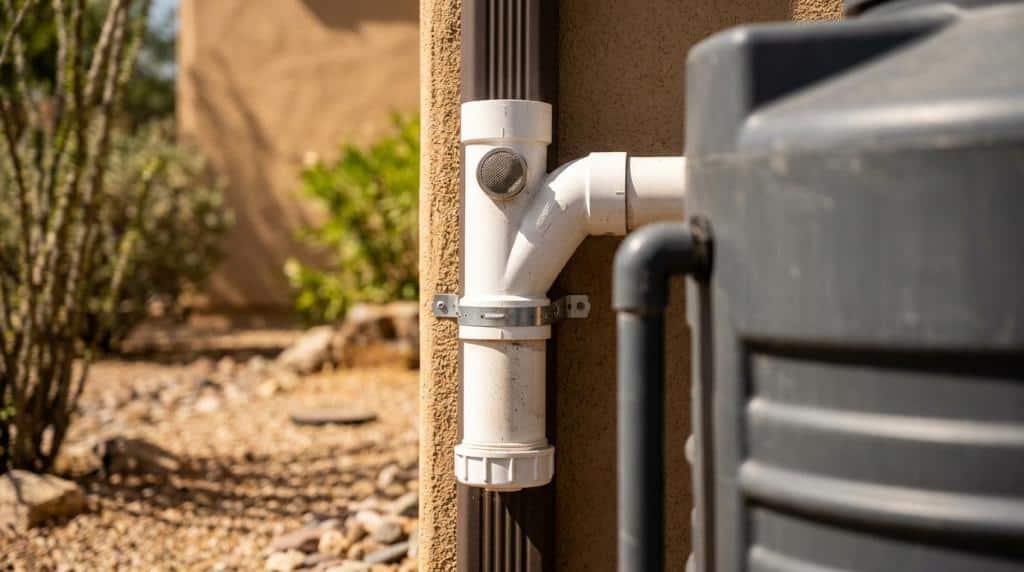
A common mistake is focusing only on gallon capacity and ignoring water quality and overflow. In Southern Arizona, dusty roofs, monsoon debris, and hard sun are hard on weak systems. A first-flush diverter helps keep the dirtiest roof runoff out of the tank. A screened inlet blocks debris and helps prevent mosquitoes. A proper overflow pipe keeps water from backing up at the downspout or washing out the pad.
"Southern Arizona Rain Gutters uses screened inlets and overflow piping on rainwater tanks, two details that help control debris and standing water issues."
Gutters matter here too. Well-pitched seamless aluminum or copper gutters, usually in a K-Style profile on homes around Tucson, do the collection work. If fascia boards are weathered, fascia wrap can be part of the fix so the gutter attachment stays solid through monsoon winds.
What rebate, permit, and code rules should Tucson homeowners check before buying a rainwater tank?
Tucson homeowners should check rebate rules, site requirements, and Arizona water-quality guidance before buying any tank.
The big local item is the Tucson Water rebate process. That means workshop, pre-approval, and then installation within one year of approval. If you skip those steps, you can miss money that might have helped pay for the system.
State-level guidance matters too. Arizona Department of Water Resources notes that residential systems should follow Arizona Department of Environmental Quality guidelines. In practical terms, that becomes more important when the system includes pumps, treatment, or any indoor use.
One more thing homeowners miss is site approval. A large cistern may affect setbacks, screening, HOA requirements, pad design, or electrical planning for a pump. If the tank is only feeding outdoor irrigation by gravity, the setup is usually simpler. If you want pressurized hose bibs, filtration, or potable treatment, the design gets more technical fast.
When is a rainwater tank too big or too small for your home?
A tank is too small when it overflows every storm and runs dry right after, and too big when your roof and demand cannot keep it cycling.
Undersized tanks are easy to spot once they are installed. You get one good monsoon cell, the overflow dumps water all over the yard, and then the tank is empty a week or two later. That usually means the roof can supply more than the tank can hold, or the demand pattern was never thought through.
Oversized tanks are quieter mistakes. They cost more, take up more yard, and may never fill enough to justify the footprint. Federal sizing guidance is useful here: compare monthly harvestable rainfall with monthly demand. If the numbers do not support the extra volume, going bigger is not automatically smarter.
A good tank size gives you useful carryover without wasting space. In Tucson, that often means right-sizing the system around a real roof section, a realistic demand number, and the dry months you actually need to cover.