ES
ES 
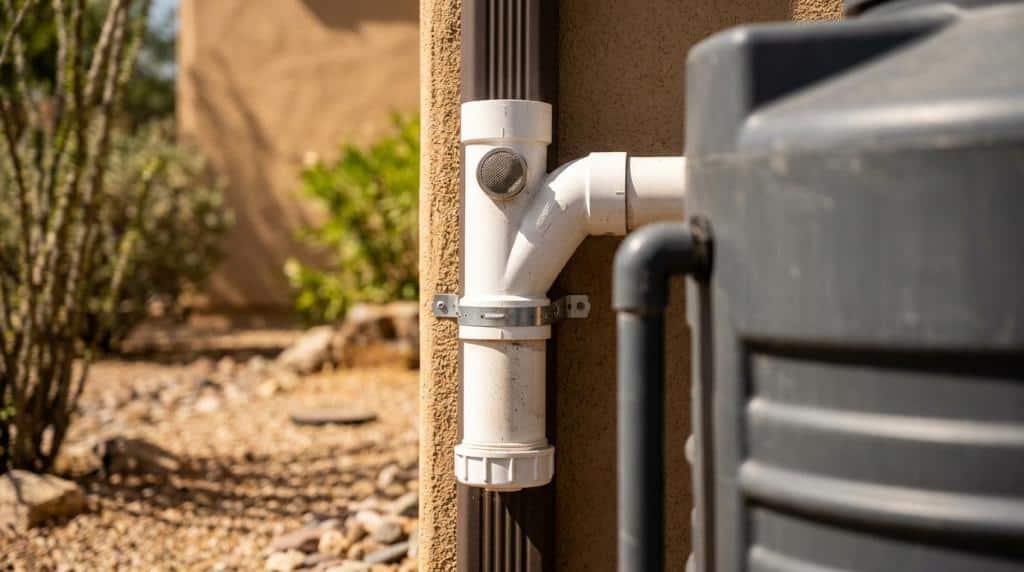
Is rainwater harvesting legal in Arizona? Yes. The state is one of the most permissive in the country on this, with no residential collection limits and tax incentives available at the state level. If you want to run a downspout into a tank in your own yard, state law is not what stands in the way. That is a very different position from parts of the country where capturing rain off a roof has been restricted or metered, which is usually where the question comes from in the first place.
The more useful question for a Tucson homeowner is not whether harvesting is allowed, but which rules apply to the specific system you have in mind. Permits, plumbing connections, drainage, and HOA appearance standards are all decided closer to home, and they vary by city, county, and neighborhood. This is a plain look at what is settled at the state level, what is not, and what to confirm before anything gets built. For the systems themselves, our rainwater harvesting and water storage work in the Tucson area covers how the pieces fit together.
Is Rainwater Harvesting Legal in Arizona?
Yes. Residential rainwater harvesting is legal in Arizona, and the state does not cap how much a household may collect. Arizona is consistently described as one of the most permissive states in the country on this point, and incentives have existed at the state level to encourage it rather than discourage it.
That permissiveness is the baseline, not the whole picture. No collection limit does not mean no rules of any kind. It means the act of catching rain that falls on your own roof is not the regulated part. What can be regulated is the construction around it: what you build, where you put it, whether it touches household plumbing, and where the overflow goes when a monsoon storm fills a tank in twenty minutes.
What the State Settles and What It Leaves to Your City
The state settles the threshold question, and it answers yes. It does not settle building permits, plumbing and backflow requirements, setbacks, grading and drainage, or how your homeowners association feels about a tank beside the driveway. Those are local decisions with local answers.
Holding onto that split explains something that otherwise sounds contradictory. You will read that rainwater harvesting is legal in Arizona, and then hear a homeowner in Oro Valley or Marana say they had to check with the city before anything went in. Both are accurate. The state question is closed. The project questions are open until someone with jurisdiction over your address answers them.
Rules that vary by city, county, and program also change over time. Treat anything you read about permits, rebates, or tax treatment, including what is written here, as a starting point to confirm with the relevant authority rather than a final answer. That is not a disclaimer for its own sake. Program terms genuinely move from year to year, and the cost of assuming is usually paid after the equipment is already bought.
Where Local Rules Can Still Apply
Local requirements tend to surface in four places: permitting for larger or more permanent installations, plumbing and backflow when a system could touch the drinking water supply, grading and drainage when water crosses a property line, and HOA standards covering appearance. None of these make harvesting illegal. They shape how a particular system gets built.
Permitting. A plastic tank set on prepared ground in a back yard is a different proposition from a buried cistern, a tank on an engineered pad, or a system tied into the house. Generally, the larger and more permanent the installation, the more likely a local requirement applies. In the Tucson area that means the City of Tucson or Pima County, and if you are in Sahuarita, Green Valley, Vail, Nogales, Rio Rico, Sonoita, or Three Points, the jurisdiction covering your address. One phone call before design beats a correction afterward.
Plumbing and backflow. Any point where harvested water could reach the potable supply turns into a plumbing question with its own requirements. Most residential irrigation systems avoid that entirely by staying fully separate from household plumbing, which is the simplest path and the one we see most often.
Drainage. Overflow planning is standard best practice for a tank, and it is also where a project can quietly become a neighbor problem. Water that exceeds capacity during a storm has to land somewhere deliberate. Sending it toward a foundation, a wash, or the property next door is the version that generates a phone call, and grading and drainage are handled locally.
HOA standards. An association usually regulates how something looks rather than whether you may do it. Tank color, placement, height, and screening are the recurring points. Ask before ordering, because moving a full tank is not a small job and repainting one is not always an option.
What Actually Sets the Limit on How Much You Collect
With no legal cap on residential collection, the ceiling is physical rather than regulatory. Roof area, gutter capacity, and tank size decide how much water you keep. Almost every homeowner runs into one of those three limits long before any rule enters the conversation.
Gutters are the part people underestimate. A tank cannot store water that never reached it, and a roof with missing runs or leaking joints loses volume during exactly the intense storms you were counting on. Seamless gutters are formed on site in one continuous piece, which removes the seams that otherwise leak under heavy flow. Downspout capacity matters just as much: the industry standard sizes are 2x3 and 3x4 inch, with larger sections used for bigger roofs or more intense rainfall, and one downspout typically serves roughly 30 to 35 feet of gutter.
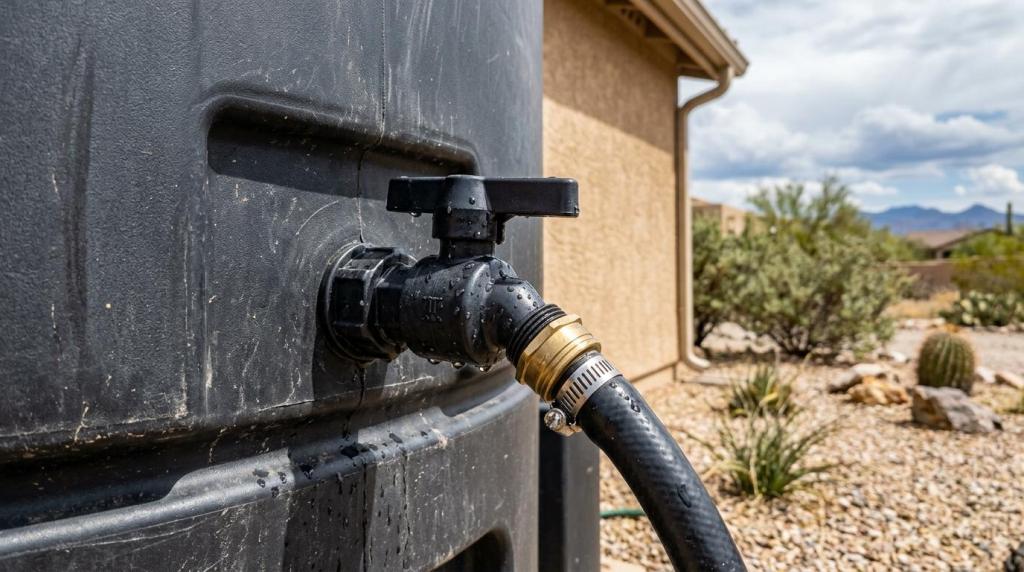
Storage is the other ceiling. There are three tank lines to choose from, above-ground plastic tanks, steel culvert cisterns, and commercial storage tanks, and the right one depends on capacity, appearance, and whether the property is residential or commercial. As general industry guidance, garden irrigation systems commonly run somewhere between 50 and 500 gallons, while whole-property residential systems commonly reach several thousand gallons and up to around 10,000. Commercial installations go beyond that. Those are ranges, not specifications, and the honest answer for any given property depends on roof area and what the water is for.
What You Are Allowed to Do With the Water
Landscape irrigation is the standard use and where nearly every residential system in Southern Arizona starts. Harvested rain goes onto trees, gardens, and planted areas, which is precisely the demand that pushes an outdoor water bill up through the summer. Nothing about that use is unusual or restricted here.
Drinking water is a separate category and should be treated as one. Potable use raises treatment and plumbing questions that irrigation simply does not, and it is not something to assume from a standard roof to tank setup. If that is your goal, plan it as its own project and confirm the requirements with the relevant authority before designing around it.
For the ordinary case, the payoff is straightforward: a lower water bill, eligibility for the Tucson Water rebate, water for landscape irrigation, added property value, and a local resource that currently runs off your roof and leaves. We looked at the bill side of that in detail in our piece on whether rainwater harvesting lowers outdoor water costs.
Does Arizona Offer a Tax Incentive for Rainwater Systems?
Tax incentives have been available at the state level, and the current status, eligibility, and value of any credit is something to verify rather than assume. Tax programs are created, amended, and retired, and a figure quoted on a contractor's blog is not a basis for a filing. The Arizona Department of Revenue publishes what is currently available on its state tax credits page, and that, together with a tax professional, is where this should be settled.
Locally, the more immediate program for most people is the utility one. Tucson Water offers rainwater harvesting rebates to its own customers, with amounts, funding, and requirements set by the utility and subject to change from one program year to the next. If that is part of your plan, the sequence matters more than the number, because some requirements have to be met before you buy equipment. We walked through how the program is structured in our guide to the Tucson Water rainwater harvesting rebate.
Worth separating the two in your head: a state incentive and a utility rebate are different programs run by different bodies with different rules. Qualifying for one tells you nothing about qualifying for the other.
What to Confirm Before You Build
Different setups raise different questions, and knowing which ones apply to yours takes about one conversation. The table below maps the storage options to the checks that most often come up, all of which are answered locally rather than by state law.
| Setup | What it is | What usually needs a local check |
|---|---|---|
| Above-ground plastic tanks | Plastic tanks set on prepared ground and plumbed to the downspouts | HOA appearance rules, placement and setbacks, overflow routing |
| Steel culvert cisterns | Corrugated steel culvert built into a cistern for larger, more permanent storage | Any permitting tied to size or structure, pad requirements, placement |
| Commercial storage tanks | Higher capacity tanks matched to large roof areas | Commercial permitting, site drainage, backflow if the system touches supply plumbing |
| Underground drainage only | Buried piping tied into the gutter system, moving water to a safe runoff area | Grading and drainage rules, where discharged water ends up |
Underground drainage is worth flagging as a legitimate first phase. If a tank is not the right step yet, piping that ties into the gutter system and carries water to a safe runoff area solves the immediate problem, which for most people is water landing where it should not. Because the gutters and downspout routing are shared by both approaches, getting the collection side right now means storage is an addition later rather than a rebuild.
None of this is complicated once it is written down, and none of it changes the headline. Harvesting is allowed here. The work is in matching a system to your property, your roof, and whatever your city and association expect.
Key Takeaways
- State law answers whether you may collect. Your city, county, and HOA answer how the system gets built.
- Permitting likelihood tracks permanence, so a buried cistern draws more scrutiny than a plastic tank on prepared ground.
- Keeping a system fully separate from household plumbing avoids the backflow question entirely.
- Overflow has to be planned deliberately, because storm water leaving a full tank is a drainage matter with a local answer.
- A state tax incentive and a Tucson Water rebate are separate programs with separate rules, and both change over time.
- The real ceiling on collection is roof area, gutter capacity, and tank size, not the law.
Legal Questions Tucson Homeowners Ask About Collecting Rain
Does Arizona limit how much rainwater I can collect?
No. There are no residential collection limits in Arizona, which is part of why the state is considered one of the most permissive in the country on rainwater harvesting. The amount you end up with is decided by your roof, your gutters, and your tank rather than by a legal cap.
Can my HOA stop me from installing a rainwater tank?
An association typically regulates appearance rather than the practice itself, so expect questions about tank color, placement, height, and screening rather than a flat refusal. Rules vary by association, so check your governing documents and ask the board before ordering equipment.
Do I need a permit for an above-ground tank in Tucson?
It depends on the installation, and it is a local question rather than a state one. Simple above-ground tanks on prepared ground are generally the least involved option, while structural pads, buried tanks, and connections to household plumbing are more likely to trigger a requirement. Confirm with the City of Tucson or Pima County for your address.
Is it legal to drink harvested rainwater in Arizona?
Potable use is a different category from irrigation and brings treatment and plumbing requirements with it. Do not assume a standard roof to tank system is suitable for drinking water. If that is the goal, treat it as its own project and confirm the requirements with the relevant health or building authority first.
Are greywater and rainwater treated the same way?
No. Greywater from sinks, showers, and laundry is regulated separately from rainwater collected off a roof, and the requirements are not interchangeable. If you are considering both, check the rules that apply to each system rather than assuming one answer covers the pair.
Is there still a state tax credit for installing a system?
Verify this before relying on it. Incentives have existed at the state level, but tax programs change, and the current status and eligibility should come from the Arizona Department of Revenue or a tax professional rather than from any contractor website, including ours.
Can overflow from my tank cause a problem with a neighbor?
It can, which is why overflow routing is part of the design rather than an afterthought. Water leaving a full tank during a storm needs a planned path to a safe runoff area, and grading and drainage rules are set locally. Plan the overflow before the tank is placed, not after the first monsoon.
Does any of this change if I rent the property out?
The legal position on collecting rain does not change, but the decision making does. Ownership, association approval, and responsibility for maintenance all need to be settled between owner and tenant before a permanent installation goes in.