ES
ES 
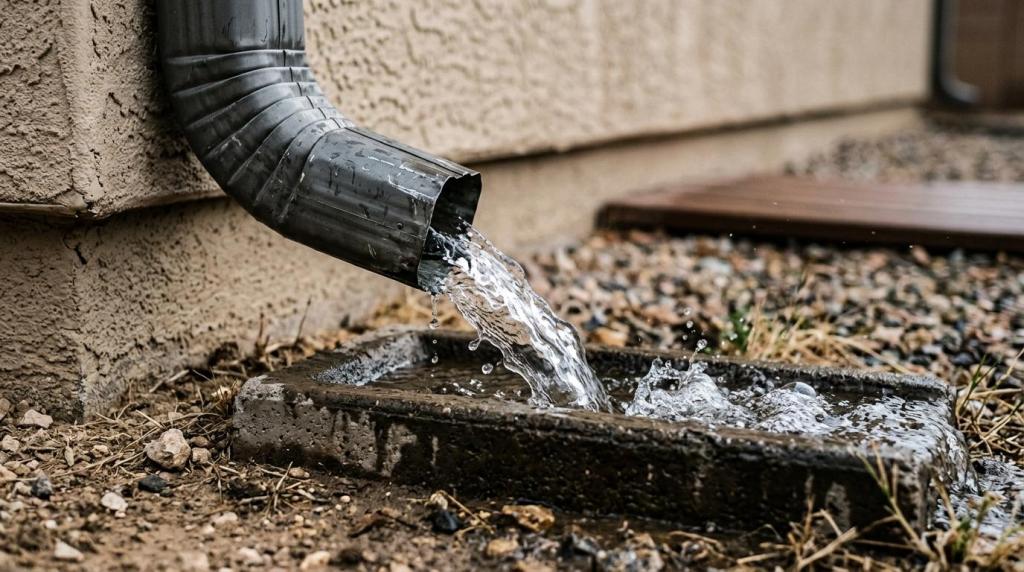
If you have lived through a Tucson monsoon, you already know how fast a calm afternoon can turn into blowing dust, hard rain, and sheets of water pouring off the roof. What surprises a lot of homeowners is not the storm itself. It is how much damage that runoff can do when there is no clear path to carry it away from the house.
A roof collects a lot more water than people expect. The U.S. Department of Energy notes that even a few inches of rain on a house roof can create several thousand gallons of runoff. In Southern Arizona, that water often arrives in a short burst, right when the ground is dry, hard, and not ready to absorb it quickly. That is where gutters and downspouts stop being an add-on and start acting like real protection.
In Tucson, good gutter work is not just about catching rain. It is about drainage planning, protecting stucco, reducing erosion, keeping water off walkways, and moving runoff away from foundation areas before monsoon season does what it always does.
Why Tucson monsoon runoff hits homes so hard
Monsoon storms are different from a long, gentle rain. They dump water quickly. The National Weather Service warns that flash flooding in Arizona can begin within hours of intense rainfall, and anybody who has watched water rush through a wash knows how aggressive that flow can get. The same thing happens on a smaller scale around your home.
When heavy rain falls on a roof, all that water gets concentrated at the eaves. Without gutters, it drops straight down in a line. That means the same narrow strip of soil gets hammered over and over. Over time, you start seeing trenching, splashing, and dirt washing away from the house.
That runoff also does not stay neatly in place. Wind-driven rain during monsoon season blows water against stucco walls, fascia boards, windows, and doors. Then the sun comes back out, bakes everything dry, and repeats the cycle the next time a storm rolls in. In the desert, sun damage and storm damage often work together.
After years of looking at homes around Tucson, Green Valley, Oro Valley, and Vail, the same trouble spots keep showing up:
- Foundation-edge erosion
- Stucco splash marks
- Washed-out gravel beds
- Wet soil near stem walls
- Slippery entries and patios
A lot of people think, "My house does not have a basement, so foundation moisture is not a big issue here." That is not really how water damage works. Even slab-on-grade homes can have trouble when runoff pools at the perimeter, works into cracks, or keeps soil wet around the foundation line longer than it should.
How gutters protect foundations, stucco, and landscaping
The main job of a gutter system is simple: catch roof runoff and send it to a controlled discharge point. That sounds basic, but the effect on the house is huge.
The Department of Energy recommends directing rainwater down and away from the building to reduce soil saturation near the foundation. That matters in Arizona just as much as it does anywhere else. The soil next to the home should not stay wet if you can help it. The ORNL foundation handbook also points to gutters, downspouts, and grading as part of keeping water away from the structure.
Here is what happens when runoff is controlled well. Instead of twelve or twenty feet of roof edge dumping water straight down, the gutter collects it, carries it along the run, and drops it at a few planned points through downspouts. Then those downspouts can empty onto splash blocks, extensions, drains, or harvesting lines that move water farther from the home.
That one change reduces several common monsoon problems at the same time.
| Problem around the home | What uncontrolled runoff does | What proper gutters help prevent |
|---|---|---|
| Foundation moisture | Keeps soil wet next to the house | Moves water away from the perimeter |
| Erosion | Cuts channels into dirt and gravel | Controls where water exits |
| Stucco staining | Splashes mud and minerals up the wall | Limits wall splashback |
| Fascia damage | Soaks exposed wood and trim ends | Protects roof edge components |
| Walkway flooding | Dumps roof water at entries and patios | Sends discharge to better locations |
| Landscape washout | Scours mulch, decomposed granite, and plants | Slows damage to planting beds |
Stucco staining is a big one here. You will see dark lines, mud splash, or mineral streaking on homes that get roof runoff dumped right at the wall. Gutters do not fix every stucco issue, but they cut down a lot of the repeated splashing that makes exterior walls look tired before their time.
They also help protect fascia and soffit areas. In Southern Arizona, sun already takes a toll on paint and exposed trim. Add repeated wetting during storms, and those roof-edge materials wear out faster. A properly installed gutter, sometimes paired with fascia wrap, helps shield those areas and gives the roof edge a cleaner drainage path.
Why gutter sizing and slope matter during monsoon season
Not all gutters do the same job. A system that works fine in a light rain can still fail during a Tucson downpour if it is undersized, poorly sloped, or missing enough downspouts.
This is where homeowners often get mixed messages. They may hear that "any gutter is better than none." In a mild climate, maybe. In a monsoon climate, details matter. Roof area, roof pitch, valley concentration, and where water naturally collects all affect how much runoff hits a single section of gutter.
A long roof plane with a valley feeding into one corner can dump a surprising amount of water into a small area. If the gutter profile is too small, water overshoots the front edge. If the slope is off, water sits in the trough instead of moving toward the outlet. If the downspouts are too few or too small, the gutter backs up right when the rain gets heaviest.
When we talk with homeowners about storm protection, these are the parts that matter most:
- Gutter size: It has to match the roof area and expected water flow rate.
- Slope: Too flat and water stands; too steep and the run can look off and drain unevenly.
- Downspout placement: The exits need to be where runoff can be moved safely away.
- Hanger spacing: Strong support helps the system hold up under heavy monsoon water loads.
- Drainage route: Water still needs a place to go after it leaves the downspout.
Seamless gutters are a good fit for this because they remove seams along the straight runs, which cuts down on leak points. Most homes in this area use aluminum seamless gutters, often in a K-Style profile. K-Style is popular because it carries water efficiently and looks right on many Southwestern and ranch-style homes. Half-round profiles can work too, especially on certain architectural styles, but performance should drive the choice, not just appearance.
Heavy-duty hangers matter more than people think. In a real storm, the gutter is carrying a lot of moving water fast. A weak attachment can loosen over time, especially on older fascia. Solid fastening and correct spacing help the system stay in shape through repeated monsoon cycles.
Downspouts and runoff routing are where the real protection happens
A gutter only handles the first half of the job. The second half is the downspout and discharge route. If water exits right at the base of the wall, you have simply moved the problem from the roof edge to the foundation edge.
That is why downspout planning matters so much. On one home, the best answer may be splash blocks and grading. On another, it may be extensions that carry water into the yard. On another, it may be tying the downspouts into a rainwater harvesting setup with cisterns.
A good drainage layout looks at the whole property, not just the gutter line. Where does the lot slope? Where are the low spots? Is there a walkway near the front door? Are there planter beds that wash out every summer? Is there a block wall trapping water in one side yard?
These are common signs that runoff routing needs attention:
- Water pooling near the slab after storms
- Gravel or mulch pushed away from the house
- Mud marks on stucco
- Erosion under roof drip lines
- Standing water by gates, patios, or AC pads
Arizona’s dry soils can fool people. Because the surface dries fast after a storm, it is easy to think the water was never a problem. But the damage often shows up later as soil movement, staining, landscape loss, or cracking in flatwork near the house.
Gutter profiles and materials for Southern Arizona homes
Material choice matters here because our weather is hard on exterior metal and finishes. Strong sun, big temperature swings, blowing dust, and sudden heavy rain put a lot of stress on anything attached to the roofline.
Aluminum is the workhorse for most Tucson homes. It is light, rust-resistant, available in many colors, and works well in seamless form. With a quality finish, it holds up well in the sun. Copper gutters are another option, usually chosen when the look of the home calls for them and the owner wants a longer-term architectural material with natural patina.
Profiles matter too. K-Style is the one most homeowners know, even if they do not know the name. It gives you good capacity and a shape that fits many fascia lines. On some homes, especially custom work, profile choice also affects how the system blends with fascia wrap and trim details.
This is not just cosmetic. The wrong profile or undersized system can make water jump the gutter during a monsoon burst. The right profile, sized for the roof and installed with proper pitch, is what keeps water inside the system and moving where it should.
Gutters and rainwater harvesting can work together
One nice thing about living in the desert is that runoff does not have to be treated like waste. When a gutter system is planned well, it can protect the home and help with water conservation at the same time.
A downspout can be routed to a basin, a planting area, or a sealed cistern depending on the property and the homeowner’s goals. For people who want to support trees, desert-adapted landscaping, or backup outdoor water use, harvesting makes a lot of sense. It also gives a controlled destination for roof runoff, which helps reduce erosion and flooding around the house.
For harvesting systems in Southern Arizona, a few details matter more than homeowners often expect:
- Screened inlets: Keep out debris, pests, and mosquitoes.
- UV-protected tanks: Desert sun breaks down low-grade materials fast.
- First-flush planning: Helps keep roof debris out of stored water.
- Overflow routing: Tank overflow still needs to drain away from the home.
Cisterns can range from smaller decorative tanks to large storage systems that hold thousands of gallons. The size depends on roof area, space, budget, and what the collected water is meant to do. Even a modest setup can make a difference if it is installed with the same care as the gutter system feeding it.
What homeowners should check before monsoon storms arrive
A lot of storm damage could be reduced with a simple pre-season check. You do not need to wait until you see water pouring over the edge to know something is off.
Start by walking the perimeter during a dry day. Look for staining below the roofline, erosion trenches under the eaves, separated joints, sagging runs, and downspouts that empty too close to the slab. If you have older gutters, check whether the finish is breaking down from sun exposure or whether the fascia behind them shows signs of wear.
Then think about what happened in the last few storms. Where did the water actually go? Did one corner of the house get hammered? Did the front walkway flood? Did the side yard turn into a channel? Those patterns tell you more than a quick glance at the gutter alone.
A smart monsoon-season check usually includes the following:
- Clear debris from gutters and outlets
- Make sure downspouts are open
- Check for loose hangers or sagging sections
- Watch for splash marks on stucco and fascia
- Confirm water discharges away from the foundation
If you are replacing or adding gutters, do not treat it like a trim upgrade. Treat it like drainage work, because that is what it is. The roof, gutter profile, slope, downspouts, fascia condition, grading, and discharge points all need to work together. That is what keeps a monsoon storm from turning a few inches of rain into expensive cleanup around the house.
And in Tucson, where every summer can bring sudden heavy rain, that kind of planning is not overkill. It is just part of protecting the property and making sure water goes where you want it to go.
Common Questions About Monsoon Gutter Protection
Is it too late to add gutters once monsoon season has already started?
Not necessarily. While the ideal time is before the first storms, gutter installation can happen during the season as long as crews can work safely between rain events. The bigger risk is waiting until you have already seen damage, since erosion and stucco staining tend to compound with every storm. If you are mid-season and noticing trouble spots, it is worth getting on the schedule rather than gambling on the rest of the summer.
My house has a flat roof with parapet walls. Do gutters even apply to me?
They work differently, but drainage still matters just as much. Many flat-roof homes in Southern Arizona use scuppers and canales to push water off the roof, and those outlets often dump runoff in a single concentrated stream right against the wall or walkway below. In those cases, the goal is catching and redirecting that discharge rather than running a traditional eave gutter. A site visit determines whether a collection box, a downspout off the scupper, or grading changes make the most sense.
Do gutters create a mosquito problem during monsoon season?
Standing water anywhere can attract mosquitoes, which is exactly why proper slope and clear outlets are so important. A correctly pitched gutter empties fully after a storm and does not hold water in the trough. The places that breed mosquitoes tend to be clogged sections, flat runs, or harvesting tanks without screened inlets. Keeping the system draining freely and screening any collection containers handles the concern.
How often do gutters need attention in a dusty desert climate?
Blowing dust, palo verde debris, and monsoon grit mean local gutters fill up faster than people expect. A check before monsoon season and another in the fall covers most homes, though properties under heavy tree cover may need more frequent clearing. The dust that settles in dry months can harden in the trough once it gets wet, so clearing outlets ahead of the first storms makes a real difference.
Will the gutter finish fade or chalk under Arizona sun?
Lower-quality finishes can chalk and lose color over years of direct exposure, which is one reason material and coating quality matter here more than in milder climates. Quality aluminum with a baked-on finish holds its color well through the heat and UV. When homeowners ask about longevity, the finish grade is often the deciding factor between a system that looks tired in a few years and one that stays clean for much longer.
Can my existing gutters be repaired, or do they need full replacement?
It depends on what is failing. Loose hangers, separated joints, and minor sagging can often be corrected without replacing the whole run. But if the system is undersized for monsoon flow, has the wrong slope built in, or sits on fascia that has started to rot, patching usually just delays the inevitable. An honest assessment looks at whether the existing setup can actually handle a Tucson downpour or whether it was never sized for it in the first place.