ES
ES 
If you want to turn monsoon runoff into stored water instead of watching it spill off the roof and disappear, Southern Arizona Rain Gutters designs rainwater harvesting systems that fit the way homes in Tucson actually work. We build plans around your roof, your lot, your landscape needs, and the hard reality of desert weather.
In Southern Arizona, a harvesting system has to do two jobs at once. It has to survive long stretches of sun and heat, and it has to catch fast, heavy runoff when the storm finally shows up. Southern Arizona Rain Gutters serves homeowners and property owners across the greater Tucson area, including Green Valley, Nogales, Rio Rico, Vail, Marana, Oro Valley, Sahuarita, Sonoita, and Three Points with custom design, installation, and DIY parts pickup.
Tucson rainwater harvesting design that starts with your roof, runoff, and storage goals
A good harvesting plan starts with the roof, not the tank. Southern Arizona Rain Gutters looks at the collection area, roof lines, valleys, scuppers, existing gutters, downspout locations, and where overflow should go so you can store useful water without creating a new drainage problem near the house.
We also size storage to match what your roof can realistically produce. Southern Arizona Rain Gutters uses roof area and local rainfall estimates to help you avoid two common mistakes: buying a tank that is too small to matter or paying for one that never gets used well.
Southern Arizona Rain Gutters designs systems from 200 gallons to over 10,000 gallons, so you can match storage to your roof, yard, and budget.
For example, a 2,000 square foot roof can collect about 1,247 gallons from 1 inch of rain. On average, a 1,000 square foot home in Southern Arizona can collect about 7,800 gallons in a year. Those numbers matter when you are deciding between a compact tank for a few trees and a larger cistern setup that can carry you through dry stretches.
Southern Arizona Rain Gutters sizes gutters and downspouts for Tucson monsoon flow
Rainwater harvesting only works if the water gets to storage cleanly and fast enough. Southern Arizona Rain Gutters designs the collection side of the system too, which means looking at gutter size, downspout size, roof pitch, tile roofs, heavy runoff areas, and long runs where water can back up during a monsoon burst.
If your existing gutters drip, sag, or dump water in the wrong place, we can design around new seamless aluminum or copper gutters as part of the system. For many Tucson homes, the right profiles, including common K-Style options, plus proper downspout sizing make the difference between controlled collection and water blowing past the edge in a storm.
Southern Arizona Rain Gutters offers seamless aluminum and copper gutter options, with more than 30 color choices for homes that need function and HOA-friendly appearance.
Southern Arizona Rain Gutters also installs fascia wrap where needed, which can help clean up roof edges and protect exposed wood. That is especially useful on older homes where sun damage and runoff have already started to wear things down.
Tank and cistern options for Tucson homes, side yards, and HOA-conscious properties
Storage should fit your space and your priorities. Southern Arizona Rain Gutters offers above-ground plastic tanks in roughly 100 to 5,000 gallon sizes, corrugated steel culvert cisterns in about 800 to 20,000 gallon sizes, and complete systems ranging from 200 gallons to 10,000 gallons and up.
That gives you real flexibility. If you want a simple backyard tank for landscape watering, we can design for that. If you want a larger steel cistern that looks more at home with the property and stores more water between storms, we can design for that too.
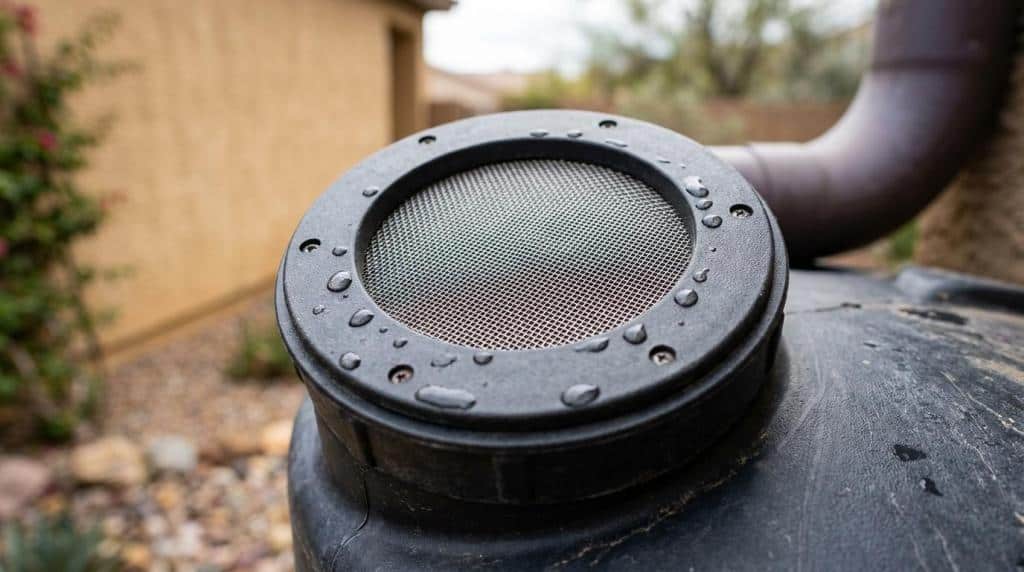
Southern Arizona Rain Gutters builds around sealed, UV-protected storage with screened openings and screened overflows. In Tucson heat, that matters because keeping light out helps limit algae growth, and screened openings help keep mosquitoes and debris out of the system.
Southern Arizona Rain Gutters uses sealed, screened storage design to help prevent algae and mosquitoes in Southern Arizona heat.
Overflow matters just as much as storage. We plan where excess water goes during a big storm so you are not trading one drainage issue for another, and steel cistern setups include cleanout access so maintenance stays straightforward when the tank is empty.
If you want an emergency drinking-water option, Southern Arizona Rain Gutters also offers the LifeSaver Jerrycan portable filtration unit. That is a separate add-on, not a whole-house treatment system, but it can be useful for backup preparedness.
What Southern Arizona Rain Gutters includes in a rainwater harvesting design service
Our design service is meant to give you a system that works on your property, not a generic parts list. Southern Arizona Rain Gutters typically plans around collection, storage, placement, and maintenance from the start.
Here is what that usually involves:
- Site visit to assess roof area, runoff points, available space, and where water should be stored or directed
- Gutter and downspout recommendations based on roof size, roof shape, and runoff intensity
- Tank or cistern sizing based on expected capture volume, intended use, and space constraints
- Overflow and screen planning to help manage monsoon events, debris, algae, and mosquitoes
- A path forward for either professional installation or DIY parts pickup, depending on your budget and comfort level
That design work makes day-to-day ownership easier. You get a system planned for Southern Arizona conditions, with fewer surprises once the first heavy storm hits.
Tucson rainwater harvesting cost, payment plans, and rebate questions
Price depends on the actual layout. Southern Arizona Rain Gutters bases cost on factors like roof collection area, gutter work, number and size of downspouts, tank or cistern capacity, conveyance length, site access, and finish choices.
If you want a lower-cost starting point, Southern Arizona Rain Gutters says small DIY tank setups can start around $600. For larger projects, payment plans are available on jobs over $2,000, which can make it easier to build a system that is worth doing right instead of piecing it together in stages.
If you are looking at Tucson Water rebate options, check the current program status before you buy. Rebate rules, workshop requirements, and pre-approval timing can change, so the design stage is the right time to make sure your system direction matches current local requirements.
This is also the stage to be specific about features you want. If details like filtration, a first-flush device, exact piping preferences, or a certain tank look matter to you, bring that up early so the final scope matches your priorities.
When Southern Arizona Rain Gutters is the right fit for your Tucson property
Southern Arizona Rain Gutters is a strong fit when you want a practical harvesting system designed around real use, not a complicated setup you will end up ignoring. We do our best work for owners who want to conserve water, protect the property from runoff, and install something that still looks right on the house.
You are probably a good fit if you want to:
- Catch roof runoff for landscape irrigation or outdoor water use
- Add gutters, downspouts, or fascia wrap as part of a complete collection plan
- Choose between poly tanks and larger steel cisterns based on space, appearance, and storage goals
- Build a professionally installed system or buy parts for a DIY setup
- Design around Tucson sun, monsoon season, HOA appearance rules, and long dry periods
Our public offering is centered on straightforward collection and storage systems with simple maintenance. If you are looking for a highly automated monitoring package or a complex whole-property treatment setup, that needs a separate discussion because that is not the main focus of what Southern Arizona Rain Gutters publicly offers.
Why Tucson homeowners trust Southern Arizona Rain Gutters for desert-ready system design
Local experience matters here. Southern Arizona Rain Gutters is a Tucson-based company, and that shows up in the details we pay attention to: UV exposure, finish durability, sudden summer storms, tile roofs, stucco homes, side-yard space limits, and the need to make a tank or gutter system look like it belongs on the property.
Southern Arizona Rain Gutters also gives you material choices that fit both function and appearance, including aluminum with long-lasting finishes, copper with natural patina, and cistern options that can work better visually than a basic utility tank on some homes. Public reviews have also noted custom conveyance layouts and gutter color matching for HOA requirements, which is often a deciding factor for homeowners investing in curb appeal as well as water savings.
If you are ready to see what your roof can actually collect, contact Southern Arizona Rain Gutters for a site visit. We will look at the roof, the runoff, the space you have, and help you design a rainwater harvesting system that makes sense for your Tucson property.
Questions About Rainwater Harvesting in Tucson
Is rainwater harvesting legal in Arizona?
Yes. Arizona law explicitly permits rainwater harvesting for residential use, and the state has encouraged it as a water conservation practice for years. There are no restrictions on collecting rooftop runoff for outdoor use. If you plan to use harvested water indoors or for potable purposes, that involves separate permitting and treatment requirements, but for landscape irrigation and outdoor applications, you are in the clear.
Do I need a permit to install a rainwater harvesting system in Tucson?
For most residential above-ground storage systems, a building permit is not required in the City of Tucson or unincorporated Pima County. However, permit requirements can vary depending on tank size, foundation work, or how the system connects to your plumbing. It is worth confirming current requirements with your local jurisdiction before installation, especially for larger cistern setups.
What is a first-flush diverter and do I need one?
A first-flush diverter is a device that routes the initial flow of runoff away from your storage tank. The first water off your roof carries the most debris, bird droppings, dust, and pollutants that accumulate between storms. Diverting that initial flush before water enters the tank improves storage quality and reduces maintenance over time. For Tucson homes with long dry periods between monsoon events, it is worth discussing during the design stage since roofs can accumulate quite a bit between storms.
Can I connect my harvested water to an existing drip irrigation system?
In most cases, yes, with the right setup. A gravity-fed system can work for slow drip applications if the tank is elevated enough to create adequate pressure. For standard drip systems that require more consistent pressure, a small pump is typically added between the tank and the irrigation line. This is one of the details worth planning around early so the conveyance layout and tank placement support how you actually intend to use the water.
How long do plastic tanks and steel cisterns last in Southern Arizona conditions?
Quality polyethylene tanks rated for UV exposure and outdoor use typically last 20 to 30 years with proper care, though direct sun exposure and heat do accelerate wear on tanks that are not UV-stabilized. Corrugated steel cisterns, when properly coated and sealed, are generally more durable long-term and hold up well in desert conditions. Tank longevity is one reason material choice and sealed, UV-protected construction matter more here than in milder climates.
How much maintenance does a rainwater harvesting system actually require?
A well-designed system is low maintenance, not no maintenance. You should expect to clean gutters and screens at the start and end of monsoon season, inspect overflow paths and screened inlets periodically, and flush or clean the tank occasionally, typically when it runs dry between seasons. Steel cisterns with cleanout access make that easier. How much attention a system needs also depends on tree cover near the roof, how frequently it rains, and whether a first-flush device is part of the setup.