ES


The Tucson commercial rainwater harvesting ordinance requires new commercial development in the City of Tucson to supply at least half of its landscape irrigation water from rain captured on the site. Adopted in 2008, it was the first requirement of its kind in the nation by the City's own account, and it is now being reworked through a City initiative called Living Landscapes.
If you own, develop or manage commercial property in Tucson, this rule shapes your site plan long before anyone plants a tree. This guide covers what the requirement says today, where the 2026 amendments actually stand, and how owners usually think about earthworks, tanks or a mix of both. For background on how SARG approaches capture and storage, start with our rainwater harvesting services in Tucson. This is general information, not legal or design advice, and for anything project-specific the City and your design professional have the final word.
What the Ordinance Requires Today
Today the ordinance asks one core thing of new commercial development: harvested rainwater has to cover at least 50 percent of the site's landscape irrigation demand. That is how the City of Tucson describes the 2008 rule.
In practice, the requirement turns rainwater from an optional green feature into a design input. The landscape plan determines how much water the plants need, and the grading and drainage plan has to show where enough rain will come from to meet half of that need.
The rule is written for new commercial development. Whether a remodel, an addition or a change of use brings an existing property under it is a question to put to the City early, because the answer depends on the specific project and its scope of work.
How Does the 50 Percent Water Budget Work?
The requirement works as a water budget. According to the City's supporting technical material, a designer estimates the landscape's annual plant water demand and then shows that harvested rainwater can meet at least 50 percent of it. The same material notes that most sites can reach the target with earthworks alone, meaning shaped ground rather than storage tanks.
That point matters for layout and budgeting. Earthworks such as basins and depressed planting areas let runoff soak in where plants can use it, while tanks hold water for later. The trade-offs between those two approaches are covered in our guide to passive vs active rainwater harvesting, so they are not repeated here. As the City describes it, the target is a share of plant water demand rather than a required piece of equipment, so the mix of earthworks and storage is a design decision your professional makes and the City reviews.
One practical consequence is that plant selection and water harvesting are linked. A landscape with lower water demand needs less harvested water to reach the 50 percent mark. That link is one reason the City is pairing the ordinance update with a Tucson plant list.
Where Do the 2026 Amendments Stand?
As of November 12, 2026, amendments to the Tucson commercial rainwater harvesting ordinance are proposed, not adopted. The City of Tucson's Living Landscapes initiative page lists no adoption date or final action and still describes the Phase 1 changes as proposed updates.
Here is the sequence so far, based on the City's page. On April 7, 2026, the Mayor and Council voted 7 to 0 to direct staff to amend the ordinance around five objectives. The Planning Commission held study sessions on August 26 and September 16, 2026, then a public hearing on the Phase 1 updates on October 7, 2026. The Mayor and Council held a study session on November 4, 2026.
A November 6, 2026 newsletter from the Ward 6 council office reported that the November 4 session was a staff presentation, with no vote on the item, and said the office expects it to come back to the Mayor and Council in spring 2027. Treat that as a forecast, not a deadline. Phase 1 is focused on commercial development, and the City has said residential rainwater harvesting recommendations will come back separately, so homeowners should not read these proposals as rules for houses.
The table compares the current requirement with the five objectives the Mayor and Council asked staff to pursue.
| Item | What it covers | Status as of November 12, 2026 |
|---|---|---|
| Current ordinance (2008) | New commercial development meets at least 50 percent of landscape irrigation demand with on-site rainwater | Current requirement |
| Stormwater capture | Depressed, non-paved areas on new commercial sites to catch more runoff from developed areas | Proposed, not adopted as of November 12, 2026 |
| Right-of-way runoff | Evaluate directing adjacent right-of-way runoff into on-site harvesting where feasible | Proposed, not adopted as of November 12, 2026 |
| Tucson plant list | Adopt a Tucson-specific Native Plant Policy List | Proposed, not adopted as of November 12, 2026 |
| Tree-to-understory ratio | Evaluate a higher ratio of trees to understory plantings | Proposed, not adopted as of November 12, 2026 |
| Parking lot applicability | Evaluate extending requirements to golf course, church and cemetery parking lots | Proposed, not adopted as of November 12, 2026 |
What Could the Proposed Changes Mean for New Projects?
If they are adopted in something close to their current form, the proposals would ask more of landscape and drainage design on new commercial sites and could bring more property types under the rules. None of it is final, and the adopted wording could differ.
Stormwater capture is the biggest design shift. The City's stated objective is to require depressed, non-paved areas that catch more runoff from developed surfaces. That points toward more earthworks in commercial site plans, not fewer.
Right-of-way runoff is listed as something to evaluate where feasible: sending water from the adjacent public right-of-way into on-site harvesting. How that would work on a given parcel depends on the final wording and on the site itself.
The plant list and the tree-to-understory ratio both affect planting design. A Tucson-specific Native Plant Policy List would guide species choices, and more trees relative to understory plants would change canopy and, with it, the water demand a harvesting system has to support.
Applicability is the change that could reach owners who never expected to be covered. The City is evaluating whether to extend requirements to golf course, church and cemetery parking lots, so managers of those properties should follow the process.
Should a Commercial Site Use Earthworks, Tanks or Both?
Most commercial sites start with earthworks, and tanks earn their place when the site needs stored water for a specific job. Because the City says most sites can meet the target with earthworks alone, storage is usually chosen because of site limits or uses beyond landscape irrigation, not because the ordinance demands it.
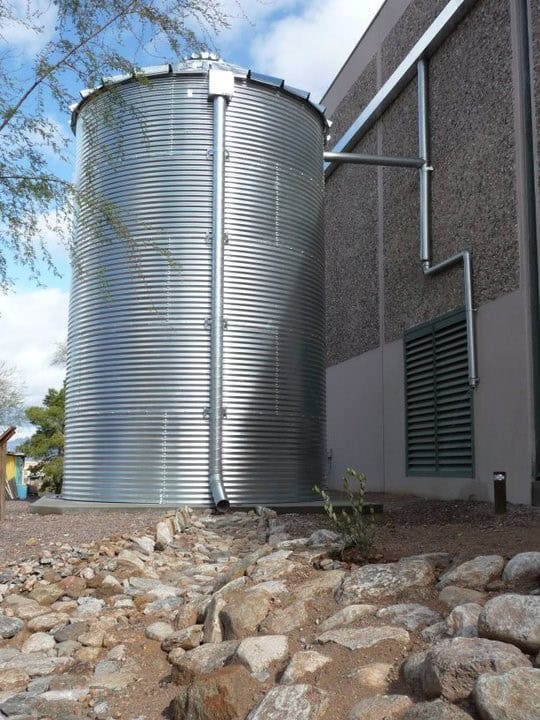
Tight sites are the common case for storage. When buildings, parking and setbacks leave little room for basins, a tank can hold roof runoff until the landscape needs it. Storage also makes sense when an owner wants water for more than plants. SARG's commercial water storage tanks are built for high-volume collection, support irrigation, fire storage and facility use, and can help a project meet regulatory requirements when the approved design calls for storage.
Capacity comes next. SARG's plastic tanks run from 100 to 5,000 gallons, and steel culvert cisterns run from 800 to more than 20,000 gallons. The chart shows the top of each published range. The right size comes from the approved water budget and the site's other water uses, not from the largest tank that fits.
Once storage is part of the plan, system design and installation become their own topic. Our post on rainwater harvesting systems for commercial properties walks through how those systems come together, so this guide stops at the planning stage.
Who Handles What on a Commercial Rainwater Project?
Three parties usually share the work. The City sets and reviews the requirement, a design professional prepares the plan, and a contractor supplies and installs what the plan calls for.
City of Tucson Planning and Development Services is the source for how the Tucson commercial rainwater harvesting ordinance, and any amendments once adopted, apply to your project. A landscape architect or civil engineer typically prepares the water budget, grading and harvesting plan and manages the submittal.
SARG does not prepare ordinance compliance plans or City submittals. Where we fit is after the design direction is set: seamless gutters and downspouts that move roof water where the plan sends it, and tanks or cisterns when the plan includes storage. Bringing a tank installer into the conversation while the design is still flexible can help, because tank footprints, inlet locations and overflow routes all interact with grading.
Key Takeaways
- The 50 percent target is measured against plant water demand, so lower-water plant choices reduce how much rain a site has to capture.
- Because earthworks alone satisfy the target on most sites, according to the City, a tank is a design choice rather than a default.
- A Ward 6 update after the November 4, 2026 study session pointed to spring 2027 for the next Mayor and Council review.
- Golf course, church and cemetery parking lots could come under the rules if the applicability proposal is adopted.
- Size any tank from the approved water budget and involve the installer before grading is final.
Commercial Rainwater Questions from Tucson Property Owners
Does the Tucson rainwater ordinance apply to existing commercial buildings?
Generally no, because the City describes the requirement as applying to new commercial development. A major remodel, expansion or change of use may raise different questions, so ask City of Tucson Planning and Development Services how your specific scope is treated before design starts.
Does the ordinance apply in Oro Valley, Marana or Sahuarita?
No, it is a City of Tucson rule and applies to projects within the city. Oro Valley, Marana, Sahuarita and other nearby towns set their own development codes, so check with the planning department of the town where the property sits.
Can a rainwater tank count toward the 50 percent requirement?
Stored rainwater can generally be part of how a site meets its harvesting target, alongside earthworks. How much a tank contributes depends on the approved plan and the City review, so have your design professional confirm the numbers before you choose a tank size.
When could the proposed amendments take effect?
No effective date has been set as of mid-November 2026. Adoption and any effective date are decisions for the Mayor and Council, and the schedule can change, so check the City's Living Landscapes page for current status before relying on either set of rules.
Who prepares the rainwater harvesting plan for a commercial project?
A design professional, usually a landscape architect or civil engineer, prepares the plan and works with the City on review. SARG supplies and installs gutters, tanks and cisterns to match an approved design, but it does not prepare compliance plans or handle City submittals.
Can harvested water on a commercial site be used for more than landscaping?
Often yes, but the ordinance itself measures landscape irrigation demand. Uses such as fire storage or facility supply depend on the project design and the codes that apply to them, so treat any extra use as a separate design question for your professional and the relevant authority.
How can property owners comment on the amendments?
The City has taken public input through Planning Commission study sessions, a public hearing and Mayor and Council sessions. For the next opportunity to comment, watch the Living Landscapes page or contact City of Tucson Planning and Development Services directly.