ES
ES 
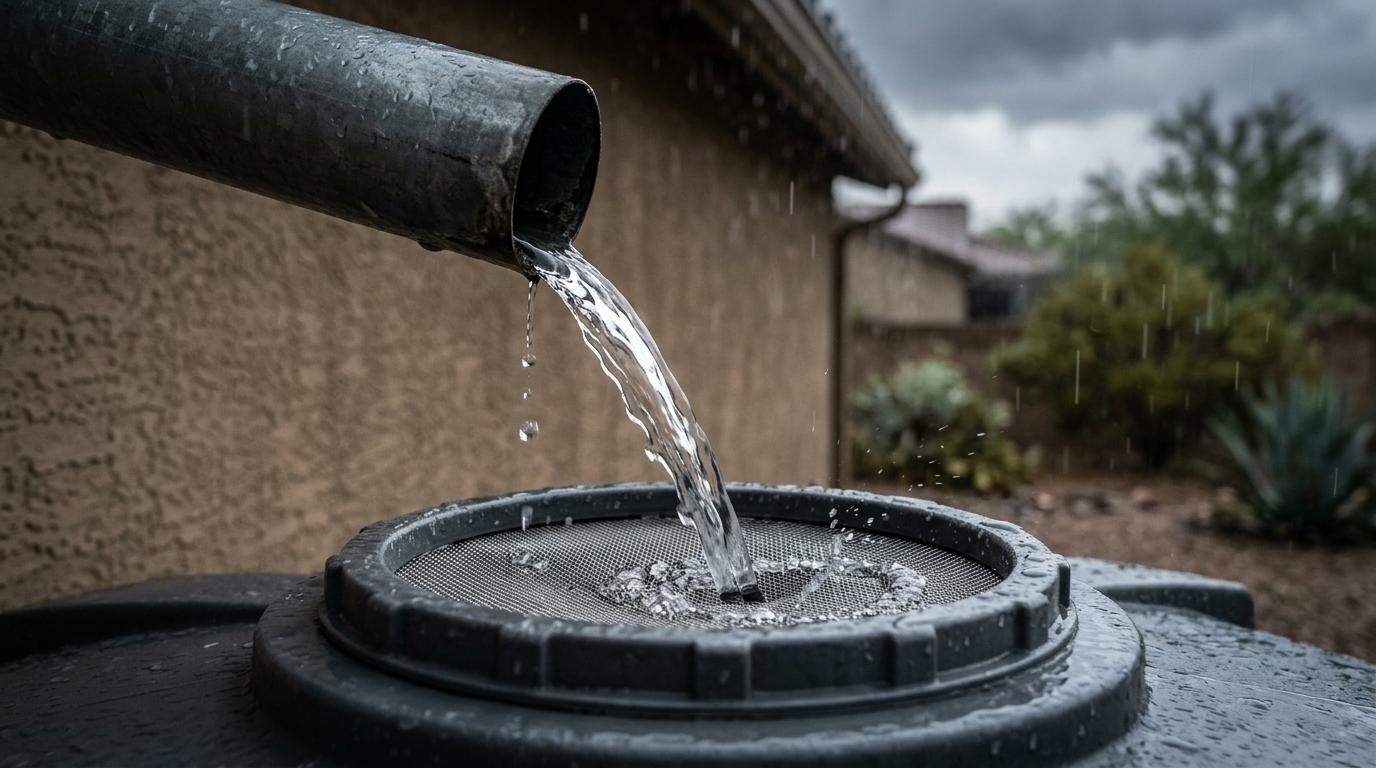
Rainwater harvesting makes a lot of sense in Arizona, but it works a little differently here than it would in a place with steady weekly rain. Around Tucson, most of our annual rainfall comes in bursts. A monsoon storm can dump a lot of water in 20 minutes, then you may not see meaningful rain again for weeks.
That pattern is exactly why a well-built system matters. If your gutters are undersized, your downspouts are in the wrong spots, or your tank is not screened and shaded correctly, you can lose a lot of water fast. Done right, a harvesting system catches roof runoff, stores what you can use later, and sends overflow where it still helps the property instead of washing out the yard.
Why this works so well in Southern Arizona
In the desert, every gallon that lands on your roof is a gallon worth paying attention to. Most homeowners are not trying to go fully off-grid with water. They just want to cut back on city water use, keep plants alive through hot months, and make better use of the rain that already hits their property.
That is where harvesting shines. Roof water is one of the cleanest runoff sources on a home site because it is easier to predict and easier to direct. With the right gutter profile, properly placed downspouts, and storage or infiltration planned ahead of time, you can turn a short storm into irrigation water for trees, shrubs, and garden areas.
It also helps with runoff control. A lot of Tucson properties have trouble spots where water pours off a roof edge, splashes near the foundation, erodes soil, or cuts ruts through gravel. Capturing and redirecting that flow protects the home and the landscape at the same time.
The two main ways Arizona homes harvest rain
Most residential systems fall into two categories: active and passive. A lot of the best setups use both.
An active system stores water in tanks or cisterns. Rain lands on the roof, runs into gutters, flows through downspouts, passes screening and often a first-flush device, then ends up in a sealed tank. From there, the water can be used later with gravity or a pump, usually for drip irrigation, hose bibs, or other non-potable uses.
A passive system does not store water in a tank. It directs runoff into the soil right away using swales, basins, berms, or infiltration areas. On many Arizona lots, passive harvesting is one of the smartest ways to support shade trees and native plants. It is simple, lower cost, and it helps recharge the ground where plants need the moisture.
When we talk with homeowners, the usual recommendation is not tank or basin. It is tank and basin. Store part of the runoff for later, and route overflow into the landscape so a big storm still benefits the property after the tank fills.
What the roof-fed system is actually doing
At its core, an active rainwater harvesting system is just moving water from a catchment surface to a storage point in a controlled way. The roof is the catchment. Gutters and downspouts are the delivery path. The tank is the storage. The rest of the parts help keep the water cleaner, keep bugs out, and control where overflow goes.
On Arizona homes, gutter design matters more than many people expect. Monsoon storms are intense, so a system needs enough capacity to move water fast without spilling over the front edge. That is why K-Style gutters are common. On some houses, half-round or other profiles can make sense, but the right choice depends on roof area, slope, and appearance.
A good setup usually includes these working parts:
- Leaf screens: stop larger debris before it enters the tank line
- First-flush diverter: sends the dirtiest first runoff away from storage
- Cistern or tank: holds water for later use
- Screened vents and openings: keep mosquitoes, pests, and sunlight out
- Overflow line: sends extra water to a basin, swale, or drainage point
- Pump with float switch: supplies pressure and helps keep the pump from running dry
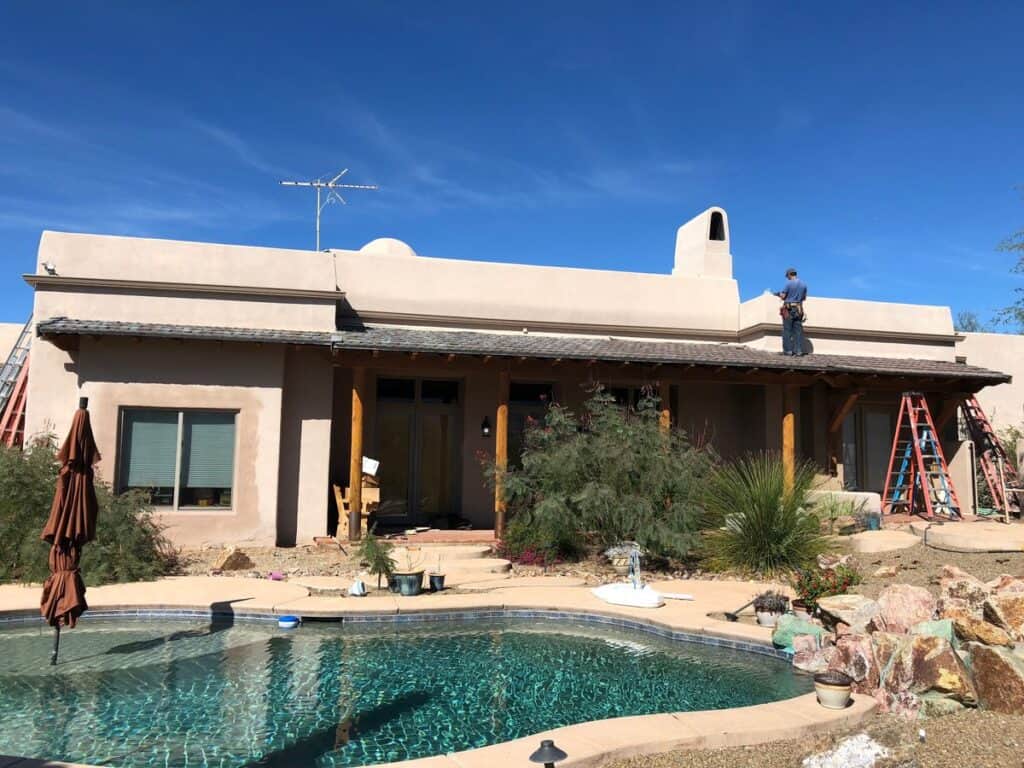
The roof edge matters too. If fascia boards are weathered, soft, or sun-damaged, the gutter system does not have a strong foundation. In Tucson, fascia wrap is often part of the conversation because it protects the wood from sun exposure and moisture at the same time. It also gives the gutter a cleaner mounting surface.
How much water can a roof collect?
A simple rule of thumb is that 1 inch of rain on 1 square foot of roof yields about 0.623 gallons. So if you have a 1,000 square foot roof section and you get 10 inches of rain over a year, that roof area can produce roughly 6,230 gallons before losses.
Real-life numbers are a little lower because of splash, debris, first-flush diversion, and overflow. Still, the math surprises people. Even in a dry climate, a decent roof can collect a useful amount of water across a year.
| Roof Catchment Area | Annual Rainfall | Approx. Gallons Collected |
|---|---|---|
| 1,000 sq. ft. | 8 inches | 4,984 gallons |
| 1,000 sq. ft. | 10 inches | 6,230 gallons |
| 1,500 sq. ft. | 10 inches | 9,345 gallons |
| 2,000 sq. ft. | 10 inches | 12,460 gallons |
| 2,000 sq. ft. | 12 inches | 14,952 gallons |
That does not mean you need a 10,000-gallon tank on every house. It means you should match storage to your goals. Some homes do great with a 200 to 500 gallon tank feeding a few fruit trees. Others benefit from larger cisterns in the 1,500 to 5,000 gallon range, especially if the owner wants longer irrigation backup between storms.
Designing for desert conditions
Arizona is hard on materials. The sun breaks down cheap plastics. Dark tanks in full exposure heat up fast. Unsealed openings invite algae growth and mosquito issues. A harvesting system here needs to be built for UV exposure, heat, and sudden high-volume rain.
That is why tank choice matters. Poly tanks can work very well when they are UV-protected and properly installed. Corrugated steel cisterns are another solid option, especially on larger systems. Both need tight lids, screened inlets, and well-planned overflow. If the tank is in direct sun all day, placement and color become more important.
It is also why gutter and downspout sizing should be based on storm flow, not just average rain. A system that looks fine in light rain can fail badly in July or August. When a monsoon cell parks over your neighborhood, the whole roof can become a fast-moving sheet of water.
The best Arizona systems usually have a few things in common:
- Wide, properly pitched gutters
- Enough downspouts for the roof area
- Screened tank openings
- Covered storage
- Overflow to planting basins
- Easy access for cleaning
Stored water is useful, but overflow is part of the plan
A lot of homeowners focus only on the tank, but overflow design is just as important.
Once a cistern is full, the next gallons still need to go somewhere safe. If overflow is not controlled, water can back up, wash out a side yard, flood a walkway, or end up near the foundation. If it is planned well, that same overflow can soak fruit trees, shade trees, or a rain garden.
This is where passive harvesting fits beautifully into an active system. The tank catches the first part of the storm. The overflow finishes the job by soaking the landscape.
What people usually use the water for
Most Arizona homeowners use harvested rainwater outdoors. That is the easiest and most practical use. Trees, shrubs, native plants, raised beds, and drip systems all benefit from it. Some people also use it for washing tools, rinsing patios, or other non-potable needs.
Indoor use is a different level of design. Rainwater can be used for things like toilet flushing or laundry in some setups, but that requires code-compliant plumbing details and separation from the potable system. Drinking water use requires proper filtration and disinfection. Without that treatment, rainwater should be treated as non-potable.
That distinction matters because many homeowners hear “rainwater system” and picture drinking water right out of the tank. That is not how most residential Arizona systems are set up. Most are built to save municipal water outdoors first, where the biggest savings usually happen.
Maintenance is not difficult, but it is real
A harvesting system is not something you install and ignore forever. It needs routine attention, especially after windy weather and monsoon storms.
The good news is that maintenance is usually straightforward. If the system was designed with access in mind, most of the work is quick seasonal upkeep instead of a major chore.
A simple maintenance rhythm looks like this:
- Before monsoon season: clear gutters, check screens, test overflow paths
- After major storms: remove debris, inspect downspouts, look for washouts near overflow outlets
- A few times a year: clean first-flush parts and sediment filters
- Any time you notice odors or bugs: inspect tank lids, vent screens, and light intrusion points
One thing many people miss is the condition of the gutter support area. If fascia is deteriorating, the system can sag or pull away over time. In our climate, sun damage and intermittent wetting are a rough combination. Fascia wrap can help extend the life of that edge and protect the structure behind the gutter line.
Arizona rules, rebates, and HOA questions
Arizona allows rainwater harvesting on private property, and HOAs cannot simply ban it.
That said, legal does not mean unplanned. Local code, tank placement, plumbing details, backflow prevention, and rebate paperwork all matter. In Tucson, rebate programs can offset a good chunk of the cost, but they usually require a workshop, pre-approval, and a final inspection. If a homeowner wants the rebate, it is smart to check those requirements before buying parts or setting a tank.
Programs change over time, so it pays to verify the current rules with Tucson Water or the applicable local agency. Many homeowners are surprised at how much incentive money may be available for active tanks, and in some cases for passive landscape harvesting too.
Picking the right size system for your property
The right system size comes down to three things: roof area, water demand, and budget.
If your main goal is helping a few landscape zones through hot weather, a modest tank tied to one good roof section may be enough. If you want to support a larger yard, fruit trees, or a more developed irrigation setup, you may want a larger cistern and a pump-based system with dedicated distribution lines.
There is also the visual side. Some homeowners want the tank tucked away near a side yard. Others are fine making it a feature. Tank location affects piping length, pump performance, sun exposure, and how easy the system is to service later.
A practical first step is to identify which roof sections produce the best runoff and which parts of the yard need water the most. Once those two pieces are clear, the rest of the design gets much easier.
Questions Arizona Homeowners Ask About Rainwater Harvesting
How much does a residential rainwater harvesting system cost in Tucson?
Cost depends heavily on tank size, number of downspout connections, and whether a pump and distribution lines are included. A basic setup with a single 200- to 500-gallon tank connected to one downspout can start in the low hundreds for a DIY install, or roughly $1,000 to $2,500 professionally installed. Larger systems with 1,500- to 5,000-gallon cisterns, pumps, and multiple roof connections typically fall in the $3,000 to $10,000 range. Tucson Water rebates can offset a meaningful portion of that cost, making the effective price lower than most homeowners expect.
Can I connect a harvesting system to gutters I already have?
In many cases, yes. If your existing gutters are in good condition, properly sized, and sloped correctly, a tank can often be tied into the current downspout path without replacing the entire gutter system. The installer adds screening, a first-flush diverter, and the tank inlet to the existing line. However, if your gutters are undersized for monsoon flow, sagging, or leaking at joints, it usually makes more sense to replace them as part of the project so the whole system performs as one unit from day one.
Does the tank need a concrete pad or foundation?
It depends on the size. Smaller tanks under 500 gallons can often sit on a level, compacted gravel pad without a poured foundation. Larger cisterns — especially steel tanks in the 1,500-gallon range and above — benefit from a concrete pad or engineered base because a full tank is extremely heavy. A 2,500-gallon tank at capacity weighs over 20,000 pounds. An uneven or soft base can cause the tank to shift, stress pipe connections, and create leak points over time. Your installer should assess the soil and grade at the planned location before setting the tank.
What happens to stored rainwater if I go on vacation and it sits unused for weeks?
Properly stored water holds up well, even in Tucson's heat. If the tank is sealed, screened, opaque, and UV-protected, water can sit for several weeks without significant quality issues. Problems start when light enters the tank — that is what drives algae growth. Heat alone does not ruin the water if the tank is designed correctly. When you return, running the first few gallons through the hose bib before irrigating is a reasonable precaution. If the water will sit for months rather than weeks, draining the tank down and cleaning sediment before refilling next season is a worthwhile step.
Can I expand my system later if I start small?
Yes, and starting small is a common approach. Many homeowners begin with one tank on the most productive roof section, use it for a season, and then add capacity once they see how quickly it fills and empties. The key is planning pipe runs and overflow routing during the first install so a second tank or a larger replacement can connect without reworking the whole layout. Letting your installer know that expansion is a possibility — even if it is a year or two away — helps them position the first tank and overflow line in a way that makes the future addition straightforward.
Will a large water tank affect my homeowner's insurance?
Most standard homeowner's policies do not specifically exclude rainwater tanks, but it is worth notifying your insurer, especially for larger installations. A 2,500-gallon tank that fails could cause water damage to adjacent structures, fencing, or landscaping. Some insurers may ask about the tank's location relative to the house, whether it is on a proper base, and whether overflow is managed. In practice, a professionally installed and well-maintained system rarely triggers a premium increase, but confirming coverage before installation avoids surprises if something goes wrong later.
Is harvested rainwater better for plants than city water?
Many gardeners and landscapers think so. Tucson's municipal water is treated and contains chlorine and dissolved minerals that some plants tolerate but do not prefer. Rainwater is naturally soft, has a near-neutral pH, and contains no chlorine or fluoride. Desert-adapted plants, fruit trees, and vegetable gardens often respond noticeably well to rainwater irrigation. The difference is most visible on sensitive species and container plants where mineral buildup from tap water can accumulate in the soil over repeated watering cycles.
Do I need to worry about freezing in Tucson?
Tucson rarely sees hard freezes, but overnight temperatures in December and January can occasionally dip below freezing, especially in foothill neighborhoods, Oro Valley, and higher-elevation areas around Vail and Sonoita. Exposed above-ground pipes, pump lines, and hose bibs are the most vulnerable components — not the tank itself, since the large water volume resists freezing far longer than a thin pipe does. Insulating exposed lines and disconnecting hoses during cold snaps is usually enough. Below-ground supply lines are naturally protected and rarely an issue at Tucson-area elevations.