ES
ES 
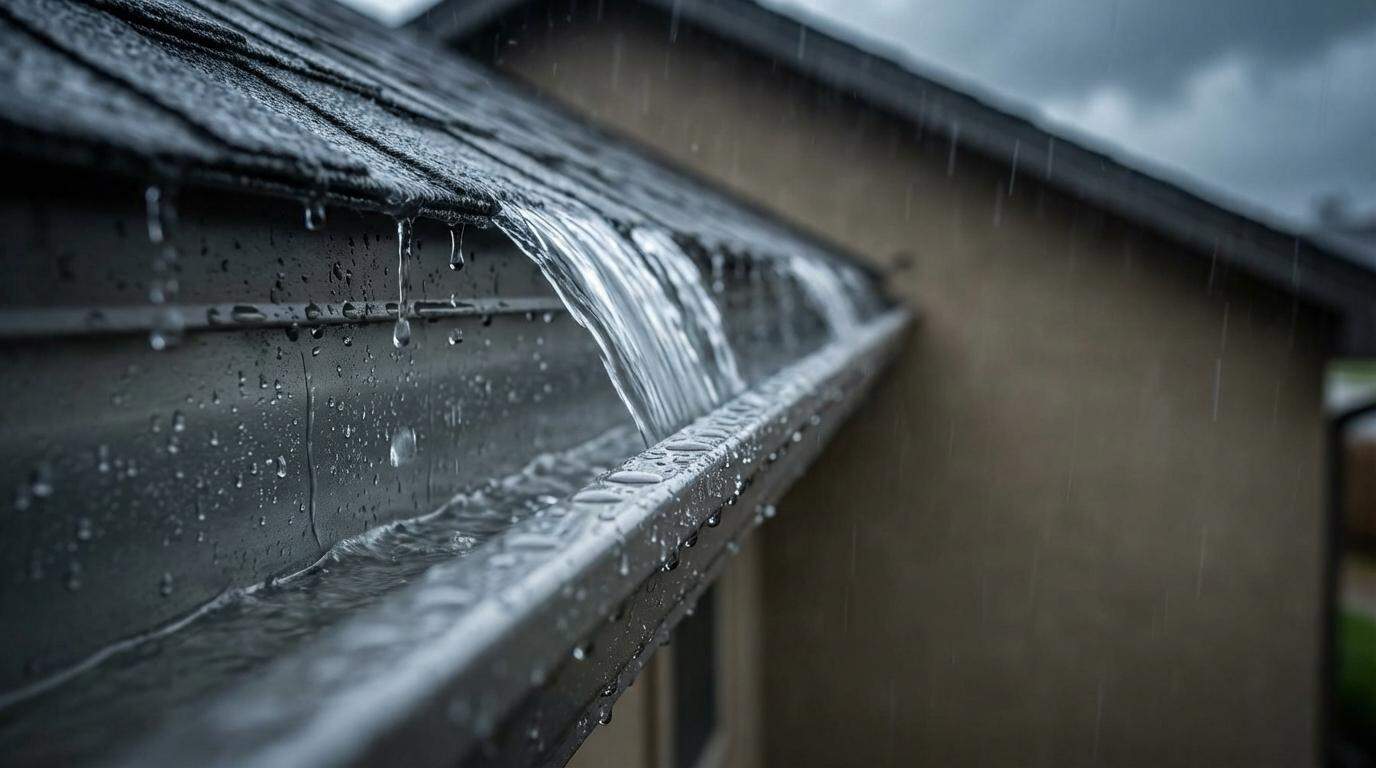
When a storm drops a lot of water in a short time, your gutters have one job: catch it, move it, and get it away from the house before it spills over the edge. That sounds simple until a summer monsoon hits and a roof starts shedding water faster than the system can carry it. In places like Tucson, that is when gutter size stops being a cosmetic choice and becomes a performance decision.
The short answer is simple: if heavy rain is part of your climate, sizing up is usually the safer move.
The quick answer most property owners need
A standard 5-inch gutter works well on many homes, especially when roof sections are modest and rainfall rates are moderate. Once roof planes get larger, slopes get steeper, or storms come fast and hard, 6-inch gutters often become the better choice.
After looking at roof area, rainfall intensity, and roof shape, the usual starting point looks like this:
- 5-inch gutters for smaller, simpler residential rooflines
- 6-inch gutters: a stronger choice for large roof sections, steep roofs, and areas with intense downpours
- 8-inch systems: usually reserved for commercial buildings or very high-flow conditions
That extra inch matters more than many people expect. A 6-inch K-style gutter can hold about 67% more water per foot than a 5-inch gutter. In real storms, that added capacity can be the difference between controlled drainage and water pouring over the front lip near the foundation.
Why gutter size changes everything
A gutter is basically a channel with finite space. When runoff enters faster than that channel can carry it to the downspouts, the excess has nowhere to go but over the edge.
Heavy rain makes that problem show up quickly. Even homes in dry climates can face intense single-day storm events, and Southern Arizona is a prime example. The annual rainfall total may not look extreme on paper, yet monsoon storms often deliver water in short, concentrated bursts. Gutters have to be sized for that peak flow, not just the yearly average.
This is why a system that seems “fine most of the year” can still fail during the few storms that matter most.
What the numbers look like
Code-based sizing charts compare gutter size to roof area and rainfall rate. The figures below show approximate roof area that a single gutter can drain at a slight slope of 1/16 inch per foot.
| Gutter size | Roof area at 2 in/hr rain | Roof area at 4 in/hr rain | Roof area at 6 in/hr rain |
|---|---|---|---|
| 4-inch | 720 sq. ft. | 360 sq. ft. | 240 sq. ft. |
| 5-inch K-style | 1,250 sq. ft. | 625 sq. ft. | 416 sq. ft. |
| 6-inch K-style | 1,920 sq. ft. | 960 sq. ft. | 640 sq. ft. |
The pattern is clear. As rainfall intensity rises, the roof area a gutter can safely handle drops fast. That is why a 5-inch system may be perfectly acceptable on one house and completely undersized on the house next door.
If your home has large roof planes draining into one long run of gutter, or if local storms can push into the high-intensity range, a 6-inch system is often the smart investment.
Roof size is only part of the answer
Two homes with the same square footage may need different gutters.
Roof pitch changes runoff speed. A steep roof sends water downward with more force and less delay than a lower-pitch roof. Smooth roofing materials also move water quickly. Metal roofs are especially good at this, which is great for drainage but demanding on gutters. Tile roofs can also create concentrated flow, depending on the layout.
Then there is roof geometry. Valleys, long eave lines, and areas where multiple planes dump water into one section can overload a gutter even when the rest of the system looks generously sized. A valley feeding into a corner can create a surge that overwhelms a smaller gutter during a short storm.
Flat roofs need a different strategy. Water is often directed through scuppers rather than simply dropping off an eave. In that setup, the scupper box, gutter size, and downspout size all need to work as one system.
Downspouts can make or break the system
A large gutter paired with undersized downspouts is like a wide highway ending in a single narrow exit. Water collects, backs up, and rises until it spills.
That is why downspout sizing should always be part of the conversation. In heavy-rain applications, larger downspouts are often installed alongside larger gutters. A 3-by-4-inch downspout is common with 6-inch residential gutters, while large commercial systems may use 4-by-5-inch downspouts with 8-inch gutters.
Placement matters too. One downspout at the wrong end of a long run is not as effective as two downspouts located to shorten travel distance and reduce pooling.
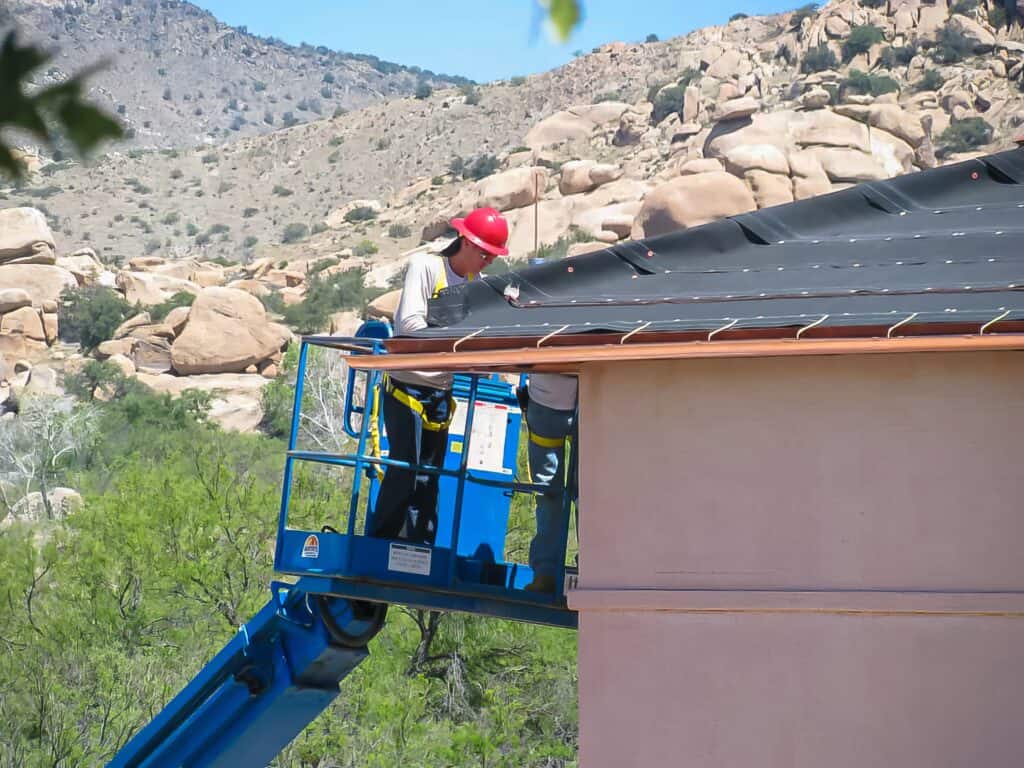
A well-sized gutter system is never just about the trough. It is the trough, the slope, the outlets, and the discharge path working together.
Which gutter shape handles heavy rain best?
Not all 6-inch gutters perform the same way.
K-style gutters are popular because they carry a lot of water relative to their profile and fit many architectural styles. For most homes, they are the practical choice when capacity matters. Box-style or deep-flow gutters can carry even more and are often used on commercial buildings or modern homes with high runoff demands.
Half-round gutters look beautiful, especially on historic or custom homes, but they generally carry less water than a K-style or deep-flow gutter of comparable width. That does not make them wrong. It just means they need to be selected with care when heavy rain is part of the picture.
If performance is the first priority, these are the profiles that usually rise to the top:
- K-style: strong capacity for residential homes
- Box or deep-flow: ideal where runoff volume is unusually high
- Half-round: better suited to architectural preference when drainage demand is moderate or the size is increased to compensate
Material matters in hot, stormy climates
A gutter that can hold the water still needs to survive heat, sun, wind, and debris.
In Southern Arizona, metal gutters are usually the strongest long-term fit. Aluminum is widely used because it resists rust, performs well in harsh sun, and comes in many finishes. Copper offers exceptional longevity and a distinct architectural look. Galvanized steel is strong, though long-term corrosion is still a consideration.
Vinyl is harder to recommend where extreme heat and intense storms meet. It is more vulnerable to warping, cracking, and joint issues, and it cannot provide the same kind of seamless performance as site-formed metal systems.
That is one reason many Tucson-area installations favor seamless aluminum or copper.
What usually works in Southern Arizona
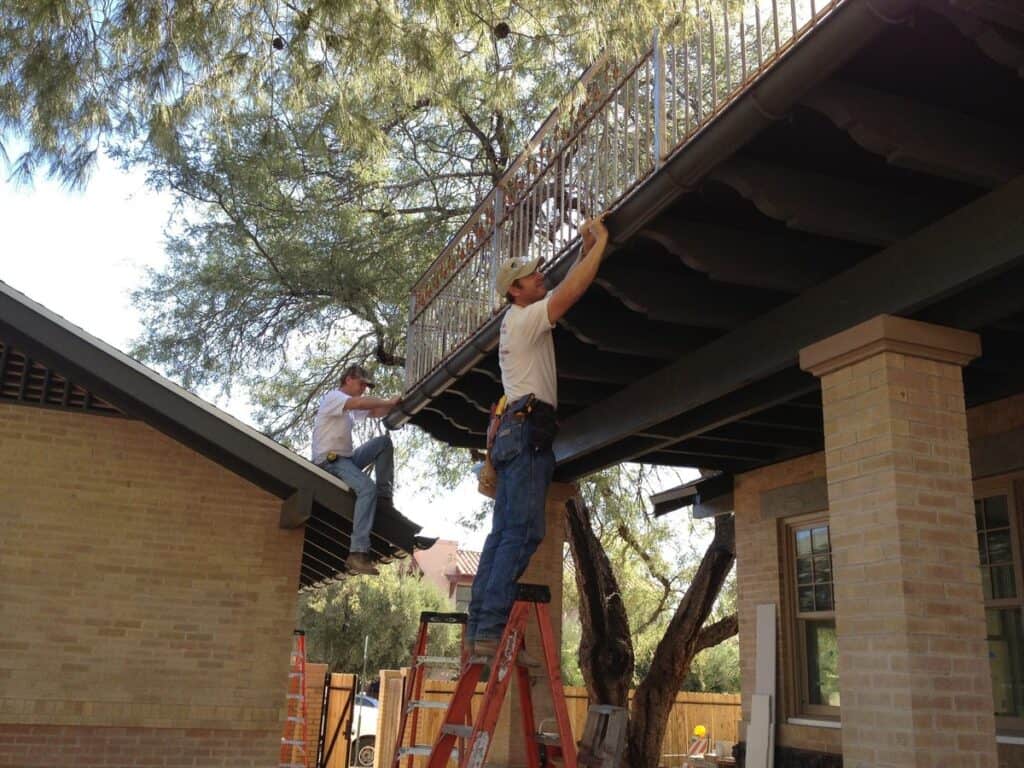
For homes across Tucson and nearby communities, 5-inch and 6-inch K-style gutters are the common residential choices. A local installer like Southern Arizona Rain Gutters often uses 6-inch systems when flow rates are higher or roof design calls for more capacity. On larger commercial projects, 8-inch seamless gutters with larger downspouts may be the right fit.
That local experience matters because Southern Arizona storms are unusual. Long dry periods can make it easy to overlook drainage needs, then a monsoon arrives and pushes an undersized system past its limit in minutes.
Homes with flat roofs often need scupper boxes to collect roof drainage and direct it into the gutter line. Sloped roofs need enough pitch in the gutter itself so water keeps moving toward the downspouts. A slight grade sounds minor, but it has a major effect on performance.
Support hardware matters as well. Gutters full of water get heavy fast. Strong hangers spaced every two feet help the system stay attached, straight, and properly pitched during peak loads.
Signs your current gutters are too small
Many owners do not think about sizing until they see failure during a storm.
If any of these show up, capacity may be part of the problem:
- Water pouring over the front edge in hard rain
- Splashing near the foundation
- Gutters that stay full and slow to drain
- Erosion below downspout areas
- Staining on fascia or siding
- Sagging sections after storms
Overflow is not always caused by size alone. Clogs, poor slope, too few downspouts, or loose hangers can produce similar symptoms. Still, when those issues are corrected and water still spills over during heavy rain, upsizing is often the right next step.
A practical way to choose the right size
The most reliable answer starts with measuring the roof area draining into each gutter run, then matching that load to local rainfall intensity. A good installer also looks at roof pitch, valleys, material, downspout placement, and any place where water concentrates.
That process usually leads to a clear recommendation:
- Standard 5-inch gutters: often enough for smaller roof sections with moderate flow
- 6-inch gutters: a strong choice for many homes in monsoon-prone areas
- Larger custom systems: best for commercial properties, flat roofs with scuppers, or very large drainage areas
If rainwater harvesting is part of the plan, sizing becomes even more important. A properly sized gutter system helps capture more runoff cleanly and direct it into screened, sealed storage rather than losing water to overflow. That matters for both property protection and water conservation.
Bigger is not always excessive
Some homeowners worry that 6-inch gutters will look oversized. In practice, many homes wear them well, especially when the color matches the trim and the profile is selected carefully. The visual difference is often smaller than expected, while the performance difference is substantial.
That is one of the better upgrades a property can make. A gutter system is not just trim attached to the roofline. It protects fascia, foundations, landscaping, walkways, and exterior walls. It can also support rainwater capture when designed with that purpose in mind.
If your property sees heavy rain, steep roof runoff, or large roof sections draining to one line, the safer answer is often to move up from 5 inches to 6 inches and make sure the downspouts keep pace. On many homes, that is the size that turns a vulnerable system into one that feels ready for the next hard storm.
Gutter Sizing Questions Tucson Homeowners Ask
Does upgrading from 5-inch to 6-inch gutters cost significantly more?
The material cost difference is usually modest — the jump from 5-inch to 6-inch aluminum is far less than most homeowners expect. Where cost can increase is if larger downspouts, wider fascia wraps, or additional outlet points are needed to support the bigger profile. For most residential projects in the Tucson area, the price gap is small enough that the added storm protection and longer trouble-free performance make the upgrade worthwhile rather than a stretch.
Can I mix gutter sizes on the same house?
Yes, and it is more common than people think. A home might use 6-inch gutters along the back where a large roof plane concentrates runoff into one run, and 5-inch along the front where shorter eave sections handle less water. Mixing sizes lets you put capacity where it is actually needed without over-building sections that do not face the same demand. The key is making sure downspout sizing matches each section independently.
How do I measure my roof area to figure out what size gutters I need?
You do not need to climb onto the roof. Measure the ground footprint of each section the gutter will serve — length times width — then adjust for pitch. A low-slope roof drains close to its footprint area, while a steep roof effectively drains a larger surface. For a rough estimate, multiply the footprint by 1.05 for a low pitch, 1.12 for a moderate pitch, or 1.3 for a steep pitch. That gives you the adjusted square footage to compare against sizing charts for your local rainfall intensity.
Do I need a permit to install or replace gutters in Tucson?
Standalone gutter installation on a residential property typically does not require a building permit in the City of Tucson or Pima County. However, if the project includes underground drainage lines tied into a public right-of-way, or if it is part of a larger remodel that triggers other permit requirements, it is worth confirming with the local building department before work begins. Commercial projects may have additional requirements depending on scope and site drainage plans.
Can undersized gutters cause damage even if they only overflow a few times a year?
Yes. Even a handful of overflow events per year can leave lasting damage. Repeated water spilling behind the gutter soaks fascia boards and can start rot that is invisible from the ground until it becomes serious. Overflow near the foundation causes soil erosion and can lead to moisture migration under slab edges. Stucco staining from splashback is also cumulative — each storm adds another layer that becomes harder to clean. The damage compounds even when the storms are infrequent.
Should I size my gutters differently if I plan to add rainwater harvesting later?
Yes, and planning ahead saves money. If there is any chance you will add collection tanks down the road, sizing up now avoids the cost of replacing gutters later. A 6-inch gutter captures more runoff per storm event, which directly increases the volume available for storage. Downspout placement should also be planned with future tank inlet locations in mind, so the harvesting hookup is straightforward rather than requiring rerouting or additional elbows and extensions.
Do gutter guards affect how I should size my gutters?
They can. Some guard and screen designs reduce the effective opening of the gutter, which means less water enters the trough per second — especially during the kind of fast, heavy downpours Tucson sees in monsoon season. If you plan to install gutter guards, it is worth factoring that flow reduction into the sizing decision. Going with a 6-inch gutter instead of a 5-inch gives the system more margin to compensate for any intake restriction the guard introduces.
How do I know if my downspouts are the bottleneck instead of my gutters?
If your gutters fill up and overflow near the downspout outlet rather than along the full run, the downspouts are likely undersized or too few. Another sign is water backing up at the top of the downspout during heavy rain while the far end of the gutter run stays relatively empty. Adding a second downspout to split the load, or upgrading to a larger downspout size, often solves the problem without replacing the gutters themselves.