ES


A commercial fascia wrap is a custom-fit aluminum covering installed over the existing wood fascia on an office building, retail center, apartment community, or any property with more than one roofline to maintain. For owners, property managers, and HOA boards, it turns a board that needs regular repainting into a finished roof edge that does not need repainting to stay protected. Southern Arizona Rain Gutters provides aluminum fascia wrap service for residential and commercial clients across the Tucson area.
On a single house, peeling fascia paint is a small painting job. On a property with several buildings, dozens of units, or a long retail frontage, the same problem repeats on every roofline and returns on its own cycle. This guide covers how a commercial owner can treat the roof edge as one asset: its upkeep, its consistency, its condition, and how to plan the work around the people using the property.
What Is a Commercial Fascia Wrap?
A commercial fascia wrap uses the same product as a residential wrap, applied across a larger or more complex property. Each section is custom-fit aluminum with a chemically bonded finish rated for 50 to 100 years, and that finish will not fade, rust, or peel. The difference on a commercial job is scale and coordination, not the material.
The wrap is installed in long overlapping sections, and the top edge is tucked under the roof's drip edge so water running off the roof is directed over the aluminum instead of into the wood behind it. The existing wood fascia stays in place as the structure underneath.
Why Repainting Fascia Adds Up Across Buildings
Repainting fascia is a recurring cost that multiplies with every building, unit, and linear foot of roof edge a property owns. A paint cycle that feels manageable on one home becomes a standing line item when it covers a whole complex. Each round brings scaffolding or lifts, surface prep, paint, labor, and disruption near entries and walkways.
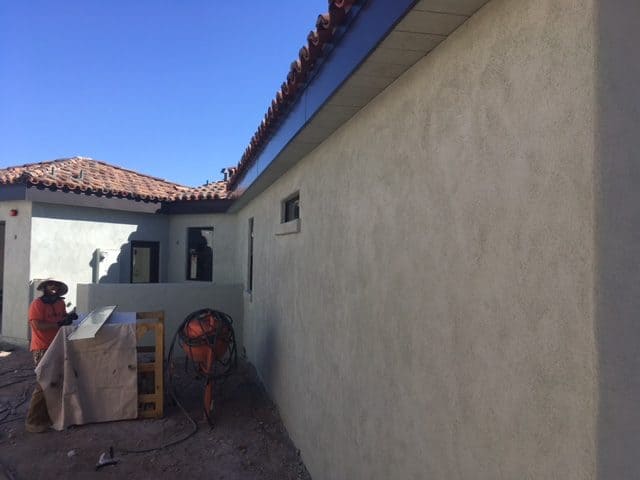
How often that cycle comes around depends on the wood and the exposure. Research from the USDA Forest Service, published in Agriculture Handbook 647 (Table 6), lists the expected life of a two-coat paint job on exterior wood as roughly 3 to 5 years on smooth pine or fir, 4 to 6 years on smooth cedar, 4 to 6 years on rough plywood, and 6 to 8 years on MDO plywood. Those ranges are for an average U.S. location, and the source notes that results in extreme climates such as the desert can vary. Southern Arizona sun is anything but average, so owners should treat these figures as a general reference rather than a Tucson forecast.
Multiply any of those cycles by the number of buildings on a site and some building is always due. A wrap replaces that rolling obligation with a single project and a finish rated in decades rather than years.
How Painted Wood and Aluminum Wrap Compare for Commercial Owners
Aluminum fascia wrap trades a recurring paint obligation for a one-time installation, while painted wood keeps the board exposed and on a repaint schedule. The table below sets out the decision factors commercial owners and boards ask about most.
| Factor | Painted wood fascia | Aluminum fascia wrap |
|---|---|---|
| Repaint cycle | Needs periodic repainting; USDA Agriculture Handbook 647 lists roughly 3 to 8 years for a two-coat paint job depending on the wood, at an average U.S. location | Chemically bonded finish rated for 50 to 100 years; no repainting needed to stay protected |
| Color consistency across buildings | Each building is repainted on its own schedule, so faces of different ages can drift apart in color | One finish color can be specified for every building, and the finish will not fade |
| Finish behavior in sun | Paint can peel and fade, especially on east and west exposures | Will not fade, rust, or peel |
| Condition of the board underneath | The board stays exposed to sun and monsoon moisture between paint jobs | Installed over existing wood fascia, so damaged boards are addressed before wrapping; the sound board is then covered |
| Coordination with gutter work | Repainting is a separate task that recurs on its own cycle | Can be planned with gutter work as one roof-edge project |
How Do You Keep One Fascia Color Across a Whole Property?
The simplest way to keep one fascia color across a whole property is to specify a single wrap finish for every building and install it as one program. Painted wood rarely stays uniform on a large site because buildings get repainted at different times, from different batches, and weather at different rates depending on which way they face. A finish that will not fade removes most of that drift.
For HOA boards and owners of multi-building sites, a uniform roof edge is part of how the property reads from the street and the parking lot. Choosing the color itself is a separate decision, and our guide to choosing fascia wrap colors in Tucson covers that step. Once the color is set, record it in the project file so any later building, addition, or phase can be matched to the same finish.
Why Assess Each Building Before Wrapping?
Each building should be assessed on its own because a wrap goes over existing wood fascia, and boards that are cracked, warped, or soft need attention first. On a large site, fascia condition is rarely the same everywhere. A building with a west-facing elevation or a corner that collects runoff can look very different from one a few yards away.
A practical approach is to walk the property building by building and note, for each roofline, whether the fascia is sound, needs isolated board repair, or shows wider damage. Signs that point toward a wrap include peeling or fading paint, cracking or warping wood, strong east or west sun exposure, and moisture or mold left behind by monsoon storms. Board repair is its own topic; for a commercial plan, what matters is that the condition of each elevation is written down before the wrap is scoped.
That record keeps the scope honest, so repairs are found during planning rather than mid-project, and shows which buildings are urgent and which can follow.
How Does Fascia Work Get Scheduled Around Tenants?
Fascia work on an occupied property is easiest when the schedule is agreed before work begins and tenants or residents are told in advance which areas are affected and when. Roof-edge work happens at entries, walkways, and parking areas, so the people using those spaces need to know where access will change.
Every property is different, so scheduling details belong in the estimate conversation rather than in a general rule. Useful points to settle with the contractor include:
- Which buildings or elevations should be done first, based on the condition survey.
- Business hours, deliveries, and busy periods that crews should work around.
- Where equipment and materials can be staged without blocking entries or parking.
- Who sends tenant or resident notices, and how far ahead.
- One on-site contact who can answer access questions as the work moves around the property.
Should Fascia and Gutters Be One Roof-Edge Project?
Planning fascia and gutters together usually makes sense, because gutters hang on the fascia and both sit at the same roof edge. Doing them as one project means the roof edge is assessed once, the board condition is known before gutters go up, and the finished look is coordinated from the start.
It also cuts down on how often crews and equipment need to be on the property. If gutters are part of the plan, our post on commercial gutter installation in Tucson explains how SARG approaches the gutter side of a commercial job. Seamless gutters are custom-formed on site in one continuous piece, and SARG offers them in aluminum and copper, so the gutter and fascia choices can be made together in one estimate.
What Documentation Helps a Board or Owner Decide?
A board or owner decides fastest when the proposal includes a clear scope, condition notes for each building, the finish specification, and proof that the contractor is properly licensed. Boards often have to justify a decision to members or investors, so a written package matters.
A useful decision package for a commercial fascia wrap project typically covers:
- The buildings and elevations included, with the condition of each.
- Any board repair needed before wrapping, identified by location.
- The finish color, recorded so future phases can match it.
- Whether gutter work is included and how it ties into the fascia.
- Contractor license and bonding information.
Licensing deserves attention on commercial work. The City of Tucson Planning and Development Services permit FAQ notes that improvements to commercial properties and residential rental properties require a licensed contractor, and whether a permit is needed depends on the scope of work. Requirements can differ by project and by jurisdiction, so owners should confirm with the city, or with their own town or county if the property sits outside Tucson. Southern Arizona Rain Gutters is licensed and bonded, holds Arizona ROC licenses 326453 and 326462, and has been in business since 2005.
Boards also like to hear from other customers. SARG holds a 4.8 rating from 453 Google reviews and is BBB accredited, and owners can read customer reviews and testimonials before scheduling a site review.
Key Takeaways
- USDA Agriculture Handbook 647 puts two-coat paint life on exterior wood at roughly 3 to 8 years at an average U.S. location, and desert results can vary.
- On a multi-building site, some fascia is almost always due for paint, which turns upkeep into a rolling expense.
- Specifying one wrap finish for every building, and recording it, keeps later phases matched.
- A building-by-building condition survey finds board repairs during planning instead of mid-project.
- City of Tucson guidance says commercial and rental property work requires a licensed contractor; permit needs depend on scope.
Fascia Questions from Tucson Property Managers
Can a commercial fascia wrap go over fascia that is already painted?
Yes. The wrap is installed over the existing wood fascia whether it is painted or bare, provided the boards are sound.
Will an aluminum fascia wrap ever need painting?
No, not to stay protected. The finish is chemically bonded and will not fade, rust, or peel, but it is paintable if the property later changes its color scheme.
Can buildings on one property be wrapped in phases?
A phased plan can be discussed during the estimate. Specifying the same finish color for every phase is what lets later buildings match the first ones.
Does Southern Arizona Rain Gutters work on commercial properties as well as homes?
Yes. SARG serves both residential and commercial clients, and the same custom-fit aluminum fascia wrap is used on both.
Will a wrap change the shape of the roof edge?
No. Each section is custom-fit to the existing fascia, so the roof edge keeps its original lines while the exposed surface becomes finished aluminum.
Who should be the main contact for a multi-building fascia project?
One person with authority to answer questions works best, usually the property manager or a designated board member. A single contact keeps approvals, access, and tenant notices moving without delays.
Which areas does SARG serve for commercial fascia work?
SARG serves Tucson, Oro Valley, Marana, Vail, Sahuarita, Green Valley, Nogales, Rio Rico, Sonoita, and Three Points. For a property outside those communities, contact the office to ask whether it can be served.